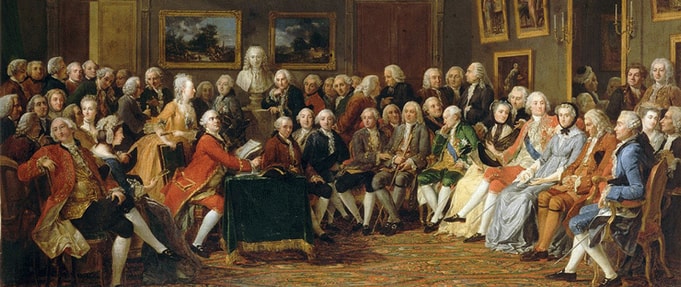

The Enlightenment, or Age of Reason, was an incredibly significant period in Western Europe during the late 17th and 18th centuries, and it later crossed the Atlantic to the American colonies, with thinkers such as Benjamin Franklin and Thomas Jefferson.
As put by German philosopher Immanuel Kant, in his 1784 essay, “What is Enlightenment?,” the era was fueled by the notion: “Dare to know! Have courage to use your own reason!” In other words, the Enlightenment, which stretched across every facet of reason—from science to philosophy and authority—was primarily rooted in the belief that human reason is the ultimate source of truth.
Often, the period is divided into three chronological periods: the Early Enlightenment (1685-1730), rooted in science with thinkers like John Locke and Isaac Newton, the High Enligtenment (1730-1780), sparked by french philosophers including Voltaire and Jean-Jacques Rousseau who argued for individual, natural rights, and finally, the Late Enlightenment (1780-1815), where the American and French revolutions challenged notions of absolute monarchy (with differing outcomes).
The “long 18th century,” from 1685 to 1815, sought to replace chaos with order—but in doing so, was itself highly chaotic. Throughout Europe and into America, thinkers who, although they were promoting human progress, destabilized the systems in place. However, as in line with the philosophies of the era, change is not only inevitable, but necessary. It is important that we question the structures in place to guarantee human rights—as Rousseau did in The Social Contract, beginning, rather famously, with, “Man is born free, and everywhere he is in chains.”
That being said, much happened during the Enlightenment’s roughly 130-year period. So much so, it can be difficult to know where to start. These nine books, beginning with general overviews and then works specifically devoted to the three main phases, are meant to serve as a guide to the scientific and philosophical thinkers who formed the basis of much of the thought we rely on today.
Overviews
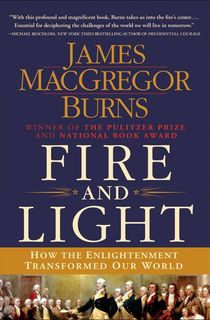
Fire and Light
From a Pulitzer Prize and National Book Award-winning historian comes an illuminating overview of the entire Enlightenment, from the ideas that formed in Europe and then spread across the New World.
Focusing on revolutionary leaders such as Benjamin Franklin, John Adams, and Thomas Jefferson, author James MacGregor Burns considers how their interactions with early European ideals of liberty and equality helped give birth to a new nation.
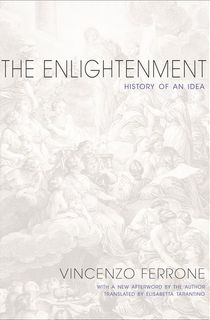
The Enlightenment
Vincenzo Ferrone, a leading historian on the Enlightenment, recontextualizes the pivotal period—arguing that other interpretations have been far too abstract.
Instead, he avoids oversimplifications and views the era, in all its complexity, as a deeply humanistic movement and cultural revolution.
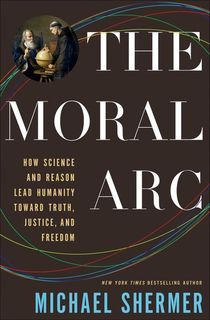
The Moral Arc
The Age of Reason was a crucial step in scientific reasoning, during which theorists applied this belief to largely non-scientific fields, including politics and moral philosophy. Instead of relying on religion or a past treatise as a source of authority, people employed rationality, reason, and even skepticism to challenge the world around them.
From foundational thinkers like Galileo and Newton to the pioneer Martin Luther King, Jr., author “Michael Shermer is a beacon of reason in an ocean of irrationality,” throughout this exploration on the importance of science (Neil deGrasse Tyson, American astrophysicist and writer).
Early Enlightenment (1685-1730)
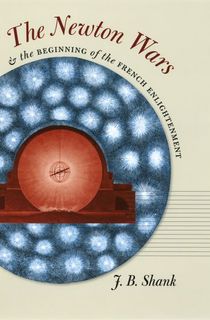
The Newton Wars & the Beginning of the French Enlightenment
Many scholars automatically link Isaac Newton to the Enlightenment without considering the changes that made this shift possible.
Author J.B. Shank, drawing on a range of scientific sources and academic papers, argues that although the rise of Newtonianism was a significant catalyst for the movement, other intellectual battles were taking place in early 18th-century France.
Rather revolutionarily, he focuses on the beginning of the era, the actual mechanics of intellectual shifts and public culture, rather than considering the Enlightenment as a natural evolution.
High Enlightenment (1730-1780)
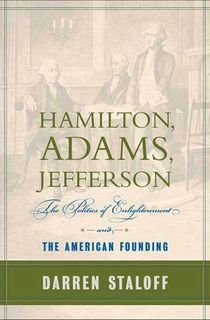
Hamilton, Adams, Jefferson
American historian Darren Staloff offers “a lucid argument, usefully extending the intellectual history of the American Revolution by interrogating three great revolutionaries” (Kirkus Reviews).
In both their political and personal lives, Alexander Hamilton, John Adams, and Thomas Jefferson were guided by Enlightenment principles, which would eventually play a key role in achieving American independence.
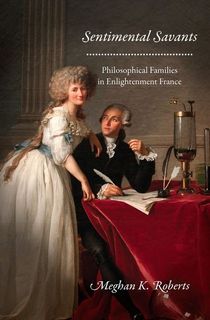
Sentimental Savants
In the first book of its kind, scholar Meghan K. Roberts considers the families of the era’s most crucial scientific and philosophical thinkers and how they influenced their thought.
Focusing on figures like Denis Diderot, Emile Du Chatelet, the Marquis de Condorcet, and more, she offers a striking, innovative “contribution to what Robert Darnton has called ‘the social history of ideas’” (Choice).
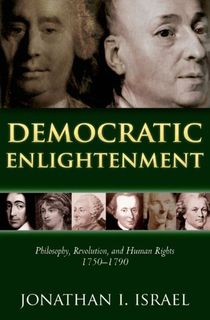
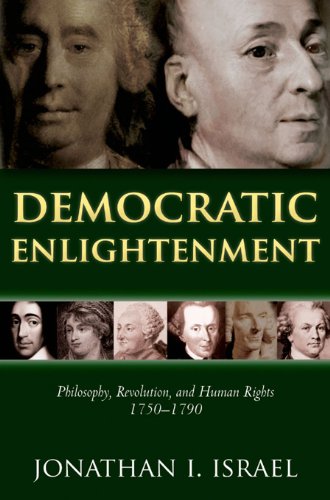
Democratic Enlightenment
Jonathan I. Israel, an influential British historian whose name appears twice on this list, traces the High Enlightenment through the lens of political and social turmoil.
He argues that the era was a revolutionary process and that key events, including the American Revolution, ultimately sparked a Radical Enlightenment that ricocheted across North America, Europe, and beyond.
Late Enlightenment (1780-1815)
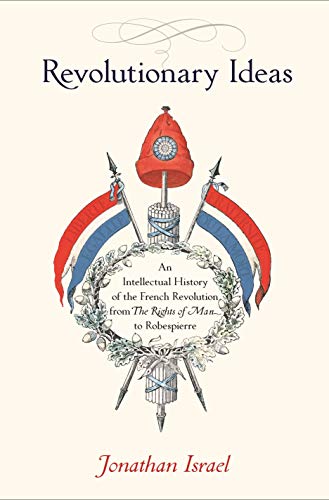
Revolutionary Ideas
Scholars agree that the French Revolution was motivated by economic and social crises—but, as author Jonathan Israel argues, they overlook the principal role of the Enlightenment.
He considers the beginning of the revolution, its roots in figures like Jean-Pierre Brissot as true defenders of freedom, and how the Reign of Terror ultimately betrayed that ideal, rather than achieving it.
The Shape of the New
One of the New York Times 100 Notable Books of 2015, The Shape of the New considers the legacy of the Enlightenment’s pivotal thinkers—including Adam Smith, Thomas Jefferson, Charles Darwin, and Karl Marx—and how they have shaped our modern beliefs across disciplines.
It is, as authors Montgomery and Chirot argue, impossible to understand the conflicts of our contemporary time without turning towards the past. Ultimately, they trace how these late-Enlightenment philosophers, with their concepts of freedom, equality, evolution, and democracy, created the modern world.
Featured image: Wikimedia Commons


