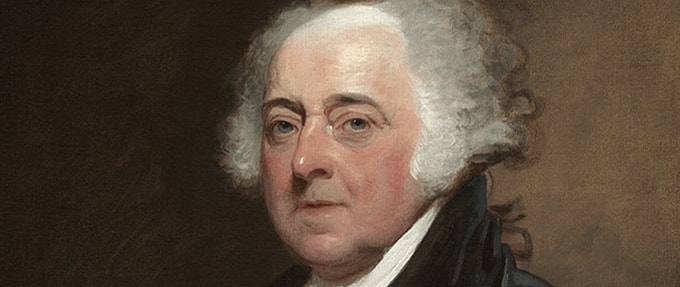

John Adams is an incredibly compelling figure in history, not just for his accomplishments, but also for his routine contradictions. Deeply patriotic, perhaps more than anyone else, and incredibly intelligent, he was also self-centered and stubborn when it came to his beliefs.
He had the immense challenge of following in the footsteps of George Washington, the first president of the United States, who had near-universal popularity. At the time, the nation was unsure if the presidency could thrive, let alone survive, without the guidance of Washington—and Adams would do everything in his power to prove them wrong.
In our opinion, flawed people make for the most interesting stories, and these five biographies consider the remarkable career of John Adams, a political and philosophical leader who ultimately shaped American independence—for better and for worse.

John Adams
The definitive, highly popular go-to, David McCullough’s take on John Adams’ life not only served as the basis for an HBO series but won the Pulitzer Prize.
Praised for its narrative style, it unfolds the daring life of the founding father, with his background as a forthright, Yankee patriot always at the forefront. Combining politics, war, love, religion, and friendship, McCollough considers how Adams stood on the world’s greatest topics and debates.
Equal parts surprising and inspiring, the New York Times Review describes this character portrait as “the best biography of Adams ever written [...] McCullough’s special gift as an artist is his ability to recreate past human beings in all their fullness and their humanity.”

Abigail & John
There are dozens of biographies of John Adams and, equally, of his life partner, Abigail, but this is the first full-length biography of the couple. As described by Booklist, “[Edith Belle] Gelles’ focus here is on the relationship, even partnership, between two highly intelligent, strong-willed individuals.”
Abigail and John married in 1764, and soon after started a family together, while John went on to become one of the most respected lawyers in Massachusetts. As his role expanded, as a statesman and diplomat, the pair would be separated for long periods of time—and yet, as their letters demonstrate, their love remained strong.
In these correspondences, Abigail comes into her own, reveals the numerous familial tragedies they endured, and conveys their joint efforts to shape a nation.
John Adams and the Fear of American Oligarchy
Before the “one percent” became widely used, particularly in protest, John Adams spoke of “the few,” and the ways in which they threatened democracy.
A different take on the life of the founding father, “The prose used [...] is highly readable and thought-provoking, breaking down one of the last, great, misrepresented legends” (New York Journal of Books).
In Adams’ view, affluence is politically powerful, not only as it garners influence, but as others admire wealth. Luke Mayville latches onto this theory, placing it in the context of today’s debates surrounding inequality, to offer an illuminating look at what can be done to counter oligarchy.
John Adams: A Life
With over 50 years of experience as a historian of early America under his belt, John E. Ferling is well-equipped to cover the complex history of John Adams, a figure who played a key role in securing American independence.
Moving from his service in the Continental Congress to negotiating the Treaty of Paris following the War of Independence, Ferling shows how Adams navigated the most powerful office on a path he believed best for the nation.
Not only is Adams portrayed as deeply intelligent and strategic, but the scholar also reveals the man as equally petty and jealous. He was, in all transparency, a self-centered man who was also capable of profound love for his wife and family—all of which is revealed in a story that portrays one of the most influential figures in history as deeply human.

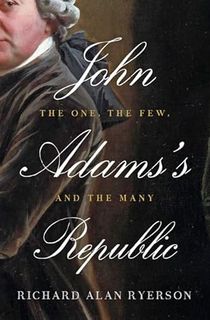
John Adams's Republic: The One, the Few, and the Many
For over two decades, Richard Alan Ryerson served as the editor-in-chief of the Massachusetts Historical Society’s Adams Papers project, where he developed a profound background in John Adams's political thought and development.
In this biography, he argues that the founding father was deeply worried, perhaps more than any other, about social jealousy and political conflict.
Through close analysis of his writing, letters, diary, and more, Ryerson weaves a narrative from the 1760s and across six decades, building a portrait of what he perceives as America’s first significant political theorist.
Featured image: Wikimedia Commons


