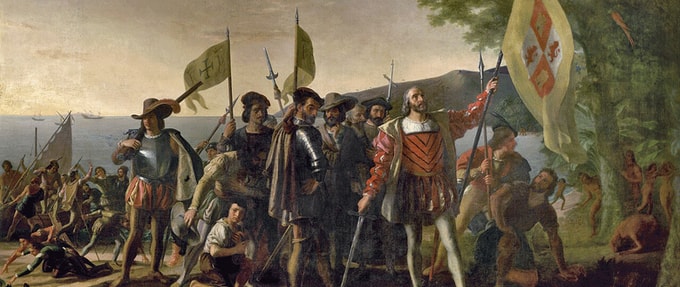

The Age of Discovery is an era that many of us became familiar with as schoolchildren. Tales of European explorers taking to the sea, navigating uncharted waters in small wooden boats. Maps carved out in expansive detail, allowing the Earth to take shape in a way it never had before. Resources such as furs and spices traded across continents, establishing new routes.
Although all of this is true, the period had significant social and economic impacts on Europe, as well as on the cultural and scientific spheres; nonetheless, it is only one version of history. “Discovery,” in fact, was only the European experience of the period—not the Native one.
When the Italian Christopher Columbus and the Portuguese Ferdinand Magellan set sail—taking root in most of the Americas, parts of Africa, coastal India, Southeast Asia, and later Oceania—they introduced diseases such as smallpox and measles, reconfigured local economies, disrupted traditions and culture. Ultimately, they decimated Native American populations, demonstrating the disastrous and lasting effects of colonization.
When these explorers and others discovered what they perceived as a “New World” in the 15th and 18th centuries, it is important to remember that Indigenous peoples had resided there for generations. Before the arrival of the Europeans, another group of people had come to settle in America: the nomadic ancestors of modern Native Americans, who travelled via a “land bridge” from Asia to modern Alaska 12,000 years ago.
Much can be learned not only by unpacking the Native American populations that thrived before contact with Europeans, but also by examining how these two cultures interacted. Before we unpack this period of exploration, I thought it important to set aside this colonial claim of “discovery,” and to accept that, although geographic and scientific knowledge grew, this is just one version of history.
The Conquerors of the New World
Although Christopher Columbus has become a widely celebrated figure in American history and the face of the era of exploration, his first voyage took place in 1492, roughly 150 years after Portuguese sailors explored the Canary Islands. While rival Spain would eventually seize control of the Canaries, the Portuguese had already established themselves as the leading powers in navigation, trade, and shipbuilding.
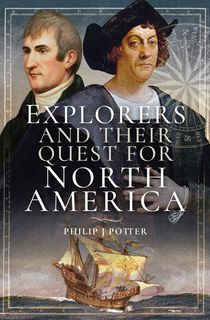
Explorers and Their Quest for North America
In 1415, the Portuguese, crossing the Strait of Gibraltar, conquered the heavily armed port of Ceuta in Morocco, under the guidance of King John I. In the coming decades, John’s son, Prince Henry the Navigator, led exploration along the African coast, from which they derived profits from gold, spices, and enslaved people, becoming responsible for the spread of the slave trade to the Americas. When Prince Henry died in 1460, the Portuguese had colonized the Madeira Islands, the Azores, and the African coast as far as Sierra Leone.
Although Portuguese exploration efforts slowed, King John II financed a mission from Portugal to India led by Bartolomeu Dias, who became the first to sail to the southern tip of Africa in 1487. After the voyage, Dias returned to Lisbon and shared tales of expeditions with John’s court—and in the audience was navigator Christopher Columbus. Invigorated, Columbus proposed a voyage to the Indies to John, but he was not interested, so he turned to the rival monarchs, Isabella and Ferdinand of Spain.
Thus, on August 3, 1492, Columbus sailed from Palos, Spain, with three small ships toward Japan, according to the maps he referenced. Instead, he encountered the Bahamian island of Guanahaní and renamed it San Salvador. He went on to reach Cuba, Haiti, and the Dominican Republic before returning to Europe in 1494, with gold, spices, and “Indian” captives.
Throughout his life, Columbus led four expeditions to the “New World,” including the Caribbean islands, the Gulf of Mexico, and the South and Central American mainland. But by the time of his death in 1506, he never accomplished what he had originally set out to find: a western ocean route to Asia. Still, his expeditions would go on to make Spain the wealthiest nation on earth—while also initiating centuries of brutal colonization.

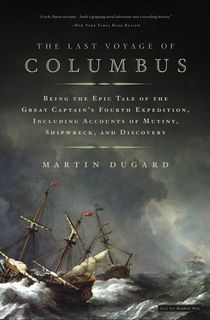
The Last Voyage of Columbus
In 1498, supported by the Portuguese monarchy, Vasco de Gama led an expedition that established a sea route to India. With four ships and over 160 men, they faced hunger, scurvy, and numerous dangers, but with the help of a local navigator, they crossed the Indian Ocean and reached Calicut. From there, the first water route between India and Europe was established, laying the groundwork for future colonialism and a network of trading posts.
With these rampant “discoveries,” Portugal and Spain decided to split up control of the “New World,” with the Treaty of Tordesillas drawing a line through the Atlantic Ocean. Spain was given all the lands west of the line, while Portugal seized all the lands east of it. Not only did they neglect the 50 million people already residing in the Americas, but other powers, such as Britain, France, and the Netherlands, would ignore these divisions. European expansion knew no bounds.
In 1522, Portuguese explorer Ferdinand Magellan led the first expedition to circumnavigate the globe, although he was killed before the voyage ended. However, during the trip, he discovered the Strait of Magellan, which unites the Pacific and Atlantic Oceans, and became the first European to encounter the Philippines.
Because of Magellan, European geographic knowledge expanded immensely, leading them not only to learn about a massive, previously unknown ocean, but also to realize that the world was much larger than they had once thought.
The Transition into the Modern World—And Its Lasting Impacts
Millions of years ago, North and South America were separated from Eurasia and Africa by continental drift. After 1492, an artificial reestablishment occurred between these Old and New Worlds, bridging animals, plants, and bacteria. This is commonly referred to as the Columbian Exchange.
When Europeans first arrived in the Americas, crops they were familiar with, such as wheat, barley, and rice, had not yet crossed the Atlantic. The same was true with animals—there were no horses, cattle, or sheep—and pathogens that developed into smallpox, measles, chickenpox, and more. Swiftly, Europeans who settled in the New World transformed the landscape and ecosystems. Ultimately, the outcome was catastrophic for Indigenous peoples, who had not encountered the dense populations of the Old World or associated creatures.
During the Spanish conquest, which was the century following Christopher Columbus’s initial journey to the Americas, research finds that roughly 90% of the Indigenous population was killed off through conflicts and spreading disease. That is almost 56 million deaths in a century. According to a study conducted by researchers at University College London, Europeans caused so much death that the global climate responded with a massive decrease in atmospheric carbon dioxide.
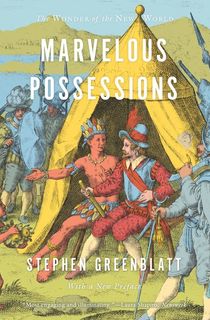
Marvelous Possessions
Moreover, as the world became more interconnected through navigation and trade, a surge in enslavement emerged, beginning as early as the 15th century when Portuguese explorers captured Africans along the West African coast. European slave ships began using a triangular trade route between the Americas, Africa, and Europe, known as the Atlantic slave trade. The slave trade marked the beginning of the history of people of African descent in the United States—a history forged through harrowing weeks and even months spent locked in the holds of slave ships.

Black Cargoes
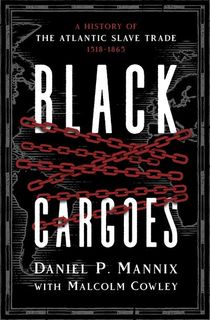
When discussing the age of discovery or exploration, it is important to acknowledge the painful, disturbing, and traumatic histories that are often overlooked. While it is true that the world became more unified during this period—for better and for worse—it is essential to spotlight this facet of history, rather than that of the conquerors. The suffering experienced is woven into the very foundation of America and what it means to be American, and this is something we need to face, as it cannot be repaired.


