
At one time, tool use was considered one of the defining qualities of humanity. And throughout the ages, our various tools and inventions have done much to shape society and change the way we live, work, and even play.
From the earliest stone tools and the invention of the wheel to the modern internet and the smartphone that you may be reading this on right now, human history is a history of inventions.
Here are seven of the most important inventions that shaped society and helped create the world we live in today.
The Printing Press (1440-50)
Few inventions in history have proliferated as quickly and thoroughly as the printing press—and few have changed society as irrevocably as a result. Though other inventors had worked on similar schemes before him, it was Johannes Gutenberg who created the first ancestor of the modern printing press in the middle of the 15th century.
In less than fifty years, it is estimated that as many as twenty million books were printed with the new technology, and historian Elizabeth L. Eisenstein wrote that “printers’ workshops would be found in every important municipal center by 1500.” For the first time, the printing press enabled the mass distribution of the written word, which marked, quite possibly, the greatest revolution in communications in history.
The Steam Engine (1698)
The earliest steam engines were created to pump water out of mines. These were developed in various ways by figures including a Spanish inventor and mining administrator, Jerónimo de Ayanz y Beaumon, in the late 16th century, but the first modern steam engine is often credited to an English engineer, Thomas Savery, in 1698.
In each case, these early steam engines operated on similar but slightly different principles, ultimately leading to the steam engine that would help drive the Industrial Revolution throughout the 18th century. As historian Anton Howe writes, by the end of the 18th century, steam engines were “turning machinery,” and by the 1830s, “steam boats, steam carriages, steam trains, and steam ships proliferated and began to shrink the world.”
Photography (1838)
In an age when pretty much all of us carry high-powered digital cameras in our pockets at all times, it can be difficult to imagine a time when it was impossible to take a photograph of something and look at it later. Yet, that was the case until fairly recently.
While modern photography makes use of a natural phenomenon sometimes called a “camera obscura,” in which light passing through a small opening into a dark space produces an image of what’s outside, the ability to reliably capture these images dates to the early 1800s.
In 1838, Louis Daguerre took what is widely considered to be the first photograph featuring humans. One of the earliest cameras that could be used by everyday folks was the Kodak Brownie camera, first introduced in 1900, bringing “the snapshot to the masses.”
Refrigeration (1913)
The basic principles that power the refrigerator in your kitchen have been around for thousands of years. Since ancient times, people have used blocks of ice, flowing water, or even just a wet cloth to keep food, drinks, and themselves cool.
However, the kind of artificial refrigeration that we enjoy today began in the middle of the 18th century, when a physician named William Cullen first demonstrated evaporative cooling at the University of Edinburgh.
Even then, it would take almost two centuries before modern refrigerators found their way into homes when an American engineer named Fred Wolf began producing the first domestic refrigerators in 1913.
Antibiotics (1928)
Prior to the development of antibiotics, virtually any injury could be fatal. An infection was often a death sentence, and even when it wasn’t, it might still lead to debilitating conditions. The CDC estimates that as many as one-third of all deaths were caused by infections that are now treatable with antibiotics.
That all began to change in 1877, when Louis Pasteur and Robert Koch first described the future use of antibiotics. The biggest breakthrough, however, came in 1928, when Alexander Fleming famously identified what would become penicillin, one of the earliest and most important antibiotics.
By World War II, penicillin was in common use and was as much a part of the war strategy as tanks, guns, and bombs.
Birth Control (1960)
For as long as people have been having sex both for pleasure and for procreation, there has been a need to control for unwanted pregnancies. Writing in her book Protective Practices: A History of the London Rubber Company and the Condom Business, historian Jessica Borge argues that contraceptives have existed in various forms since ancient times, while the modern rubber condom dates back to the 19th century.
The real revolution came when the FDA approved the first birth control pill in 1960. This helped to kick off a sexual revolution, ushered more women into the workplace, and gave people greater control over the size and disposition of their families.
The Personal Computer (1977)
You may be reading this on your computer at home or at work—or you may be reading it on your smartphone, which is, in essence, a tiny computer that you keep in your pocket. Whatever the case, you probably couldn’t be reading it at all were it not for the invention of the computer.
While computers of various kinds had existed for years, they were generally huge, complex machines that sometimes occupied entire rooms. As early as 1949, British newspaper The Star speculated that computers “may one day come down to our level and help with our income-tax and book-keeping calculations.”
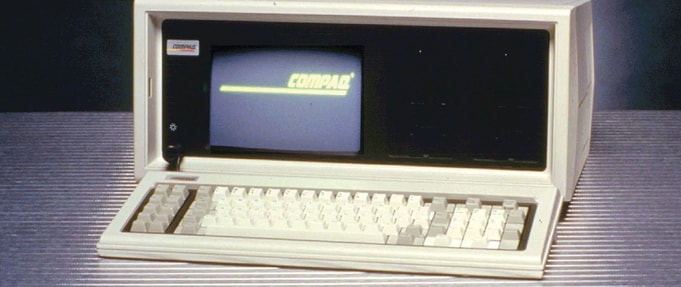
But it wasn’t until 1977 that the first recognizable modern personal computers hit the market. Look back at those and compare them to whatever you’re reading this on, and you’ll see that computers have come a long way since then.
Featured image: Compaq Computer Corp


