
The Hundred Years’ War, a drawn-out conflict between the kingdoms of France and England, lasted, as the name implies, well over 100 years. However, the war was intermittent, often interrupted by external factors like the Black Death and years of truce, as the two countries battled for lasting control of France.
The conflict was a defining moment of the Middle Ages, spanning from 1337 to 1453, and saw five generations of kings. Over the course of the war, European warfare evolved dramatically, especially with military tactics and technology. Moreover, national identities took root in both kingdoms, and have endured to the present as the countries have become major global powers.
Commonly divided into three phases, the Edwardian War (1337-1360), the Caroline War (1369-1389), and the Lancastrian War (1415-1453), the period of warfare only got its title, the Hundred Years’ War, in retrospect by later historians.
A series of sieges, raids, and battles, the conflict grew out of centuries of bickering over lands English kings held in France. The tensions came to a head when the English King Edward III, grandson of Philip IV of France, was denied his claim to the French throne and launched an attack.
The war produced some of the most famous clashes, including the Battles of Crécy and Agincourt, which demonstrated English courage, and one of history’s most enduring icons, Joan of Arc, who revitalized French spirits and ultimately changed the tide of the war.
What Started the Hundred Years' War
Although the English crown had held land in France since the Norman Conquest in 1066, by the 13th century, it had relinquished much of that control. England’s King Edward III inherited what territories they still had—but wanted more.
In 1328, King Charles IV of France died without a male heir. His cousin, Philip VI, was named as his successor, over Edward, Charles’ nephew. Edward asserted that, in 1337, as the proper heir, he should rule both England and France—which Philip did not take lightly.
Philip, in response, seized the then England-held Gascony, part of the combined Province of Guyenne and Gascony, and then raided England’s south coast the following year. His attack gave Edward the perfect opportunity to launch a conflict.
The Battles That Defined the Hundred Years' War
The war began on a high note for Edward and his English army. In 1340, a French fleet, likely intended to invade England, was sunk. In 1345, he then captured Gascony, invaded Normandy, and famously defeated a French army at the Battle of Crécy. There, roughly 15,000 troops took down a much larger French force of 30,000, thanks to tactical positioning and the superior rate at which English and Welsh longbowmen could fire an arrow.
The following year, the Black Death arrived, putting an abrupt end to any hostilities. A decade later, the next major victory for the English came at the Battle of Poitiers—so crushing that the French King, John II, was captured. Although Edward led the English to many successes, the war was expensive. Luckily, the Treaty of Brétigny was signed in 1360, granting Edward roughly a quarter of France’s territory and effectively ending the war—for now.
Following John’s death, his son, Charles V, took the French throne—and quickly went to work reclaiming the territories France had lost. His son, Charles VI, inherited a fragile peace that didn’t hold. Under Henry V, English ambitions were renewed, bringing on one of the war’s biggest conflicts and victories: the Battle of Agincourt. Although the exact numbers are debated, roughly 6,000 English soldiers managed to defeat France’s 24,000. The decisive win brought on another stretch of stability with the 1420 Treaty of Troyes.
As part of the treaty, Henry was recognized as heir to the French throne over Charles VI’s own son—but when Henry died two years later and his infant son Henry VI took the crown, tensions boiled over once again. Charles VI’s disinherited son, now calling himself Charles VII, held the south of France but remained uncrowned.
The Impact of Joan of Arc
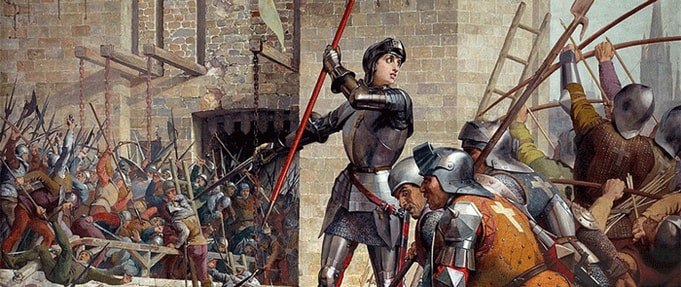
The arrival of Joan of Arc in 1429 brought about a renewed spirit among the French, translating into success on the battlefield. A 17-year-old peasant, she believed that God had chosen her to lead France to victory against the English, and convinced the uncrowned Charles VII to let her command an army.
Within weeks, she’d broken the Siege of Orléans and helped rout the retreating English at Patay—momentum that carried through to Charles’ coronation at Reims that same year, finally making his kingship undeniable.
Although the English eventually captured her in 1431 and burned her at the stake, she boosted French morale enough to help turn the tide of the war. With the French now pushing back, the end—for real this time—came in 1453 at the Battle of Castillon, one of the first major European battles decided by field gunpowder artillery. In the years following this decisive victory, the French crown regained all remaining lands.
England, meanwhile, took to another conflict: the Wars of the Roses.


