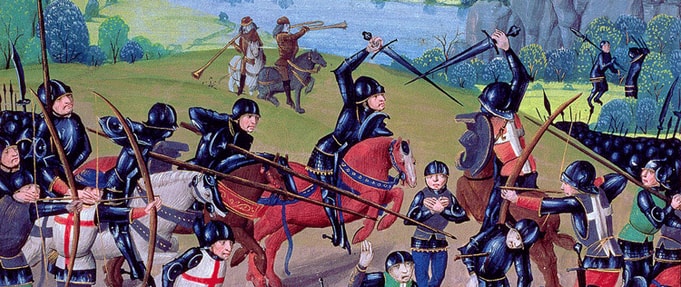

Agincourt is one of those battles people feel they already know. An English army, worn down by weeks of marching and sickness, comes up against a larger French force during the Hundred Years' War. The position looks poor. The ground is not ideal. Nothing about it suggests an easy outcome.
The longbowmen are usually placed at the center of what follows. Arrows fall, the French advance slows, then falters, and from there the story tends to move quickly toward English victory. It has been told often enough that its shape feels settled.
But when you return to the accounts written not long after the event, that sense of certainty begins to loosen. Not in a dramatic way, more in small shifts. Details that do not quite line up. Emphases that change depending on who is writing.
Who Was Actually There
The question of numbers is usually where things start to come apart. English writers make a point of the numerical imbalance—that much comes through clearly. The idea of a smaller, disciplined force holding its ground against a larger one is already present in the earliest accounts.
The Gesta Henrici Quinti, often treated as one of the more immediate sources, leans into this. It presents the situation in a way that highlights the scale of the challenge facing Henry’s army, though it does not pause to give figures that would settle the question.
French material is less direct. Some accounts imply advantage, others are more cautious. None provides numbers that can be taken at face value without question. So the imbalance may well have been real. The extent of it is harder to pin down.
Accounts Written After the Fact
The main narratives we have come from writers who were not standing in the mud that day. English historian William of Newburgh belongs to an earlier generation, so he does not enter into this particular event, but the same general issue applies. The writers we rely on were not standing in line as it happened.
The author of the Gesta, along with Jean de Wavrin and Enguerrand de Monstrelet, all worked from reports, conversations, and second-hand material. That does not make their accounts unreliable, but it does shape them. Each carries a perspective. In some cases, more than one.
The Gesta reads as though it is close to the English command. It emphasizes order, preparation, and a sense of control. Wavrin’s account, written from a Burgundian viewpoint, introduces a little more complication. The French army is not presented as a single, unified force, and that becomes relevant once the fighting begins.
Monstrelet is less vivid, but still useful. His account suggests that whatever plan existed did not unfold cleanly.
The Ground and the Advance
Most versions of the battle mention the ground, though not always with the emphasis modern retellings give it. The field lay between two wooded areas, narrowing the space available. Recent rain had left the soil heavy. That much is consistent across several accounts.
The French advance moved forward into this space. Heavily armored men-at-arms are not quick at the best of times. On firmer ground, they can still move with purpose, but here that movement appears to have slowed. The soil did not hold well. Each step seems to have taken more effort than expected, and once that begins to affect a formation, it is difficult to correct.
Those behind continued to press forward. The space in front did not open up. The line compressed. Movement became harder rather than easier.
English sources describe the effect of arrow fire, and there is no reason to dismiss that. But the same accounts also point, almost in passing, to the physical difficulty of the advance itself. The battle does not seem to break in a single moment. Rather, it wears down.
What Is Less Certain
Some of the most familiar details of Agincourt are also the least stable when you look closely. The execution of prisoners is one example.
English accounts acknowledge it, but the explanation shifts. Sometimes it is presented as a response to renewed threat, while other times it appears as a precaution taken under pressure. The exact trigger is not entirely clear.
The role of the French cavalry early in the battle is another. In some tellings, it is decisive, but it fails dramatically. In others, it is less effective from the start. Even the sequence of events is difficult to fix. The sources do not line up neatly. Actions overlap. Cause and effect are not always easy to trace.
Agincourt did not remain just a battle. It became something that could be used. In England, it settled into a story of unlikely victory. A king leading from the front. A smaller army prevailing through discipline and resolve. Over time, that version hardened.
French accounts do not usually frame the battle as a simple failure. There is a stronger sense that things are not quite coming together. Divisions within the army, decisions made before the fighting began, and the conditions on the field all seem to play a part.
Both strands of memory matter. They show how the same event can be carried forward in different ways.
Henry V’s Position on the Field
One part of the story that often gets simplified is English King Henry V’s role during the battle itself. The sources do place him close to the fighting, though not always in quite the same way later retellings suggest. He is described as being with his men, which matters, but that does not necessarily mean constant, visible leadership as it is sometimes imagined.
The Gesta presents him as composed and deliberate, someone aware of the situation as it develops rather than reacting blindly to it. There is a sense of control, though it is difficult to know how much of that reflects the reality of the moment and how much reflects the way the account was shaped afterward.
There are also references to Henry V being in personal danger at certain points. One often-cited detail involves an attack directed toward him during the fighting, which resulted in the death of his standard-bearer. It is a striking image, though, like much else, it rests on accounts that were written after the event and shaped by the need to present the king in a particular light.
What seems more certain is that Henry did not command from a distance. He remained close enough to the action for his presence to be felt, whatever that meant in practice on a crowded, difficult field.
That, in itself, would have carried weight. Not as a dramatic gesture, but as something steadier. In an environment where movement was restricted and visibility limited, even a sense that leadership was nearby could have mattered.
It is one of those details that sits somewhere between record and interpretation. The sources agree that he was there. What that looked like, moment to moment, is harder to fix.
Looking at It Again
If the accounts are read alongside one another, a general outline does appear, but it is not as fixed as it is often presented. The English force was likely smaller. That seems reasonable. By how much is less clear. The longbow mattered, but it did not operate on its own. The ground played a role, though not always in the dramatic way it is sometimes described.
More than anything, the battle does not come across as a clean sequence of events. It feels crowded. Slowed. At points, it was unclear even to those trying to describe it not long afterward. That may be the most useful way of approaching it.
The Battle of Agincourt is not diminished by this. If anything, it becomes harder to reduce to a single explanation. The more closely the sources are read, the more they seem to resist settling into one version of events. And that is where it tends to remain.
Further Reading
Agincourt: A New History by Anne Curry
Agincourt: The King, the Campaign, the Battle by Juliet Barker
Recueil des Chroniques by Jean de Wavrin
Chronicles by Enguerrand de Monstrelet
Henry V by Christopher Allmand
Featured image: Wikimedia Commons


