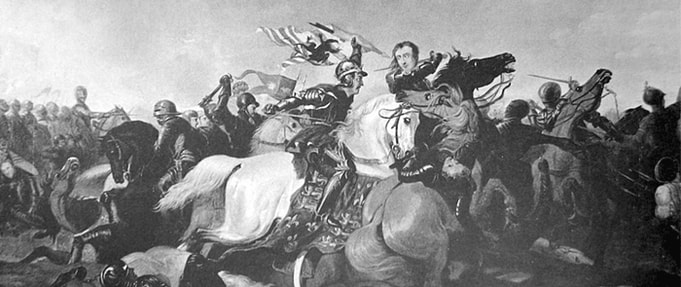
The Tudors’ rise to power and claim over the throne for over a century was no easy feat. In fact, it succeeded decades of warfare, notably between two competing royal families—the houses of Lancaster and York—in what would become known as the Wars of the Roses, or the Cousins’ War.
The final years of the Plantagenet dynasty, the period before the Tudors, were consumed by violence, with power changing hands again and again. Fueled by government corruption, a disrupted royal succession, and Henry VI’s mental illness, the English Civil Wars, lasting from 1455 to 1487, are widely regarded as the end of the Middle Ages and the beginning of the modern era.
Still, the brutal battles have remained significant in popular culture, serving as the basis for William Shakespeare’s history plays—Henry IV and Richard III—and continuing into contemporary times with George R.R. Martin’s A Game of Thrones. But how did the Wars of the Roses, with their deaths of kings and purging of royal dynasties, come to be?
What were the Wars of the Roses?
The struggle between the Lancaster and York houses was punctuated by a series of battles—the Wars of the Roses, note the plural—each with its own reasons, throughout the 15th century.
The conflict was named after the heraldic badges of the two rival branches of the royal Plantagenet family: the White Rose of York and the Red Rose of Lancaster. Each fighting for a claim over the English throne, there are several primary figures on each side that will help simplify the dense history.
In the House of Lancaster, there is King Henry VI, whose inept servitude and mental instability sparked the conflict; Margaret of Anjou, King Henry VI’s wife and a political and military powerhouse for the Lancastrians; and Henry Tudor, later King Henry VII, the ultimate victor of the wars.
In the House of York, there is Richard, Duke of York, Henry VI’s cousin, and the man who initiated the conflict by seizing the throne for the Yorkists; King Edward IV, Richard’s son, who became the first Yorkist king; and King Richard III, Edward IV’s brother, who claimed the throne after Edward’s death, imprisoning the rightful successors—“The Princes in the Tower”—until his death at Bosworth.
How Did the Wars of the Roses Start?
At the end of the Hundred Years’ War, in which England lost the majority of its lands held in France, economic hardship and ensuing public discontent became widespread. King Henry VI, in declining health, was unable to control the powerful noble lords who were building private armies.
His inadequacies left an opening for Richard of York, great-grandson of King Edward III, to claim the throne. As a result of Henry’s illness, Richard, in 1453 and 1454, was named Protector of the Realm by the King’s Council—to Margaret’s dissatisfaction. Richard, in an attempt to position his lineage as superior, dismissed the Queen’s advisors.
But, in 1454, Margaret gave birth to a son, Edward of Lancaster, which weakened Richard's claim, and, shortly after, Henry recovered. Immediately, Richard and his court were dismissed. But Richard was not so quick to relinquish his power, and, bolstered by the support of Richard Neville, Earl of Warwick (also known as the Kingmaker), the First Battle of St Albans ensued.
What Were the Main Conflicts of the Wars of the Roses?
Discover Britain estimates that around 100,000 people died across the three decades of conflicts—in fact, the number of noble families had plummeted by half after the resolution of the wars. There were 17 battles fought between the Houses, with the English crown changing hands five separate times.
After the first battle, Richard maintained control—but fearing Margaret’s retaliation, as she was working to restore Henry and maintain Edward’s position as heir, he formed an army. They met at Blore Heath on September 23, 1459 in Staffordshire. Although Margaret’s army was far larger, the Yorks defeated the Lancastrians.
On July 10th, 1460, Richard and his supporters, fleeing previously at the Battle of Ludford Bridge, were prepared to make a stand. Led by the Kingmaker, Earl of Warwick, the Yorkist troops, in the grounds of Delapré Abbey, Northampton, captured King Henry VI after only 30 minutes, while Margaret fled.
Now that Henry was under Richard’s control, Richard again established his heirs as successors. Henry agreed with one stipulation—that he would wear the crown until his death. An agreement was reached, but Queen Margaret, who wanted to see her son on the throne, would not submit.
She put together an army, and Richard, with his forces, met her in the Battle of Wakefield. Richard was prepared to settle matters, once and for all—but the clash ended with his severed head on display.
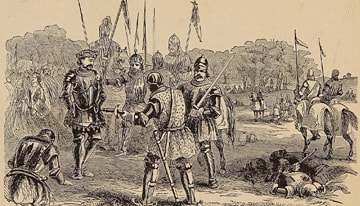

Last hours of Richard Plantagenet, father of Richard III.
Photo Credit: Wikimedia CommonsFollowing Richard’s death, his son, Edward, Earl of March, picked up where he left off. King Henry had recently been freed by his wife at the Second Battle of St. Albans, but Edward wouldn’t give up without a fight.
In March of 1461, Edward and his troop met the Lancastrians in a snowstorm at the Battle of Towton, which would go down as one of the biggest and bloodiest battles on English soil. Sources estimate that of the over 50,000 men who joined the battle, 28,000 died.
Although Edward IV managed to gain the throne, Margaret and her troops held steadfast and restored Henry as king in October 1470. After that, Edward went into hiding, but not for long, as he went on to win battles at Barnett and Tewkesbury in 1471. At the Battle of Barnet, Warwick the Kingmaker, who by this time had famously switched allegiance three times, was killed by the Yorkists.
At the Battle of Tewkesbury, Henry and Margaret’s only son was killed, and they were held in the Tower of London, meaning Edward was king, once again. On May 21, 1471, King Henry VI died in holding—of sadness, or by murder, we will never know. Margaret, on the other hand, was eventually released and returned to Anjou, France, where she remained until her death in 1482.
When King Edward IV died in 1483, his son, Edward V, who was just 12, took the throne. Richard III, brother of Edward IV, became his nephew’s Lord Protector—not without harboring his own dreams of wearing the crown. His plot to have Edward V and his younger brother declared illegitimate worked, and he took the throne in July 1483.
He had his young nephews held in the Tower of London, but when both boys vanished—known as the Princes in the Tower—many accused the king of having them murdered. After that, he lost much favor with the people and once again paved the way for a change in power.
Who Won the Wars of the Roses?
With no direct male heirs, it seemed that the Lancastrian bloodline was to die out. That is, until Henry Tudor entered the picture with a real though thin claim as a descendant of John of Gaunt.
Essentially, the last surviving figure anyone could rally around—given the Yorkist claimants were either female or a minor—Henry Tudor, with the support of France and other nobles, made his claim for the throne.
He and the king met at the Battle of Bosworth Field in 1485, where Richard III was killed. There, Henry was proclaimed King Henry VII, signaling the final chapter and ultimate Lancaster rule. He went on to marry Elizabeth of York, which effectively put the over 30-year Lancaster-York feud to rest.
When Was the Tudor Period?
The union between Henry and Elizabeth ended the War of the Roses and signaled the start of the Tudor Dynasty. The period, lasting 118 years from 1485 to 1603, began and ended with two of England’s most famous monarchs: the founder, King Henry VII, and Queen Elizabeth I, who died without heirs, ending the Tudor line.
From Henry’s six wives to the English Reformation and royal executions, the period was tumultuous yet crucial to the development of the recognizable, flourishing English culture we know today.


