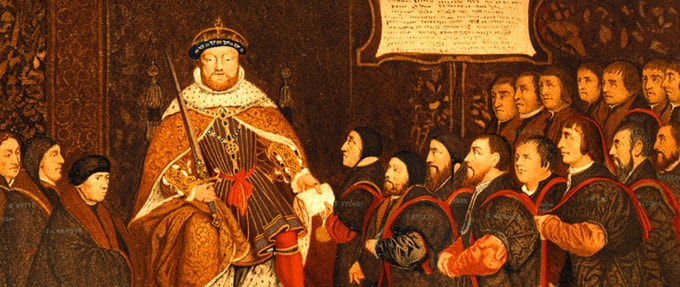

A devout Catholic once named Defender of the Faith by Pope Leo X, Henry VIII is nonetheless perhaps best remembered historically for his dramatic break with the Catholic Church, which began around 1530 and was complete by 1536. This break made Henry VIII the Supreme Head of the Church of England and initiated the English Reformation, which largely converted the country from Catholicism to Protestantism.
The break is often attributed to Henry VIII’s desire to annul his marriage to Catherine of Aragon and instead tie the knot with one of her ladies-in-waiting, Anne Boleyn. “The divorce is absolutely at the heart of the matter,” asserts Andrew Pettegree, professor of history at the University of St. Andrews. “Had there been no marital problems, I’m fairly certain there would have been no English Reformation, at least in Henry’s lifetime.”
However, few things in history are that simple, and Henry VIII’s break with the Catholic Church is no exception. Numerous factors surrounding the king, his marriage, and the political and religious climate at the time contributed to the fateful decision that would separate England from the Church and render the English king no longer subject to the Pope.
Martin Luther and the Protestant Reformation
On October 31, 1517, German friar and theologian Martin Luther allegedly nailed a copy of his 95 Theses to the door of the castle church in Wittenberg, an act often symbolized as the beginning of the sweeping Protestant Reformation that spanned much of Europe.
The Reformation involved challenges to papal authority and a desire to reform—or even break from—the Catholic Church, driven by both theological disagreements as well as fiscal and political strife. Among the most divisive topics was the sale of “indulgences” by the Church, which are described as “one of the ways God gives us to speed our return with him,” something that would essentially grease the wheels to get a soul out of Purgatory and into Heaven faster.
By 1521, Luther’s ideas had made their way into England, where they were establishing a foothold. Indeed, Henry VIII received the title “Defender of the Faith” as a result of a book he wrote in defense of the Catholic Church that was specifically intended to refute Luther’s ideology.
Writing in New Worlds, Lost Worlds, however, Susan Brigden argues that Henry VIII was “often deceived and he deceived himself,” suggesting that those who had the king’s ear could exert considerable influence over him—and that influence was gradually skewing in the direction of Reformation.
The Annulment Controversy
Henry VIII’s desire to end his marriage to Catherine of Aragon and instead pursue his lady-in-waiting is often portrayed as a matter of the heart—or perhaps of other organs. However, it was rooted in political calculus and anxiety about royal succession. Though they had been married for nearly two decades by the time Henry began seeking to annul the union, Catherine had yet to produce a male heir who lived more than a few months.
Henry’s father had acceded to the throne amidst civil war over disputes regarding the succession, and Henry VIII felt it was his duty to avoid any such uncertainties by securing his line. He argued that his marriage to Catherine was “blighted in the eyes of God,” because Catherine had previously been married to Henry’s brother Arthur, until his early death in 1502.
Because of this, it had required a special dispensation from the Pope for the marriage to go through in the first place, and now it required a second dispensation for the marriage to be annulled. “Under other circumstances, it wouldn’t have been too difficult for England’s king to get a papal dispensation to set aside his first wife and marry another to produce a male heir,” writes Sarah Pruitt at History.com. However, there were a couple of complications in Henry’s case.
The biggest problem was King Charles V of Spain. Not only was he Holy Roman Emperor at the time, but he was also Catherine of Aragon’s nephew. What’s more, imperial troops had only recently sacked Rome itself, forcing Pope Clement VII to flee the city. Under these circumstances, the Pope was disinclined to risk angering Charles V by siding with Henry VIII against his aunt, even as he sought to avoid bad blood with the English monarch, if such a thing were possible. The result? Mostly delays.
A Change of Guard
The dispute between Henry and the Church stretched on for years. In 1529, Henry convened Parliament to seek a way around his difficulties. Among those who influenced the nation’s path were the clergyman Thomas Cranmer and Thomas Cromwell, one of the king’s advisors, both Protestants. It didn’t hurt that Anne Boleyn was herself more sympathetic to the Protestant cause.
To some, this was a matter of theology; for others, it was about opportunity. The Catholic Church had long wielded considerable power in England, and its monasteries held substantial landholdings. Weakening the Pope’s power within the borders of England would be beneficial to many, while the king’s eventual decision to dissolve the nation’s monasteries has been called “the greatest redistribution of property in England since the Norman Conquest in 1066.”
For all these reasons and others, the king was encouraged to break with the Church, naming himself instead the Supreme Head of the Church of England and initiating the English Reformation—a period that wouldn’t end with him. While a pregnant Anne Boleyn was crowned in 1533, she, too, failed to produce the desired male heir and was executed in 1536. It was not until Henry’s third wife, Jane Seymour, that a male heir was finally produced.
Despite Henry’s concerns about succession, the Reformation that he had begun, partly in his quest for a male heir, would ultimately be completed by his daughter with Anne Boleyn. Queen Elizabeth I took the throne in 1558, after tumultuous and short-lived reigns by her half-brother and half-sister. She was the last and longest-serving of all the Tudor monarchs, and she ruled England for nearly 50 years, completing the Reformation that her father had begun.
Featured image: Canva


