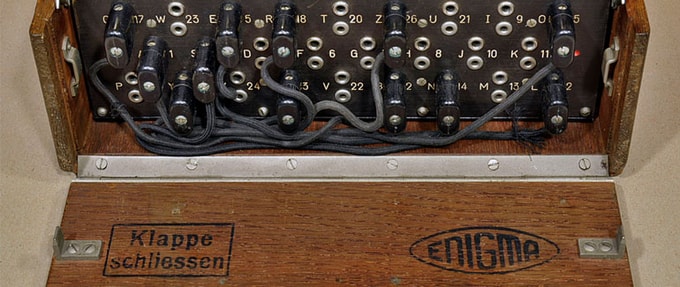
Charles Babbage and Ada Lovelace began work on a so-called “Difference Engine” in 1822, but the first modern computer didn’t come onto the scene until near the end of the Second World War. Even then, the Electronic Numerical Integrator and Computer (ENIAC) was as big as a room, and far more limited than the smartphone that you may be reading this on right now.
Despite this, a mechanical device for encoding and deciphering secret messages played a major role in the events of World War II. Know as Enigma, this device was patented by Arthur Scherbius in 1918, and began mass production in 1923. By the time Germany invaded Poland in September of 1939, kicking off World War II, Enigma machines were used by military and government services in several countries, including most of the German armed forces.
Secret messages enciphered by these machines became integral to German wartime strategy…and cracking the codes became equally vital to ensure an Allied victory.
How Did the Enigma Machine Work?
Compared to a modern computer, the Enigma machine was a relatively simple thing, consisting of a keyboard similar to the one found on a typewriter, which was attached to several rotors mounted on spindles. These rotors turned each time a keystroke was entered, effectively scrambling the 26 letters of the alphabet. Each keystroke would also illuminate one of 26 lights above the keyboard, indicating which letter substitution had been made.
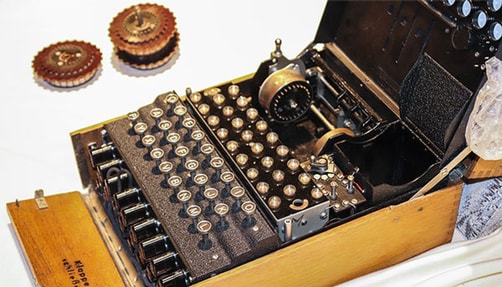

A WWII Enigma machine at the Carnegie Mellon University Library
Photo Credit: Carnegie Mellon UniversityBecause each letter was functionally encrypted with a different cryptographic key, encoded messages sent via Enigma were extremely difficult to crack, but those at the receiving end of the message could decode it relatively easily by simply using another Enigma machine —so long as they could reproduce the settings that had been used to encode the original message in the first place.
These settings were changed daily and transmitted separately to make decoding Enigma messages as difficult as possible, meaning that sending secret messages with the Enigma machine was a relatively simple undertaking, but cracking those messages was incredibly difficult for those who didn’t have access to those settings.
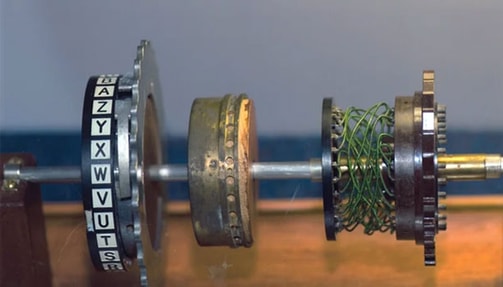
The parts and internal wiring of an Enigma wheel
Photo Credit: The National Museum of ComputingBreaking the Enigma
Because the Enigma device was in heavy use by virtually every branch of the German military—not to mention Japanese and Italian forces—finding a way to decode messages encrypted by Enigma machines became a major part of the Allied strategy.
The first people to do so were Polish mathematicians who worked from previous daily Enigma keys that were smuggled to the French by German spy Hans-Thilo Schmidt. Using these outdated keys and encrypted messages that had been sent during the time that they were in use, Marian Rejewski and several other Polish mathematicians were able to reconstruct their own versions of the Enigma machine, without having ever seen one of the originals.
These cloned “Enigma doubles” allowed the Polish Cipher Bureau to intercept and read encrypted messages sent by the German military as early as January of 1933. However, that was only the beginning of the race to break the Enigma.
With war looming, members of the Polish Cipher Bureau fled to France ahead of the German invasion, where they joined with Allied codebreakers in their efforts to decrypt the German communications encoded via Enigma machines.
These efforts eventually became focused in Bletchley Park, an English country house in Buckinghamshire. Here, the Government Code and Cypher School (GC&CS) worked tirelessly to break encoded German communications in order to help the Allies win the war.
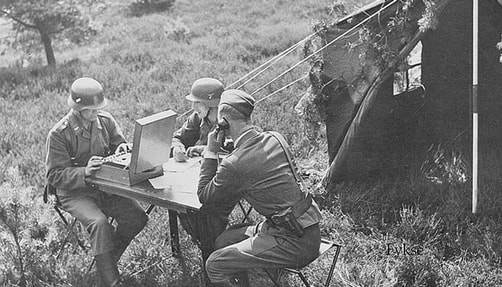 Photo Credit: enigmamuseum.com
According to Gordon Welchman, head of Bletchley Park’s Hut 6, the project “would never have got off the ground if we had not learned from the Poles, in the nick of time, the details both of the German military version of the commercial Enigma machine, and of the operating procedures that were in use.”
Yet, the scientists, mathematicians, and cryptographers at GC&CS still had a lot of work to do. German Enigma technology was constantly changing, and the earliest methods pioneered by the Polish Cipher Bureau no longer worked. Fortunately, they had also enjoyed some additional breakthroughs, such as the 1940 capture of three intact German Enigma machines, which were put to work at Bletchley Park.
The “Cryptologic Bomb”
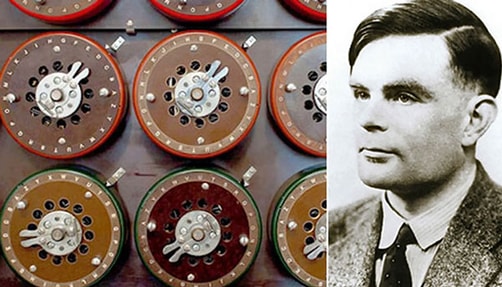
The new Bombe Machine and Alan Turing
Photo Credit: bbc.comAs early as October of 1938, before the war had even officially began, Polish mathematician Marian Rejewski had built the first of what he called “bomba kryptologiczna,” or “cryptologic bombs.” These machines were designed to mechanize aspects of deciphering coded Enigma messages.
Soon after he came to Bletchley Park in September of 1939, British mathematician Alan Turing designed a new “Bombe,” which was constructed by Harold “Doc” Keene of the British Tabulating Machine Company. Composed of a number of removable drums, the electromechanical Bombe was essentially the equivalent of 36 Enigma machines, and could be used to quickly determine important information such as the initial position of the rotors on an Enigma device, which could greatly speed the process of deciphering.
Today, a working, rebuilt Bombe sits in the National Museum of Computing at Bletchley Park, not far from where the original was used.
The End of an Enigma
Deciphering the coded messages created via the German Enigma machines was vital to the success of the Allied strategy in World War II. Without the efforts of the team at Bletchley Park—and their counterparts in Poland, France, Spain, America, and so on—the war might have ended very differently.
While his is the best remembered name associated with Bletchley Park, and his contributions to breaking the Enigma code were many, going beyond just the development of the Bombe, Alan Turing was also only one of a number of scholars, scientists, mathematicians, and codebreakers who worked to try to defeat the German Enigma machines.
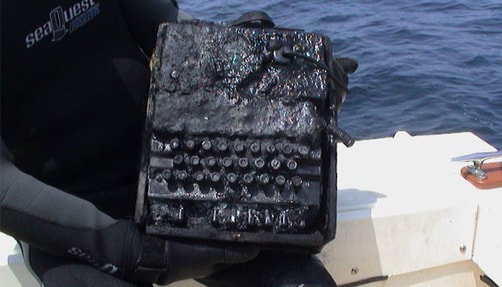
An Enigma that was recovered from a submarine off the East coast of the United States in 2001.
Photo Credit: enigmamuseum.comUltimately, there was no “aha” moment that brought down the Enigma cipher. The German machines made constant advances throughout the war, and the Allied forces were continually racing to keep up. Discoveries such as the early Polish “Enigma doubles,” inventions such as the Bombe, and fortuitous coups such as the retrieval of working German Enigma machines all helped the Allies to break coded messages and stay one step ahead of their enemies.
Even then, many scholars still believe that operator error on the part of those using the German Enigma machines was a major factor in allowing their codes to be broken at all. “That’s the sort of thing we were trained to do,” said Mavis Lever, one of the leading codebreakers at Bletchley Park. “Instinctively look for something that had gone wrong or someone who had done something silly and torn up the rule book.”
Feature Image: Collector Helge Fykse


