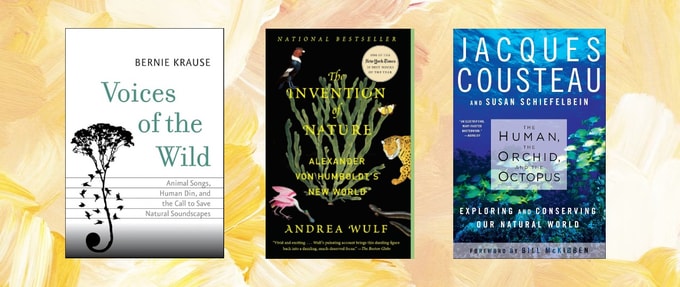

The natural world exists all around us, but how often do we actually stop to appreciate it? It’s more than taking a moment to smell the proverbial roses, it’s thinking about all the wonders that exist—and how little we know about even the life that is closest to us.
These eight science books will help to unlock not only a new understanding but also a new appreciation of the natural world and its rich and varied history. And they will help you see the wonder that is right outside your door or, in some cases, right inside your very own home…
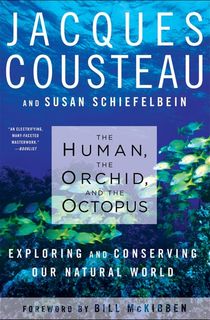
The Human, the Orchid, and the Octopus
Explorer, adventurer, documentarian, filmmaker, and activist Jacques Cousteau became a household name thanks to his dedication to making “humankind fall in love with the sea” (Booklist). Now, in his “eloquent and at times almost poetical” (Library Journal) final book, Cousteau tells a tale that is part memoir, part manifesto, and 100% a passionate plea for exploring and conserving the natural world.
From the dangers facing many natural ecosystems to the responsibility of scientists, laypersons, and people of faith, this is an “eloquent testimony on the importance of pursuing higher ideals, particularly the preservation of the oceans and the natural world for future generations” (Publishers Weekly).
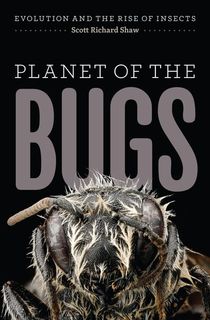
Planet of the Bugs

They say that dinosaurs once ruled the earth, and the implication is that humans do so now. Not according to professor of entomology and Insect Museum curator Scott R. Shaw, however. According to him, Earth is a bug planet. For proof, look no further than this “entertainingly written and fascinating” (American Entomologist) book that “makes a good case that Earth has long been dominated by insects” (Science News).
Beginning hundreds of millions of years ago and taking readers on a tour through geologic time, Shaw shows how insects have evolved throughout the centuries, and how their evolution has shaped the world around them in this “succinct but vivid history of the planet [as] told from the perspective of insects” (Guardian).
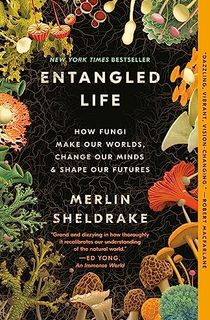
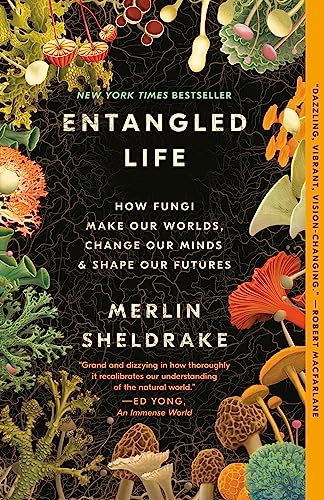
Entangled Life
Fungi: We eat it, we grow it, we use it to make medicines that can save our lives…but what do we really know about it? Shortlisted for the British Book Award and named one of the best books of the year by a dizzying array of publications, this “brilliant [and] entrancing” (Guardian) book offers a “poetic, mind-bending tour of the fungal world” (Scientific American) that explores one of the most mysterious lifeforms on Earth. And it may just upend our understanding of everything from intelligence to life itself.
Once you’ve read it, “You’ll never look at mushrooms the same way again” (People).
Voices of the Wild
When we think about the natural world, we often turn first to images or even smells. Not Bernie Krause, however, a soundscape ecologist who has traveled the world recording the forgotten sounds of everything from threatened animal species to remote landscapes.
In this book, Krause “shares his delight in the sounds of the natural world and makes an impassioned case for the importance of such acoustics” (Shelf Awareness). In a world filled with noise—much of it generated by human industry—Krause’s look at the voices of nature is “fascinating, urgent, filled with sound and fury and beauty” (Richard Louv, author of The Nature Principle), and one that you won’t forget.
The Secret Lives of Bats
Subtitled “My Adventures with the World’s Most Misunderstood Mammals,” Merlin Tuttle’s “terrific” (Huffington Post) book takes readers on a journey into the world of the only mammals capable of true flight.
Often maligned and even more often misunderstood, bats are among the most diverse mammals on the planet, making up roughly a quarter of all mammalian species. This “whirlwind adventure story” that is also a “top-shelf natural history page-turner” (Sy Montgomery, author of The Soul of an Octopus) “grips and doesn’t let go” (Wall Street Journal) as it introduces readers to the secret and fascinating world of these nocturnal creatures.
Tides and the Ocean
Artist, writer, and world traveler, William Thomson became renowned for his hand-illustrated tidal charts. These are just a few of the things that he brings to his new book, “for all of us who feel the pull of the sea and the tug of the tide” (Waterstones).
Thomson shows how the tides surge and swell with the movement of celestial bodies, how the rhythm of the tides affects us here on land, and how the tides are merely the edge of the vast mysteries that are the ocean, in a book “marrying lyrical prose with local knowledge and science” (The Daily Telegraph).
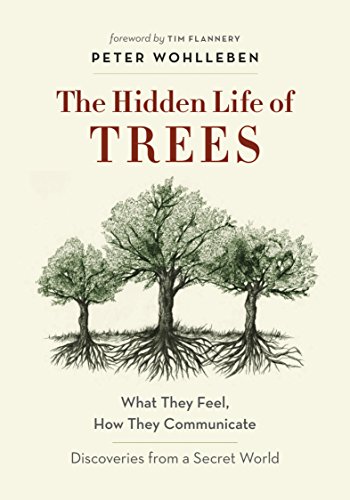
The Hidden Life of Trees
A New York Times, Washington Post, and Wall Street Journal bestseller, this exciting book from author and forester Peter Wohlleben “breaks entirely new ground” (The New York Review of Books) in its argument that trees are social beings.
“Heavily dusted with the glitter of wonderment” (The New Yorker), this “engrossing primer on trees” is “brimming with facts and an unashamed awe for nature” (Washington Post), while also drawing on new scientific evidence to suggest the social nature of forests and give new understanding of how trees and other plants live, grow, and, yes, interact with one another.
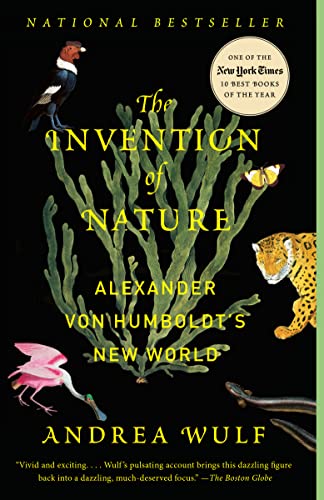
The Invention of Nature
Humans don’t exist outside of the natural world. We are every bit as much a part of it as any plants, trees, or animals around us. That, in part, was the legacy of legendary naturalist Alexander von Humboldt, a German scientist who reshaped the way humans thought about nature and their place within the world, and helped to give rise to modern environmentalism.
In this “vivid and exciting” (Boston Globe) book, biographer Andrea Wulf breathes new life into the history and the work of this “dazzling, complex personality,” while at the same time “revealing his approach as a key source for our modern understanding of the natural world” (Wall Street Journal).
Featured image: Kseniya Lapteva/Unsplash


