
For nearly as long as humankind has had a creative impulse, we have been making statues. Sometimes that entails recreating people, such as national heroes or religious figures, and other times we strive to depict our most treasured ideals, such as freedom and resilience.
Statues can tell us a tremendous amount about the people who built them, and can also offer a glimpse into the hearts and minds of those who came before us. Here are 11 famous statues throughout history and the world.
Giza Plateau, Egypt: The Great Sphinx of Giza
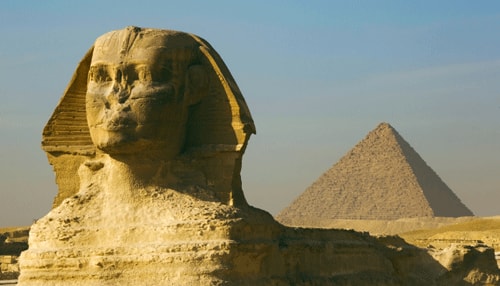
 Photo Credit: Selenay Tunca / Canva
At 240 feet long and 66 feet high, the Great Sphinx is easily among the world’s largest sculptures—and is the largest monolithic statue. Made up of a lion’s body and a human head sporting a royal headdress, the sculpture was carved from just a single piece of limestone, and pigment residue suggests that, at one time, it was entirely painted. Estimates suggest that the sphinx was created over three years by roughly 100 workers, using stone hammers and copper chisels.
Scholars, after studying the stone, determined that the statue is approximately 4,500 years old and thus was built for Khafre, a pharaoh of Egypt’s Fourth Dynasty who lived from roughly 2603-2578 B.C. Still, there is some uncertainty about whom the sphinx is dedicated to, with accounts naming Khafre’s father, Khufu, and Djedefre, another of Khufu’s sons.
Over the years, the statue has been subjected to the elements, with erosion most obvious on the face. Some scholars suggest that the missing nose is attributed to Napoleon’s troops, who struck it with a cannon, but there is little concrete evidence to support that claim. All in all, there is much mystery and uncertainty shrouding the sculpture—including exact origin, true purpose, and the identity of the builders—which perhaps contributes to its wonder.
Xi’an, China: The Terracotta Army
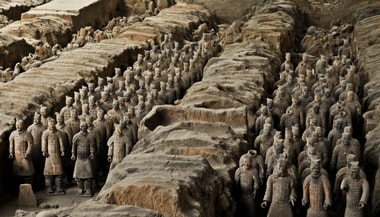 Photo Credit: Pixaby / Canva
One of the most famous archeological discoveries of all time, the life-sized Terracotta Army that guards Emperor Qin Shi Huang's body is one of the greatest wonders of ancient China. Even by today’s standards, the Terracotta Army is an artistic marvel. Each soldier—archaeologists estimate there are more than 8,000—has a unique facial design and expression and was positioned according to rank. The soldiers were found buried in trench-like corridors alongside large clay horse sculptures that were hitched to wooden chariots.
The Terracotta Army is just a small part of the large mausoleum complex of the first emperor of China, Qin Shi Huang. In addition to being the first to unite the region's peoples into a single kingdom, Qin also ordered the construction of the Great Wall of China. Documents suggest that Qin ordered construction on his mausoleum soon after he took the throne at the age of 13. Work continued on the complex until 208 BCE, when political instability in the wake of Qin’s death brought the project to a halt.
Much of the contents of Qin’s mausoleum remain unknown to archeologists, and his actual tomb has never been excavated. Recent excavations around the tomb have revealed other terracotta figures that seem to depict acrobats, dancers, and musicians. As Qin’s mausoleum slowly gives up its secrets, the Terracotta Army will continue to stand sentinel, guarding their emperor's remains for years to come.
Rhodes, Greece: The Colossus of Rhodes
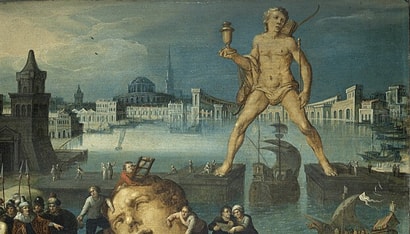 Photo Credit: Wikimedia Commons
One of the Seven Wonders of the Ancient World, the Colossus of Rhodes has captivated the public imagination for millennia. Erected in 280 BCE, the Colossus of Rhodes was built to commemorate the city's successful defense against the armies of Demetrius I of Macedon, “The Besieger.” Created by Chares of Lindos, the statue depicted Helios, the patron god of Rhodes.
Contrary to popular depictions, the Colossus of Rhodes most likely did not straddle the city’s harbor and was probably not holding a torch. However, Helios was a commonly depicted figure, particularly on Rhodian coinage, so scholars do have a good idea of what the statue’s face may have looked like. The statue most likely depicted a figure with curly hair, surrounded by a series of spikes intended to represent the sun's rays. There are several theories regarding the statue's location in the city, ranging from sites near the harbor entrance to a hill overlooking the port.
Although this statue has inspired writers and artists throughout the centuries, most facts about it remain unknown because none of the original Colossus of Rhodes remains. The statue collapsed, snapping at the knees and toppling over, in 226 BCE when an earthquake struck the island. Fearing that they had offended Helios, the people of Rhodes declined to rebuild his likeness.
The broken statue remained where it had fallen for the next 800 years and was a popular tourist site until Rhodes was captured by Arab forces in 653. The statue was then melted down, and the materials were sold to a merchant. Although the story of the Colossus of Rhodes ends there, its legacy has lived on in the popular imagination.
St. Peter’s Basilica, Vatican City: Pietà
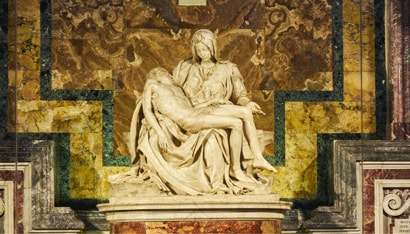 Photo Credit: Canva
One of the most emotionally stirring works of Renaissance sculpture, the Pietà launched Michelangelo's career and set him on the path to greatness. The statue was originally commissioned in 1497 by Cardinal Jean de Bilhères for his future tomb. By the time it was completed in 1499, Michelangelo was just 24 years old.
Translating to “the pity”, a Pietà refers to a depiction of Mary grieving over the dead body of Jesus after his crucifixion. Michelangelo’s Pietà is striking for several reasons. Multi-figured statues were rare at the time, so it would have stood out to any viewer. The elegant draping of Mary's clothes and the positions of their bodies are so lifelike that the Pietà almost doesn't seem as though it could have been carved from marble.
Of course, its tragic imagery is also unforgettable. The Pietà upholds the ideal that earthly beauty reflects the beauty of God, a concept heavily influenced by Neoplatonism, a popular philosophy of the High Renaissance.
Bamiyan Valley, Afghanistan: The Buddhas of Bamiyan
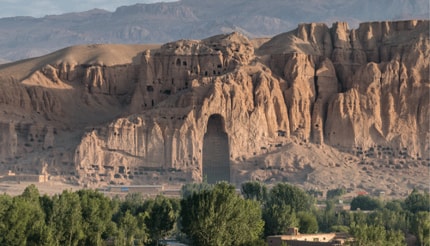 Photo Credit: Canva
Carved into the side of a cliff in the Bamyan Valley sometime in the sixth century, the two Buddhas of Bamiyan were an excellent example of the far-reaching influence of Buddhism along the Silk Road. Although little is known about who commissioned the statues or who built them, they remain an important source of information on sixth-century Buddhist traditions in the Bamyan Valley, even after their destruction.
Afghanistan’s Bamyan Valley was a popular stop near a main branch of the Silk Road, the ancient trade route that connected the East and West. Unlike other religions, Buddhism does not require site-specific worship, which made its spread along the Silk Road much easier. This rapid spread led to an abundance of Buddhist architecture. Still, the Buddhas of Bamiyan were always notable, having once been considered the largest Buddha carvings in the world.
To the dismay of people around the world, these statues were destroyed by Taliban forces in 2001, who claimed that they were false idols. Today, all that remains are the large outlines cut into the rock where the Buddhas once stood.
Florence, Italy: The Statue of David
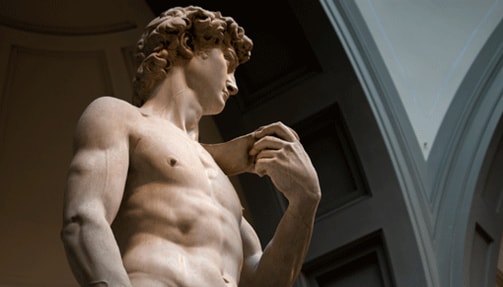 Photo Credit: Fabio Mariano / Canva
If the Pietà launched Michelangelo’s career, David cemented it. Soon after returning to his hometown of Florence from Rome in 1501, Michelangelo was commissioned to carve a statue of the biblical King David for the exterior of Florence Cathedral.
Unlike traditional depictions of the biblical figure, Michelangelo’s David depicts him before his famous battle with Goliath. Armed with his slingshot and a stone, David furrows his brow as he stares off into the distance, preparing for the battle ahead. David is also a prime example of contrapposto, an artistic style in which a human figure is depicted bearing most of its weight on one foot, resulting in a natural twist of the torso.
The Florentine statue of David also had tremendous political significance. The Medici family, who had ruled Florence for generations, had recently been expelled from the city. The citizens of Florence saw much of themselves in David, having triumphed over their own Goliath. Almost as soon as it was completed in 1504, it was decided that David should be placed in Florence’s main square, the Piazza della Signoria, where it could be easily viewed by the city’s residents. It remained there until 1873, when the statue was moved to the Gallery of the Academy of Florence.
New York City, United States: The Statue of Liberty
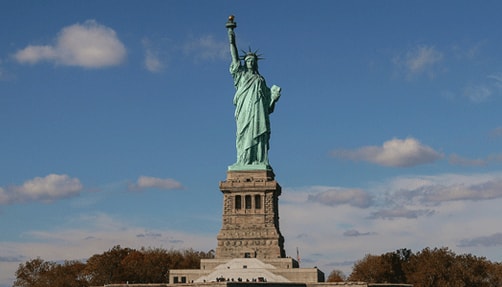 Photo Credit: Pexels / Canva
Standing proud over New York Harbor, the Statue of Liberty is often seen as the personification of American ideals. In 1865, French intellectual Edouard de Laboulaye proposed that a statue representing liberty be erected in the United States in time to celebrate the centennial of the country’s independence and to honor its recent abolition of slavery. Sculptor Auguste Bartholdi took up the task and began designing Liberty Enlightening the World in 1870. It was to depict Libertas, a Roman goddess of liberty.
Much of the symbolism Bartholdi incorporated into his design drew directly on de Laboulaye’s proposal. The spikes of her crown, which extended in all directions, were intended to resemble the sun's rays, literally illuminating the world. Her tablet would be inscribed with the date of July 4, 1776, in Roman numerals, America’s first step towards liberty, and at her feet would sit broken chains and shackles, symbolizing the nation finally living up to its ideals through abolition. Bartholdi also specifically selected the location of his statue on what was then called Bedloe’s Island, where it would be visible to every immigrant arriving by sea.
Liberty Enlightening the World was officially unveiled on October 28, 1886, to much fanfare. She was warmly welcomed by a crowd of one million New Yorkers. Since that day, she has inspired Americans, both new and old, to pursue liberty and justice for all.
Rio de Janeiro, Brazil: Christ the Redeemer
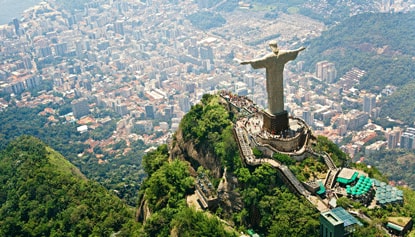 Photo Credit: Canva
With its 92-foot arm span reaching out over the surrounding Tijuca Forest National Park, Christ the Redeemer is one of South America’s most iconic landmarks. Its story began in 1921, when the Archdiocese of Rio de Janeiro proposed that a Christian monument be built on the summit of Corcovado Mountain, where it could be seen from anywhere in the Brazilian city.
The statue was designed by French sculptor Paul Landowski in the Art Deco style that was extremely popular at the time. It remains the largest Art Deco sculpture in the world. It was built between 1922 and 1931 by Brazilian engineer Heitor da Silva Costa in collaboration with French engineer Albert Caquot. Jesus’s face was created by Romanian sculptor Gheorghe Leonida. It was officially completed on October 12, 1931.
In addition to its obvious Christian symbolism, Christ the Redeemer quickly became a symbol for Rio de Janeiro and Brazil as a whole. The foundation stone of the statue was laid on April 4, 1922, before the design plans had been finalized, in order to commemorate the centennial of Brazil’s independence from Portugal. Christ the Redeemer serves as a point of cultural pride for Brazilians and was voted one of the New Seven Wonders of the World.
Volgograd, Russia: The Motherland Calls
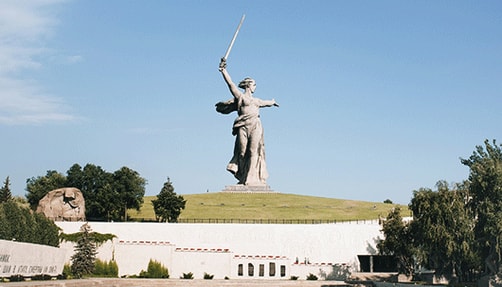 Photo Credit: Dmitry Ant / Unsplash
A masterwork of Soviet-era art, The Motherland Calls is a powerful testament to resiliency. The statue sits atop Mamayev Kurgan, a hill overlooking the city of Volgograd, Russia. It is the centerpiece of a larger memorial complex commemorating the World War II Battle of Stalingrad.
From August 1942 to February 1943, the city of Stalingrad became the site of one of the bloodiest and most grueling battles in the history of modern warfare. For months, Russian soldiers as well as everyday citizens held their ground against invading Nazi forces. As winter set in, the Russians starved the Germans out. The victory at Stalingrad turned the tide of the war, forcing the Axis powers to go on the defensive and giving the Russian people a much-needed morale boost. The entire memorial complex at Volgograd, aptly titled “Heroes of the Battle of Stalingrad”, honors the sacrifices and victories of those perilous 200 days.
When construction of the monument was completed in 1967, The Motherland Calls was the tallest statue in the world. She has since been surpassed, but remains the tallest statue of a woman in the world. The statue depicts Russia personified. Wielding a 108-foot stainless steel sword, she calls on all Russians to never surrender, just like the brave citizens of Stalingrad.
Rapa Nui (Easter Island), Chile: Maoi
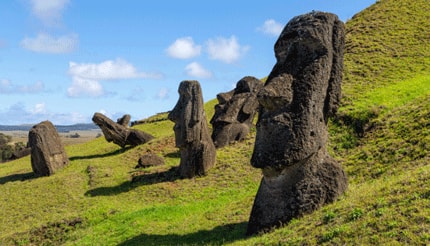 Photo Credit: Luigi Farrauto / Canva
Among the most famous and mysterious archaeological wonders are the moai, which directly translates to "statue" or "figurine" from the Rapa Nui language. As of last count, there are more than 1,043 complete statues, each standing approximately 13 feet tall and weighing 10 metric tons. Although many are referred to as heads, they also have torsos, many of which are partially or completely buried.
Many are oriented toward the sea on stone platforms called ahu, which hold 15 statues. Although many can still be found on easter island, the exact number of statues is unknown, as many remain buried where they were built, in the Rano Raraku quarry on the island’s south shore. Although the first European to record the figures arrived in 1722, the statues were erected hundreds of years earlier. Archaeologist Jo Anne Van Tilburg, director of the Easter Island Statue Project, believes that Polynesians arrived on the island around A.D. 1000, where they then built these statues and established a society and a system of worship centered on the moai.
Although the Rapa Nui people believed their leaders were descended from the Gods, the maois were meant to contain the spirits of their ancestors, if only temporarily. The platform on which many of the sculptures are situated was once the site of death rituals, with excavations finding human remains, both cremated and buried. After death, the chiefs were believed to become divine—thus, according to Van Tilburg, the sculptures can be viewed as containers that keep the moving spirits safe.
Leshan, China: Giant Buddha
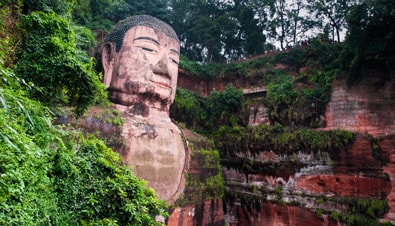 Photo Credit: Petr Polak / Canva
Recognized as the biggest stone Buddha in the world, the Leshan Giant Buddha (a very fitting name, indeed) stands at the meeting of the Min, Qingyi, and Dadu rivers. There, numerous shipping accidents occurred, and since the sculpture’s erection, it has prevented many people from being lost in the river, largely because falling rocks from the construction filled the riverbed.
In 713, a monk named Hai Tong decided to embark on the endeavour of carving a Maitreya Buddha statue to stand and protect the river. Almost 90 years later, in 803, the project was completed, with fingers 27 feet long and shoulders 92 feet across. For reference, a basketball court is 94 feet long. Employing ancient engineering practices, the ears were constructed from wood, coated in mud, and affixed to the body, carved into a red sandstone cliff face. Originally, the Buddha was covered by a wooden structure, but it was demolished during the Ming dynasty.
The sculpture, along with Mount Emei, was declared a UNESCO World Heritage Site in 1996, as it is not only a remarkable feat but also stands where Buddhism was first established in Chinese territory. That said, the first Buddhist temples in China were built in the region during the first century CE.
Featured photo: Manoj Kumar Kasirajan / Unsplash


