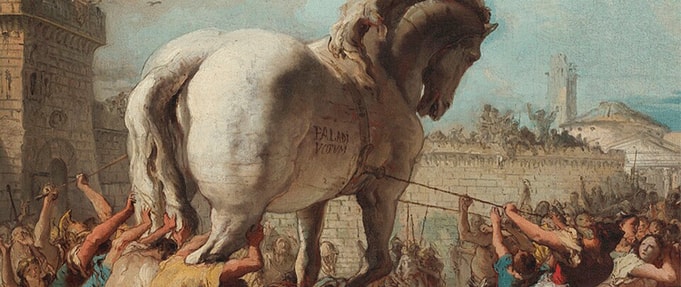

A 10-year siege sparked by one woman’s abduction, complete with a wooden horse, divine intervention, and heroic showdowns—the Trojan War has long captivated both historians and creative minds alike.
Following the release of Christopher Nolan’s Odyssey adaptation earlier this summer, the question resurfaces: how much of the Trojan War actually happened? And why do we keep trying to make sense of the tragedy after almost 2,500 years?
To answer that, we need to look at Homer’s version of events and then see where it diverges from what actually happened…
What We Think We Know
According to Homer’s epic poems, the Trojan War was a 10-year conflict between a united army of early Greek kingdoms, known as the Achaeans, and the people of the city of Troy. By many accounts, including the Iliad, Zeus orchestrated the conflict, beginning by appointing the Trojan prince Paris to judge a divine beauty contest.
Eris, the deity of discord, presented a golden apple to be awarded “to the fairest.” Three goddesses—Hera, Aphrodite, and Athena—coveted the prize, but Paris picked Aphrodite as the winner after she promised Helen, the most beautiful woman in the world, to him. Paris eloped with Helen to Troy—but not without the wrath of her husband, the Spartan King Menelaus.
Consequently, the Greeks assembled forces to retrieve Helen, commanded by Menelaus’ brother, King Agamemnon of Mycenae, with heroes Achilles and Odysseus by his side. The Trojan forces, ruled by King Priam, also involved his eldest son, Prince Hector, leading the defense. The Greek pantheon was divided: Aphrodite, Ares, Apollo, and Artemis took the Trojans’ side, while Athena, Hera, Poseidon, and Hephaestus helped the Greeks.
As put by Daisy Dunn—an award-winning classicist, known for her accessible books on the ancient world—in the BBC, although Homer routinely speaks of divine intervention throughout the poems, “There would have been no gods influencing the course of action on a Bronze Age battlefield, but men who found themselves overwhelmed in a bloody fray could well have imagined there were, as the tide turned against them.”
Once the Greeks reached Troy, Homer details the many struggles, deaths, and triumphs that the Trojan War has come to be remembered for, including Agamemnon’s sacrifice of his daughter Iphigenia, the nine years of raiding, the many deaths of heroes, Odysseus’ idea for the wooden horse, and the final fall of Troy.
What the Evidence Proves
For most ancient Greeks, the Trojan War was no myth—it was fact. Then came Herodutis, known as the “Father of History.” According to the BBC, in the second half of the fifth century, he dated the conflict almost 800 years earlier. Eratosthenes, a mathematician, placed the war at exactly 1184 BCE. But over time, modern historians have become more skeptical.
James Osborne, in conversation with the aforementioned classicist Daisy Dunn, for History Extra, explains how, at the very minimum, the city of Troy existed. Sitting between trade routes along the Aegean Sea and the Black Sea, Troy was a heavily fortified, strategic settlement, destroyed and rebuilt over centuries. Evidence suggests that at least one of these phases belonged to the Bronze Age, when the Trojan War is believed to have occurred.
We have one man to credit for the discovery—and demolition—of the famed city. Heinrich Schliemann, a wealthy German businessman and self-taught archaeologist, was tipped off to Troy’s location. Essentially, he went to Hisarlik, located in modern-day Turkey, with a limited understanding of the appropriate excavation practices or even what he was looking for. Armed with his copy of Homer’s texts, he started digging in 1870.
In the process, he disturbed centuries of history. Dunn describes how, “To modern archaeologists, he’s not really a hero [...] He made so many fundamental errors and caused so much destruction in the process of excavating Troy that he made the situation a lot muddier and murkier than it might have been.”
Rather than digging slowly, layer by layer, as is proper in modern archaeology, he approached the site like a treasure hunt. Troy was a city that had been built, sacked, destroyed, and rebuilt over many generations—the soil would’ve told us when and how.
But according to Dunn, “Schliemann’s rationale was, ‘Well, the Trojan War was surely the oldest thing to have happened at Troy, so to get to any evidence of Troy I need to dig to the bottom, or as deep as possible.’” In the process, he disrupted all of those solidified, sedimented layers—and even dug too deep, over 1,000 years older than what would have been Homer’s Troy.
Although we still have most of what was discovered, it’s hard to tell how much was lost in the process. At one point, when Schliemann and his team discovered a collection of precious items, they attributed them as belonging to to King Priam, the ruler of Troy in Homer’s myth, with no verifiable evidence.
The Gaps
Today, modern archaeologists approach the site more scientifically, identifying the layers as Troy VI and Troy VII, not Troy II. Dating to the Late Bronze Age, these phases will hopefully reveal more about the conflict. So, the city is real—but did the Trojan War actually take place? That’s less certain.
Dunn puts Troy VI and Troy VII as “the grandest cities,” with their walls of thick limestone, encompassing fortifications and lookout towers, strong evidence of a city of Homer’s magnitude. Also, some of the events detailed in his poems, including fires and earthquakes, are identified in the layers, with at least one phase followed by rebuilding.
According to German archaeologist Manfred Korfmann, the previous director of excavations at Troy, in Archaeology Magazine, it’s difficult to know if the battles—revealed in findings of polished slingstones, hastily buried skeletons, and charred structures outside of the palace walls—“were distilled in later memory into the ‘Trojan War’ or whether among them there was an especially memorable, single ‘Trojan War.’”
Nevertheless, “everything currently suggests that Homer should be taken seriously, that his story of a military conflict between Greeks and the inhabitants of Troy is based on a memory of historical event.”
The Real Question
Perhaps that is the real question—not whether the Trojan War happened exactly as Homer described it, but why we have continued to tell it as though it did. As of now, the reality of the Trojan War cannot be proved—but the famed city of Homer’s poems, one of scale, wealth, abundance, and catastrophe, is real.
Over 2,500 years ago, the Iliad came into the world and has continued to resonate long into the present. Homer’s ability to strike such human feelings—anger, love, and loss—and create a world that feels so entirely real is perhaps why we continue to hope to place it in history, in reality.
Or, as Christopher Nolan’s adaptation proposes, Homer’s Trojan War offered “an explanation for the bloody and inferior world in which” the Greeks found themselves, “leaving behind it all the bloodthirstiness, but none of the heroism or martial excellence.”


