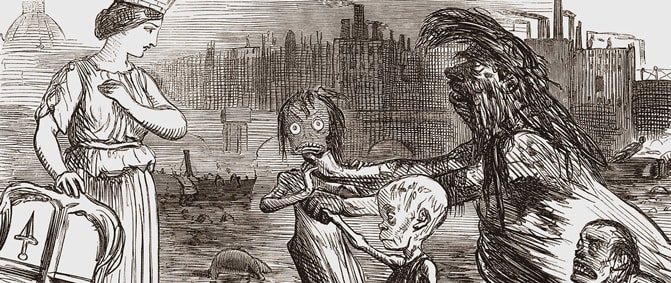
If you’re eating right now, I’d put down the fork—it’s about to get gross. In the first half of the 19th century, London’s population had doubled. With a population of nearly 2.5 million, it was the biggest city in the world.
Although “night soil men” would come and collect some of the solid waste people produced for fertilizer, most of it ended up on the streets or in the water sources. As flush toilets caught on, they simply pushed the waste into sewers that emptied into the Thames. After a series of cholera outbreaks and the fateful, scorching summer of 1858, the problem came to a head.
Centuries of improperly disposed waste fermented along the river. It was so foul that even the Houses of Parliament, newly rebuilt along its banks, talked of relocating. In short, the smell was unbearable—you don’t get named the Great Stink for nothing.
But how did policymakers in a city this size let the issue get so out of hand? And how did a civil engineer design such an advanced system that parts of it still operate in London today? Discover what caused the Great Stink of 1858, and how London finally cleaned up its act.
A “Deadly Sewer”
Across the 19th century, the foul River Thames was described in many ways. Charles Dickens encapsulated the situation in his 1850s novel Little Dorrit: “Through the heart of the town a deadly sewer ebbed and flowed, in the place of a fine fresh river.” Benjamin Disraeli, who twice served as Prime Minister of the United Kingdom, while addressing Parliament on July 15, 1858, famously called the Thames “a Stygian pool, reeking with ineffable and intolerable horrors.” Finally, scientist Michael Faraday, when testing the river’s water with pieces of paper in 1855, noted that the once “silver Thames” had become “an opaque pale brown fluid.”
Since the Industrial Revolution, urban growth had continued exponentially—yet there was no planning policy to support it. In the 1830s, parliamentary reforms had failed to change the situation, and corporations were often elected by self-centered voters, who wanted cheap government that spent little on drainage. The introduction of water closets, otherwise known as flushing toilets, ironically worsened the problem: sewers intended only to carry rainwater now carried untreated sewage, inevitably dumped in the Thames.
According to the Royal Museums Greenwich, by 1857, nearly 250 tons of fecal matter entered the Thames daily. From the river, eight private water companies sourced drinking water for the city (yes, you heard that right). As such, from 1848 to 1854, London suffered a series of cholera outbreaks. Although Dr. John Snow attempted to attribute the polluted water supply to the outbreak, contemporaries refused to believe that was the case. Instead, they viewed the inhalation of “foul air” as the culprit for this widespread disease.
As we now know, cholera is a waterborne disease. But the Metropolitan Commission of Sewers, which was responsible for addressing the worsening situation, lacked the power to impose the proper taxation. Thus, the Great Stink of 1858 arrived. In June, Queen Victoria was crossing the river at Deptford to visit a new ship, but the toxic smell coming from the Thames was so unbearable that she had to plug her nose.
To lessen the smell at the House of Commons, the curtains were soaked in chloride of lime. Still, parliamentary sittings were not bearable, and MPs, with the belief they were being poisoned, finally decided to take action. A law was passed in just 18 days, after London’s inhabitants had endured for years, and money was set aside to build a new sewer system.
“A Wonder of the Industrial World”
Who could successfully take on a project of this size? In 1856, Sir Joseph William Bazalgette was appointed Chief Engineer of the newly formed Metropolitan Board of Works (MBW), stepping up to the plate. In his early career, Bazalgette worked with notable engineer Sir John Macneill on railway projects across China and Ireland, gaining experience in drainage and reclamation. He had been working in London for the Metropolitan Commission of Sewers since August 1849, before taking on the position of chief engineer at the MBW after his predecessor, Frank Forster, died.
As summarized by Historic England, “[Bazalgette] and his team constructed a series of interconnecting sewers which carried the effluent eastwards and out to the Thames Estuary. Once away from the main centres of population, it would be dispatched on the outgoing tide.” Two of the sewers were built along the north and south banks of the river, and large embankments were built not only to conceal the new sewers, but also to act as floodgates. An underground tube line was also built below, called the Metropolitan District Railway, but is now part of the District line and is also used by the Circle line.
The embankment reclaimed approximately 22 acres of the river, which proved unpopular with some. Many houses, warehouses, and businesses lost their river access. In some areas, stretches of waterfront were demolished, proving the end of entire communities.
With the sewers and embankment, Bazalgette’s plan also included pumping stations, including Crossness and Abbey Mills, which lifted sewage from the city, so it could flow on toward the outfalls. What resulted was, as called by The Guardian, “a wonder of the Industrial world.” Although other sophisticated drainage systems had been built, nothing compared to London’s sheer industrial scale, which handled modern flushing toilets and a booming urban society.
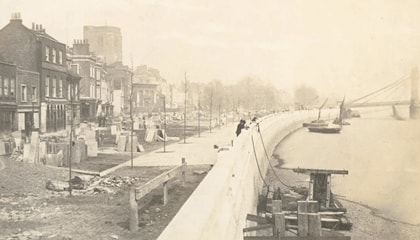

The view looking east along the Chelsea Embankment towards Chelsea Bridge.
Photo Credit: Historic England ArchiveWhat Remains
The project cost roughly £2,500,000 (about £300 million today). Bazalgette’s remarkable feat of engineering, according to Historic England, replaced over 150 miles of old sewers and created over 1,000 miles of new ones. The project required 318 million bricks, causing a citywide shortage, and meant that bricklayers’ wages increased by around 20%.
Overall, the sewage system was a success, keeping waste separated from drinking water and reducing the threat of waterborne diseases to London’s inhabitants. Finally, the smell of raw sewage was gone—except for when it moved downstream. Complaints began from those who now lived where the waste was deposited into the Thames. So, a fleet of vessels was commissioned to deposit the sewage out at sea, a system that surprisingly lasted until 1998, when it was banned by the European Union.
Still, the population continues to grow, putting strain on Bazalgette’s system. Although his original 19th century brick tunnels still operate as part of the network, it has since been updated, most notably with the Thames Tideway Tunnel in May 2025, which intercepts excess storm sewage that used to overflow into the river.
As ever, the mission of the Thames Tideway Scheme rings true: “to intercept those nasty spills and clean up our river for the good of the city, its wildlife and you.”
Featured image: Wikimedia Commons


