The war had been fought and the treaty signed—the United States was to finally be recognized as an independent nation, free from British rule. After more than eight years of unrest and bloodshed, this chapter's closure was intended to signal a fresh start. But many, particularly farmers who had fought in the Revolutionary War, were struggling, having yet to receive compensation for their efforts.
By the 1780s, a severe economic depression had settled. During this period of cash shortages, farmers were ordered by debt collectors to pay or face the seizure of their farms and other property. Businesses in Boston and across the country also ordered farmers to pay immediately in hard currency for goods they had previously purchased on credit or through barter.
Now, with no other options, these men who had worked and fought for the freedom of the nation were wasting away in debtor's prisons. Despite limited resources, Massachusetts residents were required to pay higher taxes than they had ever been subjected to under British rule to satisfy the greed of Governor James and his associates.
Although peaceful means were attempted, with farmers taking their cases to debtors’ courts, grievances and reforms continued to be dismissed. That’s when a group of 600 men, led by ex-soldier and farmer Daniel Shays, took matters into their own hands in what would come to be called Shays' Rebellion.
What led to Shays' Rebellion?
On August 29, 1786, a crowd of more than 500, many of them veterans of the Revolutionary War, united in protest and headed to the county court in Northampton, Pennsylvania. As a result, business was shut down in the court, meaning any seizures or closures were halted for the time being.
Soon, the protest's momentum spread to the Massachusetts countryside, and courts closed in Great Barrington, Springfield, Worcester, Taunton, and Concord. Talk of the growing conflict even reached the uppermost American leaders, with George Washington writing in an October 1786 letter to aide David Humphreys, “For God’s sake tell me, what is the cause of all these commotions?”
Daniel Shays led the charge in the Springfield court shutdown. Although he had worked to keep countermeasures peaceful, he soon escalated his efforts. With no one in government taking meaningful action to defend farmers, Shays refused to backdown, but neither did Governor James Bowdoin.
What happened during Shays' Rebellion?
Although the farmers found some support from Chief Justice William Whiting of the Berkshire County Court, who claimed that the state legislatures were profiting off of them, opponents swiftly emerged. Patriots like Samuel Adams urged the execution of rebel farmers.
A bill was even passed that granted sheriffs impunity if they killed any rebels, and permitted cruel treatment while in custody. Eventually, the death penalty was imposed on any men who took part in the protests, even though many of them had been fighting for their country only years prior.
In January of 1787, Governor Bowdoin had had enough. He assembled an army of 4,400 men, led by General Benjamin Lincoln and privately funded by his Boston associates, with the sole goal of putting a stop to the rebellion.
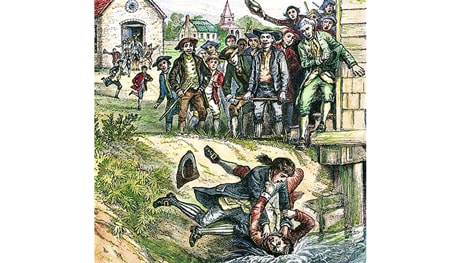

Shays' protesters taking down a tax collector.
Photo Credit: Wikimedia CommonsWhile the government forces assembled, Shays and other rebels organized and chose the federal army in Springfield as their target. Although the group and subsequent action would come to be known as Shays’ Rebellion, Shays' role in the conflict has been grossly overestimated. Nevertheless, he was one of the leaders who took to Springfield.
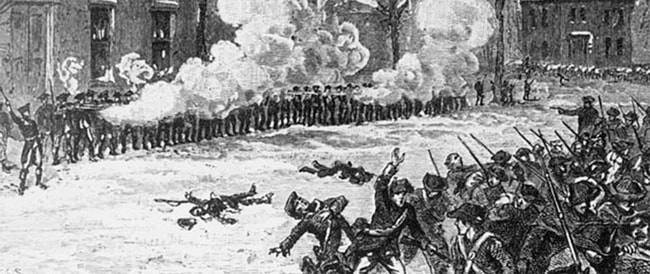
There, the rebels were met by a counterattack of 1,200 men, many of whom, on both sides, had been united years earlier under the objective of defeating the British. The militia fired two warning shots, but both parties pushed forth. Cannonballs were then launched into the frontlines of the rebels, leaving 4 dead and 20 wounded.
Quickly, the farmers scattered in all directions, with many heading north, and Shays’ men regrouped at Amherst, Massachusetts.
What was the impact of Shays' Rebellion?
Over the next few years, 4,000 people would sign confessions of their involvement in the rebellion in exchange for amnesty. In 1788, Shays, after hiding out in the Vermont woods, was pardoned and returned to Massachusetts. Still, he was portrayed in the Boston Press as an anarchist bent on overthrowing the government, further contributing to his enlarged role in the conflict.
Despite numerous government efforts to suppress Shays’ Rebellion over the years, it ultimately had a significant and lasting impact on the country. For one, it underscored the faults in the newly formed Articles of Confederation, particularly the need for reform in finance and the national government. Preparations for the Philadelphia Convention of 1787 were already underway. Still, the uprising in Massachusetts played a key role in the discussions and in the subsequent drafting of the U.S. Constitution that summer.
According to Edward J. Larson, author of The Return of George Washington, the conflict “haunted Washington,” and ultimately led him to return to public life and participate in the convention. Soon after, he would become the first president of the United States.
In more ways than one, the uprising helped create a more stable, unified America. Highlighting the steep economic divide between the wealthy elite and working-class farmers, the latter refused to be coerced into compliance, thereby establishing, in Abraham Lincoln's words, a “government of the people, by the people, for the people.”


