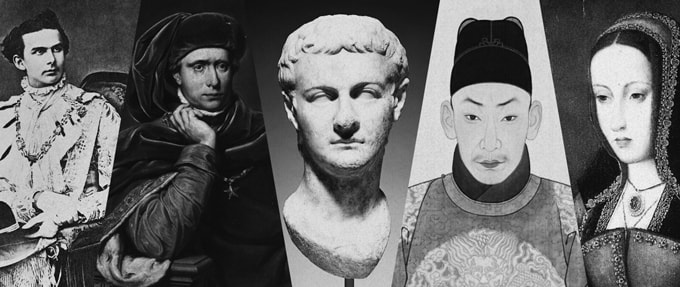
Many world leaders lead intensely sheltered lives—a condition that can often breed truly strange pastimes. From constructing a fantasy kingdom to catering to a corpse, these monarchs spent less time governing and more time indulging in the privileges of absolute rule.
That’s not to say royalty is easy—in fact, the crown comes with a web of pressures few could endure. Several of these rulers struggled with severe mental illnesses that were poorly understood and rarely treated with compassion. Others, however, became intoxicated with power itself—whether their vice was murder or draining an entire nation’s wealth.
Taken together, these five monarchs put the fairy tale image of princes and princesses to rest.
Ludwig II of Bavaria
Ludwig II, otherwise known as “the Fairy Tale King,” ascended to the throne in 1864 at the age of 18. According to his governess, he once said, "I want to remain an eternal mystery to myself and others," which remains true even today, as his life continues to draw much speculation and fascination.
His many palaces, which, in his day, were barred from strangers, have been visited by over 130 million people since his death—including the Linderhof Palace, Herrenchiemsee, and, most famously, the Neuschwanstein Castle, or the “New Castle.” The design of the latter, drawing on Christian kingship in the Middle Ages, would serve as Walt Disney's inspiration for the Sleeping Beauty Castle, a landmark of Disney Parks worldwide.
For much of his reign, Ludwig existed in a fantasy world, and by commissioning these luxurious palaces, he further retreated into himself. In addition, he was a patron to Richard Wagner, a German composer who revolutionized opera. These extravagances led to the dissolution of all his private royal revenues, not the state funds, as many believe. However, in continuing to pursue these projects, he owed money to many family and friends, which would eventually lead to his deposition.
By June 1886, he was fully possessed by the belief of a holy kingdom, which he sought to actualize through his constructions, and spent more time in the mountains at night than with people. In reality, though, he was the head of a very earthly state and had duties to his country and people. Foreign banks took his property to satisfy the increasing debt he found himself in, and the government equated his sumptuous lifestyle with insanity.
Ludwig II was deposed on the accusation of mental illness. A day after being taken into custody, he and the psychiatrist who declared him insane were found dead in Lake Starnberg. Officially ruled a suicide, the bizarre circumstances continue to prompt speculation, with many theories pointing towards a murder plot.
Zhengde Emperor
Reigning from 1505 to 1521, Zhengde was the Ming Dynasty emperor, assuming the throne at just 14 years old. Although he isn’t considered the worst emperor in China’s history, he is one of the least successful. Growing up, he received a Confucian education, marked by respect for authority and morality, but quickly rejected these principles once in power.
Frequently, he clashed with and distrusted government officials, and ultimately gave orders to the eunuchs, particularly those with whom he grew up. Eunuchs are castrated men, often used as servants, but in Zhengde’s imperial court, they seized important positions, and even worked in the secret service and army. The most powerful eunuch was Liu Jiun, who not only became the leader of the group, but also the government.
Zhengde built a new temple for Tibetan monks in the Forbidden City and built the “Leopard Quarter” nearby, which essentially served as his own private brothel. He essentially devoted himself to pleasure-seeking while allowing corruption to run rampant, with public offices bought and heavy taxes imposed on the people.
Only in 1510 did the emperor become aware of the depths of the corruption. He ordered the execution of the lead eunuch, Liu Jin, who was hoarding jewels and riches. Still, Zhengde continued to travel throughout the country, often in disguise, learning languages and indulging in eccentric behavior. He enjoyed the influence of power but not the responsibility—as evidenced in 1518, when he decided to declare himself a general and led a rather unsuccessful expedition.
While returning from Nanjing, where he stayed for a few years, avoiding several rebel raids, he fell into the water while under the influence and ultimately became ill. As a result of infections, he died shortly after.
Charles VI of France
Charles VI, most famously known as the “Mad King,” ruled France from 1380 until he died in 1422. His reign was characterized by mental illness, notably his glass delusion—a psychiatric condition that led Charles to believe that his body was made of glass and could shatter. Reportedly, he had iron rods sewn into his clothes so he wouldn’t shatter, whether coming into contact with another person or otherwise.
He frequently had to appoint regents—those who governed temporarily while he remained incapacitated—among them his corrupt uncles, his wife, Queen Isabeau, and his licentious younger brother, Louis I of Orléans. Charles VI’s reign was marked by turbulence for France, including the onset of a civil war between the Armagnac and Burgundian factions and a defeat at the Battle of Agincourt against the English.
His first mental break occurred in August 1392, when he was 24, while leading a military expedition in the forest of Le Mans. Charles has recently recovered from a severe fever, thought to be typhoid, and in a fit, killed several of his own knights, believing them to be traitors.
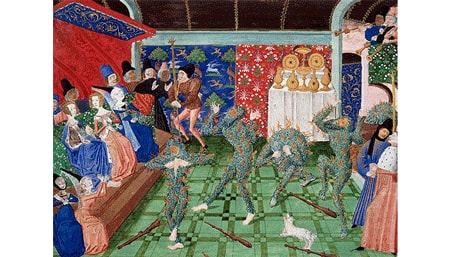

Miniature from Jean Froissart's Chroniques of Le Bal des Ardents.
Photo Credit: Wikimedia CommonsAnother incident took place the following year. The queen, Isabeau of Bavaria, who had married Charles in 1385, threw a masked ball. As part of the festivities, six young noblemen were disguised and doused in resinous wax to give them the appearance of woodland creatures. However, only a few were aware that Charles was behind one of the masks.
The following events would give the evening the title the Bal des Ardents, or Ball of the Burning Men. The king’s young brother and friends walked in carrying lit torches, and accidentally set the men aflame. Recognizing the king, the Duchess of Berry quickly covered him, but the other four men were quickly absorbed by the flames and succumbed to injuries.
The disastrous event naturally only worsened the king’s mental state, and, with a limited understanding of psychosis, he remained misunderstood, which led him to serve out the remainder of his rule in a power vacuum.
Caligula
Born Gaius Caesar, the third Roman emperor, Caligula, was at first a beloved ruler, providing a generous funeral for his predecessor and offering delightful spectacles for the people. When his mother and brother passed, he went to collect their ashes, bringing them back to the Mausoleum of Augustus, and touching spectators. He even freed many political prisoners who had been tried for treason during the Tiberius regime and awaited execution.
But, in mid-October 37 CE, everything changed when Caligula became ill. Although ancient sources differ, some suspect it was a nervous breakdown, while others reference epilepsy. Marco and Silanus, who had been among his closest allies, fearing they would lose their influence, looked for another successor they could control. When Caligula recovered, he was shocked to learn that those he had thought of as friends had turned on him during a brush with death.
Shortly after, Gemellus, Macro, and Silanus were disposed of in equally malicious ways—forced to drink poison, commit suicide, and slit their own throat, respectively. Although the Senate was disturbed by how easily Caligula turned upon his closest allies and relatives, such was only the surface extent of his cruelty.
According to History, his routine behaviors included forcing high-ranking senators to run for miles in front of his chariot while conducting affairs with the wives of his allies. His biographer sums up Caligula’s life with a quote the ruler often used: “Remember that I have the right to do anything to anybody.”
Although his cruelty continued to escalate, as noted with his restoration of the treason trials, he treated his horse, Incitatus, with utmost love. He provided the animal with his own home and even a marble stall with an ivory manger. Before he could appoint the horse to the high office, he was assassinated by Cassius Chaerea, a member of the Praetorian Guard, whom Caligula frequently mocked.
Joanna of Castile
Although Joanna was the queen of Castile, from 1504, and then Aragon, from 1516, her power was routinely operated by others—whether her husband, Philip I, her father, Ferdinand II, or her son, the emperor Charles V. Her marriage was arranged, to Philip the Archduke of Austria, manufacturing a political alliance with Holy Roman Emperor, Maximilian I, Philip's father.
Her mental imbalance surfaced in 1502, with jealous, albeit justified, fits towards Philip. Not only was he cruel, but he was also unfaithful, and Castile would respond by throwing herself against the wall or, at one point, cutting off a rival’s hair and stabbing her in the face. The extent of her insanity is often disputed, with sources often incomplete and contradictory.
When Philip died, in August 1506, it is said Joanna would not part with his embalmed body—and even believed he still lived. As she moved around the castle, the corpse would come with her, whether to the dinner table or the bedside. Although she allowed the body to be buried, she soon asked for the remains to be exhumed and continued to bestow her love upon the corpse.
Her father soon took over the regency and confined Joanna to the fortified palace at Tordesillas, while the corpse was sent to a nearby convent. Until the queen died, she legally remained in control of Spain.
Featured image: Wikimedia Commons


