
Modern medicine is easily one of humanity’s greatest feats, based on centuries of research, experiments, and hard-fought discoveries. Because of the people who have devoted their lives to finding solutions, we now have the tools to diagnose diseases accurately and treat them effectively—ultimately helping people live longer, healthier lives.
It was not always this way. Throughout history, medical practices often did more harm than good. But that was before we had standards in medical practice, let alone the MCAT. Often, these treatments, from advising patients to ingest mercury to intentionally cutting open arteries, were based on superstition, rather than fact.
Read on to explore five of the most shocking historical medical treatments in history—methods that, while incredibly disturbing, ultimately helped pave the way for the standards we rely on today.
Trepanation
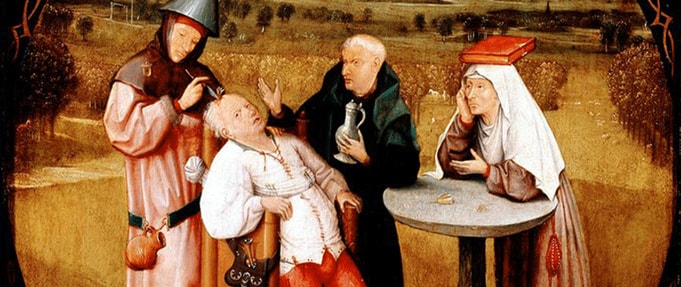
Although modern neurosurgery did not begin until the 19th century, as early as the Mesolithic and Neolithic periods, skeletons unearthed reveal a most unusual practice: holes, deliberately drilled and scraped, into the skull. As described in the MIT Press Reader, a 1865 finding was key to understanding ancient trepanation. When explorer and archaeologist Ephraim George Squier was in the ancient Inca city of Cuzco, his hostess, Señora Zentino, an art and antiquities collector in Peru, gifted him a skull from a nearby Inca burial ground.
Right away, Squier noticed something about the skull: there was a hole, roughly a half-inch square, cut out of it. His thought was that the damage was inflicted deliberately, and when he returned to Europe, he brought it to Paul Broca, the leading authority in that region on the human skull. Today, the French physician and anatomist is famous for identifying the localization of speech in the third frontal convolution, known as the “Broca’s area.”
Once Broca examined the skull, he confirmed that the hole in the skull was a result of trephination—and more than that, the person had lived for a while. But, when he presented his findings at the Anthropological Society of Paris, as before—Squier had brought the skull to the New York Academy of Medicine—the audience, racially prejudiced, did not believe an Indigenous person could carry out such a challenging procedure. Several years later, in central France, skulls in a Neolithic gravesite were found with many holes two or three inches wide, at last irrefutably confirming Broca’s theory.
Since Broca’s confirmation, thousands of trephined skills have been discovered around the world, in various cultures and countries. Dating from the Paleolithic era to this century, these discoveries are crucial not only for understanding how ancient peoples treated head injuries but also for contextualizing modern craniotomy, in which a section of the skull is removed to access the brain for procedures such as tumor removal. But of course, the main difference today is that the bone is placed back and secured once treatment is complete.
Archeologists have discovered that the reasons for performing trepanation span both medical and spiritual contexts. Research by Fernando Ramires Rozzi and Alain Froment confirms the medical purpose, noting that early ancestors may have practiced their techniques on animal skulls, with examples on boar and cow skulls. Additionally, the Hippocratic Corpus, a collection of ancient Greek medical texts associated with Hippocrates, points to therapeutic benefits, mental health management, and what we now know as seizures.
Bloodletting and Leeching
Leeches: Those pesky, bloodsucking aquatics that cling to your ankles after a dip in the lake were once a vital form of medicine—if you can believe it. Although most would squirm at the idea of a worm sucking their blood, leeches were a crucial means of a practice called bloodletting from the Egyptians 3000 years ago to the late 19th century.
According to Hippocrates, a Greek physician widely regarded as the “Father of Medicine,” the body was made of four humors—a “humor,” in ancient medicine, was a fluid or semifluid substance—blood, phlegm, black bile, and yellow bile. When these humors were balanced, the patient was healthy; when they were imbalanced, disease would take root.
Thus, by this logic, the way to cure a patient of illness was to remove the excess of whichever humor from the body. Often, the practice used was bloodletting—that is, removing blood from a patient to restore equilibrium to the body’s “humors.” And, the most common instrument used…you guessed it: leeches.
Today known as hirudo medicinalis, or the European medicinal leech, the worm can take in at each feeding almost 10 times its weight in blood. Leeches, believe it or not, are incredibly useful tools in medicine, shown to improve blood flow in areas with poor blood circulation. Additionally, their saliva contains anticoagulants that prevent clotting and can even dissolve blood clots. Since they release a natural antiseptic when they bite, this significantly reduces the host's risk of infection.
Leeches are still used in modern medicine, though not as widely or as a cure-all. Their scope is limited to microsurgery, and most notably, reconstructive or plastic surgery. In plastic surgery, when tissue is reattached, there is a risk of blood clots forming, and leeches can be used to relieve tension.
The first instance of microsurgery was completed in 1985, when a dog bit off the ear of a five-year-old boy in Boston. Plastic surgeon Joseph Uton attempted to reattach the ear, but it was beginning to turn black and die. So, remembering an article he had once read about leeches and their therapeutic impact on congested tissue, he contacted Biopharm, a company in Wales that bred and sold leeches. Shortly after he placed two on the boy’s severed ear, it recovered, and he was able to reattach it to the child.
However, leeching was not the only method of bloodletting, nor was it nearly the most dangerous. If you’re squeamish, this is your sign to skip to the next section! There was also venesection (cutting a vein), arteriotomy (opening an artery), and scarification (scarring skin). The specialized instruments employed included lancets and fleams—both types of blades—as well as cupping for local blood removal.
Bloodletting is said to have significantly contributed, if not been the cause, of President George Washington’s death in 1799. After staying out in stormy weather, Washington developed a fever, and his three physicians removed large quantities of blood and administered blistering and emetics. Although the ultimate reason for his death is still widely debated, Dr. Howard Markel, a physician and medical historian, puts it best: “The truth of the matter is that they did the best they could, against a pathologically implacable foe, using now antiquated and discredited theories of medical practice.”
Mercury
The history of using mercury—what we know today as a highly toxic element—as medicine dates back to the ancient Persians and Greeks, who considered it a healing ointment. In the second century, Chinese alchemists boasted of liquid mercury, known as “quick silver,” for its presumed ability to increase lifespan.
One of the most notable of such casualties was Qin Shi Huang, a Chinese emperor, whose physicians fed him mercury pills, said to be the key to immortality. Reportedly, he began experiencing delusions and shortly after died, but that would not prevent him from being buried with mercury pools. Still, his tomb has never been opened, for concerns of toxic contamination.
Have you ever heard the term “mad as a hatter?” Beyond being a key figure in Alice in Wonderland, Victorian age hatmakers would use mercurous nitrate, a form of mercury, in the felt they used to make hats. Therefore, after inhaling mercury vapors, hatmakers began to exhibit strange symptoms—rashes, muscle pain, mouth sores, and more—and, following long-term exposure, more severe neurological symptoms. Ranging from irritability to extreme cases of psychosis, it wasn’t until the 1950s, after centuries of hat-making, that researchers identified mercury exposure as the cause.
Although these people weren’t intentionally consuming mercury, as is the case in medical use, this example signals the end of administering the chemical for healing and offers a look into the symptoms that had come before. Indeed, for centuries prior, mercury was used to treat one of the most painful, feared diseases in history: syphilis.
In the 15th century, the virulent epidemic had terrible symptoms, including large sores, agonizing pustules, joint pain, and facial disfigurement. People were willing to do anything, including endure harsh, experimental treatments, to experience some kind of relief. The Swiss physician Paracelus was advocating the use of mercury as a treatment as early as 1530. It had been used to treat other diseases, including leprosy, and could be applied directly to the skin as an ointment, consumed as pills, or drunk and injected as a solution.
The reaction of patients to mercury led physicians to believe they were experiencing a kind of purging, such as profuse sweating. Although some historians believe it may have stopped syphilis in the first stage, and even reduced the effects of the third, and final deadly stage, likely any perceived healing was to do with the dormant phases of the disease.
Given that mercury is highly toxic—with side effects from organ failure to tooth loss—it’s more likely the chemical contributed to, rather than cured the disease. That said, although numerous patients died as a result of administering mercy, the treatment would remain popular from the 16th century on, even into the early decades of the 20th century.
Corpse Medicine
Corpse medicine, or medical cannibalism, is exactly as terrible as it sounds: People, predominantly in Europe from the 16th to 18th centuries, would consume human remains, most of which were Egyptian mummies, to treat various ailments. It became common practice for wealthy members of society to host mummy-unwrapping parties in their homes—said to be for both entertainment and scientific purposes—with some pieces of the remains occasionally given to guests or consumed as medicine (known as mumia).
The practice of consuming ancient Egyptian mummies, and later, embalmed corpses of any kind, first began in the 11th century. But, as historian Karl Dannenfeldt writes, it was really a mistake. When Western Europeans first encountered Islamic texts, a mistranslation ultimately led people to understand the word “mumia” as a substance from preserved corpses in Egyptian tombs. Really, mumia refers to a substance found on a single Persian mountainside in black-rock asphalt, said to possess healing powers.
However, the notion that the human body had healing powers and could thus heal other human ailments was not new. Before the Victorians, the Romans would consume the blood of dead gladiators, believing that it would cure epilepsy. In medieval Western Europe, King Charles II is said to have consumed a drink called “King’s Drops,” which was a mixture of crushed human skulls and alcohol.
British men in the Victorian era would return home from archaeological expeditions or colonial conquests, with human mummies they’d stolen from Egyptian tombs. Although there was skepticism about mumia, the fascination with mummies only continued to grow, and “Everything,” as poet Robert Southey lamented, “must now be Egyptian.” The mass production of goods in Victorian England largely contributed to the obsession, permeating everything from architecture to popular culture.
As Richard Sugg, author of Mummies, Cannibals and Vampires, said to the Smithsonian magazine, “The question was not, ‘Should you eat human flesh?’ but, ‘What sort of flesh should you eat?’” The treatment was thought to have magical properties, and that by consuming a mummy, one would also be ingesting their spirit, offering healing properties. Often, the ailment corresponded to the cure—skull for migraines, human fat for muscle aches, and so forth.
Towards the end of the 19th century, the practice of mumia finally came to a close. It’s impossible to know how many mummies were stolen from their sacred tombs and consumed in such a brutal manner—in which once living, breathing human beings were reduced to mere biological matter. Today, although archaeology is more professional, some of the first stolen Egyptian antiquities are still on display in the British Museum—even though they were never supposed to see the light of day.
Featured image: Wikimedia Commons


