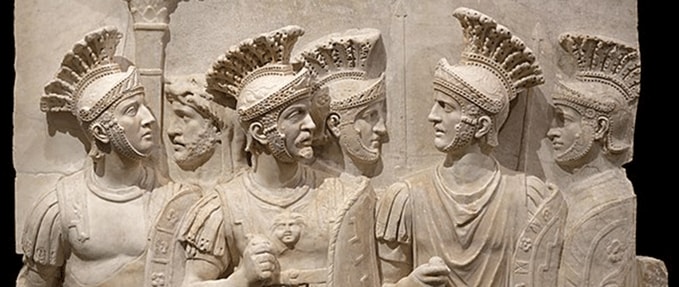

Think U.S. Secret Service, special forces, and intelligence agencies, all rolled into one: That’s the role the Praetorian Guard played in the Roman Empire. Tasked with protecting the emperor and his family, they also wielded significant behind-the-scenes influence. Known to engage in espionage, arrests, and even killings, the guard often acted in the emperor’s best interest—by any means necessary. But that’s not to say they were always loyal.
In fact, they played a role in the assassinations of several emperors—including Caligula in 41, Commodus in 192, Caracalla in 217, Elagabalus in 222, and Pupienus and Balbinus in 238—thus engineering much of the instability that characterized the Imperial Roman Empire. From their origins in the late Roman Republic to their roughly 300-year dominance, the Praetorian Guard proved not only their power, but that it could be bought and sold.
Early Origins
Although a fixture of the imperial empire, which began with Augustus as the first emperor, their origins date back to when Rome was still a republic. Beginning as early as the second century BCE, special units were selected to protect military commanders or praetors—such as Scipio Africanus and Lucius Cornelius Sulla—when they headed out into battle.
It’s unclear how large these units were, but according to records, the earliest mention of the praetorians dates to the siege of Numantia in 133 BCE, when General Scipio Aemilianus commanded about 500 men. Larger than usual, as noted by contemporaries, the group effectively served as bodyguards and became known as cohors praetoria, or Praetorian cohort.
Throughout the remainder of the Republic years, they didn’t see much action—but all that would change with the birth of a new era.
The First Established Order
In 44 BCE, Julius Caesar led a civil war that not only brought about the fall of the Republic but also his eventual assassination. His former allies, Octavian and Marc Anthony, joined forces to avenge his death, each possessing large Praetorian cohorts in the thousands. Once they triumphed over his assassins, the Second Triumvirate, an alliance between the two men and Lepidus, was formed to rule Rome.
However, they didn’t get along, and ultimately Octavian, who changed his name to Augustus, would emerge victorious in 27 BCE as the first emperor of the newly formed Roman Empire. Having learned from Caesar the advantage of having a group of men to protect and serve, Augustus formed the first official Praetorian Guard. Although the number of men in the cohort fluctuated over their 300-year reign, during Augustus’ reign, it’s estimated there were 4,500 soldiers; at its peak, the guard had 15,000 soldiers.
Mainly, the Praetorians were Italian, though some records point to recruits from Germany, Thrace, and Pannonia. All of the bodyguards were already veteran soldiers, but an additional criterion under Augustus’ rule, which was carried forth, was that they must be from good families. Service lasted 12 years but was extended to 16 by Augustus, and it seems that most soldiers were in no hurry to leave. Despite popular belief, the Praetorians didn’t just follow the emperor around; they also engaged in other duties, including espionage, arrests, and even serving as emergency firemen.
There is evidence that, beyond just handling the crowds at the Roman games, they participated. The soldiers were involved in wild-beast hunts, demonstrating their courage, as well as in a rare spectacle called the “naumachia,” or staged sea battle, hosted by Emperor Claudius in BCE 52. Around 19,000 men and 100 boats were taken out on Lake Fucine to participate in a mock naval battle. Most of the participants were prisoners, already condemned to execution, and the Praetorians added to the chaos with catapults and ballistae.
The Tables Turn
When Augustus formed the Praetorian Guard, he appointed two people to manage the cohort. One of those men was Sejanus, who proved himself to be very dishonorable. Following Augustus to the throne was his stepson, Tiberius, and although a successful leader in both administration and battle, he didn’t possess his predecessor's authority. Thus, Tiberius gave his responsibilities to the praetorian prefect, Sejanus, retiring to the island of Capri following the deaths of his son and nephew.
Most people accepted Sejanus as ruler, and he began using his power to take down any Romans he viewed as threats. He also enacted numerous reforms to benefit the Praetorians, including the construction of the massive, fortified military camp, Castra Praetoria. Although Augustus had made a point of stationing ranks across the city, Sejanus consolidated the soldiers into a single station, which would play a key role in bolstering their influence in the coming years.
Sejanus, after spending several years ruling in relative obscurity, was eventually discovered by the historian Tiberius and executed. Although many prefects would come and go, none would manage to seize the amount of influence Sejanus did. In addition, he showed the Praetorian Guard what they were capable of doing—with or without the command of an emperor.
Making an Emperor
Officially, the next ruler to take the throne was Caligula: a man whose name precedes him. You’d be hard-pressed to find someone in the Roman Empire who did not want him dead—but it was two Praetorians, Cassius Chaera and Cornelius Sabinus, who wielded the knife. Once Caligula was dead, there was discontent over who should seize power next.
Chaera had joined forces with the Senate, who wanted to return power from a centralized emperor back to the popular assemblies—but members of the Guard were worried this would take away their power. Eventually, they decided to look within the royal family and appoint a new emperor. Choices were slim, as Caligula had killed almost all of them, but they settled on his uncle Claudius, a man who posed little threat, and ended up doing a fair job.
However, the stability would be short-lived, as another prolifically terrible emperor took the throne: Nero. Although the Guard initially worked with him, he would soon find himself with no allies, taking his life, and with it, the end of the Julio-Claudian dynasty. What followed was the Year of the Four Emperors, which spelled crisis after crisis for the Praetorian Guard.
The third ruler that year, 69 CE, after Galba and Otho, was Vitellius. Recognizing the power of the cohort, he disbanded the guard and instead formed an army of his own, trusted soldiers. But what Vitellius didn’t anticipate was that he had bolstered another army, all united under a shared belief: their hate for him. Joining up with the final emperor, who would seize the throne that year, Vespasian, the Second Battle of Bedaricum ensued—and the Praetorians emerged triumphant.
A Final Changing of the Guard
Under Vespasian and the beginning of the Flavian Dynasty, the empire achieved a period of peace for roughly 100 years. He knew what could happen if the Praetorian Guard’s power went unchecked, and thus, reduced the size to nine cohorts, and recruited soldiers across armies—including those of Otho and Vitellius. He also appointed Titus, the future emperor, as the praetorian prefect.
For the most part, they performed regular soldier duties until the rise of Commodus in 180 CE. Again, the Praetorian Guard was able to centralize their power and kill the praetorian prefect Laetus, who orchestrated Commodus’ assassination, as well as the new emperor Pertinax’s accession. After only three months, the cohort killed Pertinax and decided to sell off the Roman Empire. But the winner, Didius Julianus, would only serve for two months before being killed himself.
With the coming of the Severan Dynasty, there came more bloodshed. After Septimus Severus, who made attempts to disband the guard, his son and the following emperor, Caracalla, was murdered by his prefect, Macrinus. Ruling for one year, Macrinus was killed, and succeeded by Elagabus, who was shortly after killed in a bloody display in the streets. Not a good time to be in Rome. During the Year of the Six Emperors, almost 15 years later, the Praetorian Guard would kill two co-emperors, Balibunus and Pupienus, and what ensued was a period of absolute chaos throughout the empire.
After 300 years, the various power plays and strategies the Praetorian Guard enacted would catch up to them in the form of Constantine the Great. He was involved in a civil war with two other emperors, Maxentius and Licinius; the former had the support of the cohort. But again, they supported the wrong emperor, resulting in a confrontation by Constantine at the Battle of Milvian Bridge in 312.
Along the Tiber River, Maxentius was killed, and the Praetorian Guard was defeated—for once and for all. Constantine, above all, knew they could not be trusted, and thus separated the cohort across the empire and destroyed their barracks, the Castra Praetoria. Without a central place to meet and regroup, the Praetorians were stripped of their political leverage and absorbed into normal, civilian life.
Learn More About the Praetorian Guard
Praetorian

Featured image: Wikimedia Commons


