(1).png?w=3840 "The Monroe Doctrine: Empire and Nation in Nineteenth-Century America")
The Monroe Doctrine, first announced in a message by the United States’ fifth president, James Monroe, was delivered to Congress on December 2, 1823.
The Doctrine stated the United States’ ongoing position within the shifting power dynamics of the Western Hemisphere by signaling that the U.S. would operate independently of European political control and influence, becoming an early cornerstone of U.S. foreign policy.
The doctrine was also a warning, signifying that European powers should not interfere with the newly independent states of Spanish America and the United States. A catalyst of the Monroe Doctrine was the War of 1812 between Great Britain and the United States, which lasted two years. Both countries would eventually withdraw, bringing the war to an end and preventing further territorial destruction.
The effects of the war created a turning point in America’s foothold amid changing territorial control. It influenced Monroe’s decision to strengthen U.S. military and economic forces, so they could effectively defend the nation against potential threats, establishing its independence and national sovereignty.
The Doctrine was America’s way of asserting that there could be no further colonization by European powers and that any such colonization would be considered a hostile act. It’s also important to note what the Doctrine didn’t state: a plan for American military action or intervention if the European powers ignored the message. Even though the United States was a newly independent nation, the Doctrine ambiguously suggested the country's ambition to grow into a global empire.
The Doctrine became a nationalistic instrument, often enforced for various political purposes and to support elections within the American states. It was not used solely to solidify independence from Great Britain and European powers, but to emphasize the United States’ emergence as a powerful, independent nation.
Author Jay Sexton's The Monroe Doctrine: Empire and Nation in Nineteenth-Century America details the document's history in rich and compelling detail. Sexton is a professor of history and director of the Kinder Institute on Constitutional Democracy at the University of Missouri, where he also holds the Rich and Nancy Kinder Chair of Constitutional Democracy. He has published extensively on the Monroe Doctrine.
Read on for an excerpt from Sexton's The Monroe Doctrine.
____________________

____________________
The Monroe Doctrine
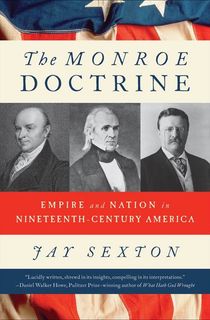
Excerpt From The Monroe Doctrine by Jay Sexton
Early Americans were not bashful about proclaiming their ambitions for their fledgling republic. George Washington spoke of “our rising empire”; Thomas Jefferson boasted of the expanding American “empire of liberty”; and Tom Paine predicted that American principles “will penetrate where an army of soldiers cannot; it will succeed where diplomatic management would fail … it will march on the horizon of the world and it will conquer.” In the twentieth century, American power would transform global politics, though perhaps not in the ways foreseen a century and more before. The global preeminence of the United States in our own time has given early American statesmen an aura of clairvoyance for predicting what one historian has called the “rising American empire.” Yet there was nothing preordained about the global rise of the United States. Though Americans predicted future greatness for themselves, they also were consumed with their vulnerabilities in an era in which their young and untested union faced challenges from within and without.
The empire that was most dramatically rising in the nineteenth century was not the American but the British. Despite having lost her most important North American colonies in the 1783 Treaty of Paris that ended the American Revolution, the height of the British Empire lay in the future. The British Empire was larger and more powerful in 1820 than it had been in 1776. During the intervening decades, it tightened its grip on India; its resources and people poured into its settler colonies in Canada and Australasia; it acquired strategic way stations such as the African cape and Singapore; it increased its commercial and naval presence in distant markets in East Asia and in Latin America; its naval power became unrivaled; industrialization at home fueled economic growth and the expansion of overseas commerce; it developed a sophisticated and flexible financial system capable of both underwriting international trade and funding wars of unprecedented cost; and its political system weathered the ideological storm unleashed by the American and French revolutions. Even within North America, the British retained a position of great strength, holding Canada and the strategically important Caribbean islands of the British West Indies and maintaining relations with Native American tribes.
Following the defeat of Napoleon’s France after nearly a quarter of a century of conflict (1793–1815), Britain stood atop the global hierarchy, a position of preeminence that it would consolidate as the nineteenth century progressed. By the early twentieth century, the British governed two-thirds of the world’s colonial territories and three-quarters of its colonial population. To be sure, Britain’s position of strength brought with it great anxiety stemming from the need to secure its many interests scattered around the globe, particularly as rivals emerged later in the century. This anxiety could serve as the rationale for retrenchment (as would be the case in North America) or could fuel further expansion (as would occur in Africa in the late nineteenth century).
The nineteenth-century British Empire was a multifaceted and dynamic entity. It “included formal colonial possessions such as India and, in the late nineteenth century, large portions of Africa, governed through governmental structures originating in London. Settler colonies in Canada and Australasia functioned as a virtual “British West,” as the historian James Belich has recently put it, attracting capital and migrants from the home country much like the American West of the same period. The inhabitants of the settler colonies enjoyed increased self-government during the nineteenth century, though they increasingly viewed themselves as members of a “Greater Britain.” In Latin America and East Asia, the British largely refrained from formal colonial rule, instead pursuing their interests through the informal projection of commercial and cultural power. Central to the British Empire in both its formal and informal manifestations were so-called collaborating elites, the native peoples whose self-interest led them to associate with the British. Recent historians have emphasized the interconnectivity and dynamism of the British Empire, arguing that its power rested on the fusion of its component parts. The integration of formal colonial possessions, settler colonies, and a global commercial empire constituted an expansive and adaptable “British world-system,” as it has recently been called. The decentralization of the British Empire contributed to its power and, as the nineteenth century progressed, paradoxically fueled its integration. Far from being the product of simple military might, the nineteenth-century British Empire rested upon the interconnected foundations of commercial and financial power, naval supremacy, communication networks, technological innovation, and political cooperation with indigenous elites.
The expanding British Empire cast a long shadow over nineteenth-century America. The young United States remained entrapped in the webs of the British world-system long after achieving its political independence during the Revolution. “In the year of grace 1776, we published to the world our Declaration of Independence. Six years later, England assented to the separation,” wrote the American nationalist Henry Cabot Lodge in 1883. “These are tolerably familiar facts,” Lodge continued. “That we have been striving ever since to make that independence real and complete, and that the work is not yet entirely finished, are not perhaps, equally obvious truisms.” The persistence of “colonialism in the United States,” as Lodge called it, threatened to keep the United States in a position of subordination to its former colonial master.
The forms of British power in nineteenth-century America were as pervasive as they were enduring. When American statesmen consulted world maps, they found ever more territories colored red (the traditional color of British possessions); the national ledger books showed increasing indebtedness to British banks; English novels took up most of the space on American bookshelves; schoolchildren in the United States continued to be taught with British textbooks deep into the nineteenth century; popular songs—even Francis Scott Key’s “Star-Spangled Banner,” which later would become the national anthem—were set to old British tunes. It would not be until 1828 that Noah Webster formalized the spellings of “American English,” and even then his dictionary served as much as a reminder of the links as of the differences between the two peoples. Nineteenth-century Americans were consumed by the question of how best to consolidate their independence from the British. The ongoing struggle to free themselves from the yoke of British imperialism united the disparate sections and peoples of the United States. It also created political divisions that endangered the union itself. British power was an inescapable reality that paradoxically threatened and benefited the young American republic.
Nowhere did British power exert itself more in the United States than in the material world of economics. If anything, independence brought with it a closer economic relationship than had existed before 1776. British merchants and “financiers quickly recovered their leading position in the American economy, elbowing aside their opportunistic Dutch and French rivals who had sought to replace them during the Revolution. For most of the nineteenth century, Britain would be the United States’ greatest source of foreign investment, its largest source of imports, and its most important foreign market. To be sure, this economic connection was symbiotic; just as Britain was central to the American economy, the United States was important to the British. But there is little doubt that the United States was the subordinate partner in the relationship. The young republic was a classic “developing economy” with vast resources at its disposal but lacking the means of exploiting them. The majority of American exports to Britain were raw materials and agricultural goods (especially, as the nineteenth century progressed, cotton), whereas most of Britain’s exports to the United States were finished goods. Moreover, as Americans would discover in the run-up to the War of 1812, Britain’s diplomatic and naval might could be turned against their republic, closing off the international connections upon which their economy relied.
In the eyes of many Americans, this unequal economic arrangement threatened the very independence of the United States. As the Kentucky statesman Henry Clay put it in 1820, the United States was in danger of remaining a “sort of independent colonies of England—politically free, commercially slaves.” The frequent financial panics that originated in London rippled through the American economy; banks in London had a habit of recalling loans when credit was tight in the United States; British manufacturers, exploiting the cheap labor at their disposal, undercut upstart American rivals; reliance on British capital necessitated unpopular compromises in foreign policy to reassure foreign bondholders. The American economy, in short, drifted in winds that originated across the Atlantic. As the Virginian John Taylor put it, “The English who could not conquer us, may buy us.”
Yet for all the potential dangers of economic dependence upon Britain, the United States greatly benefited from this relationship. The British market provided the chief outlet for America’s farmers and cotton planters. If the period of international instability in the early nineteenth century demonstrated the dangers of reliance upon the British market, the ensuing century of Pax Britannica and unilateral British tariff reductions revealed the advantage. Even as the British lowered their tariffs, the United States remained free to protect its industries, an option it would take full advantage of later in the nineteenth century. British capital played an important role in the dramatic economic takeoff of the United States in the nineteenth century. Investment channeled to the United States by London banks, such as the powerful Baring Brothers firm, kept down interest rates in the capital-starved republic. British investment underwrote important aspects of the “transportation revolution” of canals and railroads, as well as financing the debts of municipalities, state governments, and the federal government itself. By the mid-nineteenth century, nearly half of the United States’ national debt was held abroad, chiefly in Britain. Funds provided to the federal government by Baring Brothers also underwrote American territorial expansion. Both the 1803 Louisiana Purchase (which acquired extensive territory in the interior of North America from France) and the Mexican indemnity payment of 1848 (which compensated Mexico for lands conquered by the United States) were made possible by loans from the English bank.
These benefits notwithstanding, how to break the cycle of economic subordination to the British was a principal issue in early American politics. Though Americans in the early republic agreed that the status quo was undesirable, they disagreed over the means that would best establish their economic independence. From this debate emerged the political coalitions of the first party system of Republicans and Federalists. Led by Thomas Jefferson, Republicans sought to construct a liberal international order cleared of preferential trading systems. This commercial vision, which aimed to entrench republicanism at home and advance the interests of agricultural exporters, challenged the structures of the British Empire. When Britain would not acquiesce to American demands for open trade and the respect of neutral rights, Jeffersonian Republicans advocated economic retaliation (either in the form of tariffs, which Jefferson advocated as a temporary measure at various points in the 1790s, or, as in 1807–1809, in the form of an all-out embargo). In opposition were the Federalists, led by Alexander Hamilton, who viewed Britain as an indispensable economic partner as well as a model to emulate. The Hamiltonian program called for the consolidation of the union’s finances through the creation of a national bank and the federal assumption of state debts. The Federalists were prepared to make diplomatic compromises with their former colonial master to achieve their objectives, thus further widening the partisan divide at home. Most notable was the 1795 Jay Treaty, which averted war with Britain in the short term by addressing several leftover issues from the Revolutionary period, but outraged Republicans for aligning the United States with its old nemesis and for its failure to protect neutral rights on the high seas. If Republicans and Federalists disagreed on the means of establishing their independence, they were of one voice in identifying Britain as their greatest economic rival in the long term. For all their differences, both parties agreed on the fundamental objective of establishing American economic independence.


