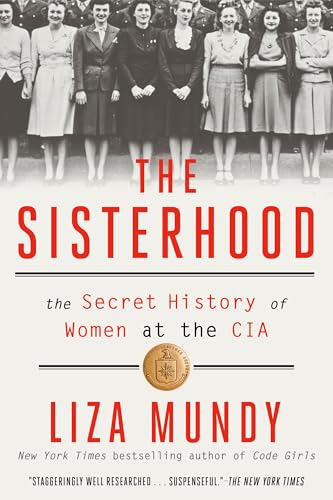
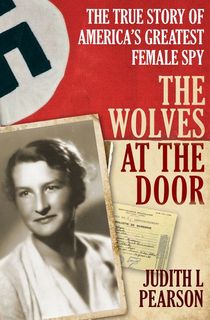
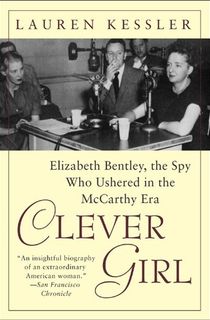
While the high-stakes pressure of intelligence work is often personified by characters like Homeland’s Carrie Mathison, the real history of women in the CIA is defined by a decades-long record of foundational service. Frequently overlooked, their presence at Langley was never incidental. Since the Agency’s inception, female officers have navigated a dual challenge: managing global security threats while dismantling an internal culture that often questioned their aptitude for clandestine work. From the strategic sabotage of the 1940s to the analytical breakthroughs of the War on Terror, the trajectory of women in American intelligence is a study in persistence against systemic resistance.
1940s: The OSS and the "Glorious Amateurs"
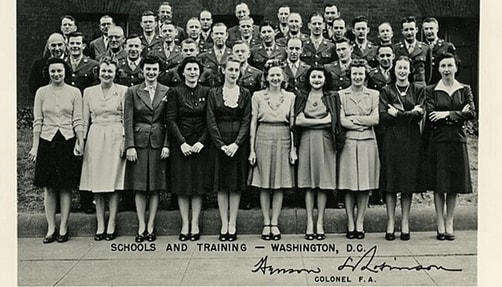

OSS Schools and Training Headquarters Staff, 1945 XMAS Card
Photo Credit: Wikimedia CommonsThe blueprint for the American female spy was drafted during World War II within the Office of Strategic Services (OSS), the predecessor of the CIA. According to the CIA’s own historical archives, General William Donovan recruited over 4,000 women—nearly a third of the organization—to serve in every theater of the war.
These women, later dubbed the "Glorious Amateurs," handled everything from decoding Axis secrets to conducting field sabotage. In her biography The Wolves at the Door, Judith L. Pearson details the exploits of Virginia Hall, an operative who organized the French Resistance despite having a prosthetic leg. Hall proved that women were uniquely suited for clandestine work because they were often overlooked by enemy counterintelligence. When the CIA was established in 1947, it inherited this veteran female workforce.
1950s–1960s: The Cold War and the "Boys' Club"
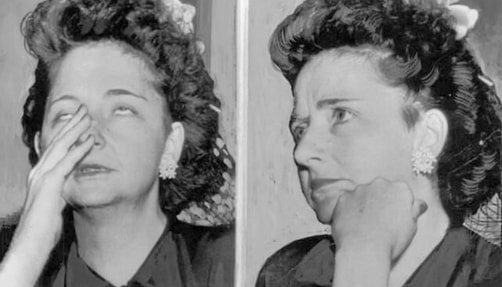
Elizabeth Bentley, NKVD spymaster
Photo Credit: Wikimedia CommonsAs the CIA became a permanent bureaucracy, the meritocracy of the war years shifted toward a rigid "boys' club." While pioneers like Adelaide Hawkins and Eloise Page (the subject of the CIA profile "The Iron Butterfly") were instrumental in building the Agency’s technical and administrative frameworks, they operated within a culture that viewed espionage as a masculine pursuit.
During the 1960s, despite the rise of the Women’s Liberation Movement, female agents faced a "pink-collar" ceiling. In her book Clever Girl, Lauren Kessler explores how even highly successful female spies were often dismissed as "neurotics" or "idealists" by the establishment. Regardless of their linguistic skills or field experience, many were steered toward clerical work, battling the myth that they were "too emotional" for the cold, calculated risks of the Cold War.
1970s–1980s: Tactical Advantages and Systemic Pushback
The 1970s marked a pragmatic shift. In a speech at the California Institute of Technology, Director Stansfield Turner acknowledged that while certain regions remained culturally difficult for female officers, they possessed distinct tactical advantages. Turner famously argued that "in many instances a lady might be even preferable to a man" for clandestine work because they were less likely to draw suspicion.
However, internal friction remained high. In The Sisterhood, Liza Mundy describes a "litany of indignities" routinely inflicted on women working in the CIA. Mundy recounts a 1980s meeting where the head of the clandestine service, Dick Stolz, asked a room of female officers to raise their hands if they had ever been sexually harassed. As Mundy records, "Every hand went up." Despite this environment, women became the backbone of the Agency’s analytical side, proving their value through superior tradecraft.
1990s: Breaking the Institutional Seal
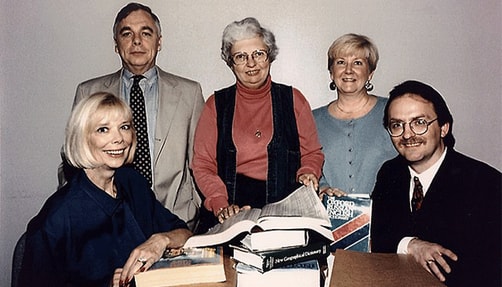
The Central Intelligence Agency team that discovered Soviet mole Aldrich Ames.
Photo Credit: Wikimedia CommonsBy the 1990s, the disparity between women’s contributions and their rank became impossible to ignore. A 1992 "Glass Ceiling Study" confirmed that while women made up 40% of the CIA's professional workforce, they held just 10% of senior leadership roles.
The decade was eventually defined by officers like Jeanne Vertefeuille, who demonstrated the power of the "Sisterhood's" analytical rigor. As noted in The Sisterhood, Vertefeuille led the small team that unmasked Aldrich Ames, one of the most damaging Russian moles in CIA history. Her success shifted the internal narrative, proving that the Agency’s most effective weapon was often its female analytical corps.
2000s–Present: The Vanguard of Counterterrorism
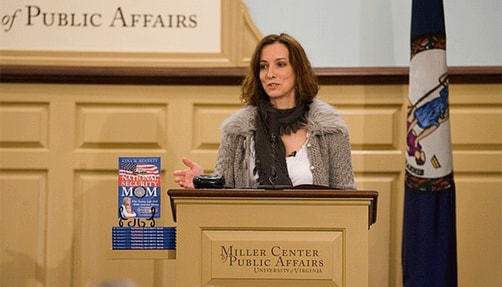
Gina Bennett speaks at the Miller Center Forum, March 14, 2011.
Photo Credit: Wikimedia CommonsIn the wake of 9/11, women moved to the center of national security. A dedicated group of analysts—including Cindy Storer, Gina Bennett, and Barbara Sude—became the world’s leading experts on Al-Qaeda. Their work, along with memoirs like Nada Prouty's Uncompromised, highlights the personal and professional sacrifices of women in the modern intelligence age.
This evolution culminated in 2018 with the appointment of Gina Haspel as Director. While her tenure was marked by controversy, her rise reflected a broader shift in the Agency's history. From a marginalized wartime workforce to the analytical and strategic core of American intelligence, these women demonstrated a persistent commitment that transformed the CIA from the inside out.
Sources & Further Reading
CIA Archive. "The 'Glorious Amateurs' of OSS: A Sisterhood of Spies."
Central Intelligence Agency. "Glass Ceiling Study," January 1992.
Stansfield Turner. "Q&A Session at the California Institute of Technology," CIA Reading Room, October 1978.
Los Angeles Times. "CIA Director Says 'The Opportunities are There' for Women," CIA Reading Room Archive.
Wikipedia. “Aldrich Ames: The Soviet Mole.”