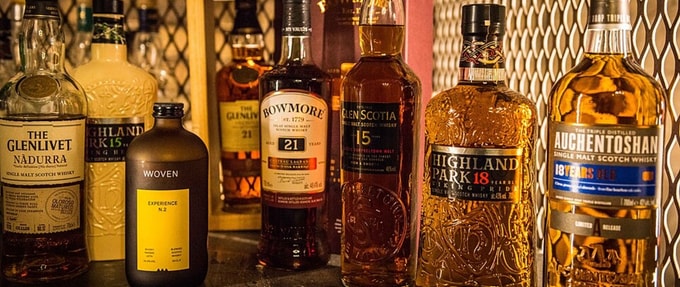
The label on your favorite Scotch whisky likely says it was founded in the 1820s or shortly thereafter, but that label is almost definitely inaccurate. That date is probably the year when the production of your whisky became legal. And there’s a good chance that year was 1823. Most probably, your favorite Scotch whisky distillery is decades or hundreds of years older than that.
Let me back up. There’s more to this story than organized crime and smuggling.
Let me begin with the “portly Hanoverian” British King George IV. After his official accession to the throne—after serving as Prince Regent for almost a decade—in 1820, his entourage endeavored to make King George IV as visible as possible, so they arranged a visit to all the countries in his kingdom which included Wales, Hanover, and, at that time, Ireland, as well as Scotland. This visit was known as the King’s Jaunt.
173 years had passed since a British monarch had been in Scotland, and that was King Charles II… Suffice it to say that, after that disaster, Scotland was due for a visit.
The part of the King’s Jaunt during which he visited Scotland has since been caricatured as “One and twenty Daft Days.” The royal visit to Scotland was, as the Royal Collection Trust says, “stage managed” by Sir Walter Scott. You may recognize the name Sir Walter Scott from his many publications on Scottish history or his novels like Rob Roy, Ivanhoe, and the Waverley series. The extremely well-attended events during the Jaunt included a Highland ball and a theatrical production of Rob Roy.
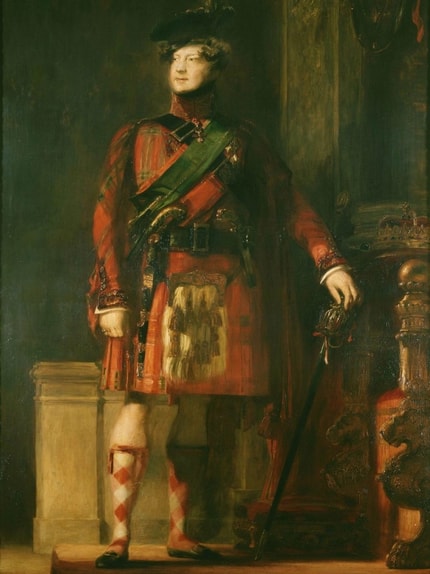

King George IV in a kilt during his visit to Scotland
Photo Credit: Wikimedia CommonsThe subject of this play is an interesting foreshadowing to later events during the King’s Jaunt, as Rob Roy MacGregor was a 17th century outlaw infamous for both cattle raiding and multiple Jacobite uprisings—that is, rebellions that supported the House of Stuart being restored to British thrones. Rob Roy and the Gregors were so disdained that for 150 years, just claiming the last name MacGregor was punishable by death. King George IV belonged to the House of Hanover, that line who was actually on the throne. By the time King George IV saw this play, though, Rob Roy MacGregor was restored to folk hero status.
Sir Walter Scott was also an historian, and he’s credited with rediscovering Scotland’s own crown jewels, the Honours of Scotland. In the best attended event of his visit, King George IV escorted the Honours of Scotland along the Royal Mile from Holyrood to the Castle, which was also coordinated by Sir Walter Scott.
As an historian and author, Sir Walter Scott also held the position as chairman of the Celtic Society, which was especially important in preserving Highland Dress. (Read, here, “preserving” as instead “reviving,” since after the 1745 Jacobite Rebellion, the Disclothing Act had made it illegal to wear “the Highland Dress.”) That ban did not kill the kilt, of course. It rather made it a symbol of rebellion. (By the way, the fact that this great celebration of Highland culture happened during the Highland Clearances is peak irony.)
Even after the Use of Highland Dress Act essentially repealed the ban in 1782, the kilt was no longer a staple of the Scottish dress, though. Sir Walter Scott, however, persuaded King George IV to order a full Highland Dress from George Hunter & Co., which he wore to his reception at Holyrood House. Oral histories claim that this visit is why the kilt is so recognized as a Scottish symbol to this day, and additionally, the fact that King George IV did not travel with his queen is the reason why there is no equivalently symbolic dress for women.
Let me remind you, reader, that King George IV was “portly,” the folklore says he had varicose veins, he wore sheer pink silk stockings for warmth with his kilt, which was ultimately too short. One society wit, Lady Hamilton-Dalrymple is noted for joking, “Since he is to be amongst us for so short a time, the more we see of him the better!” The English yellow press made fun of the king, but it appears that the Highland Lords were flattered.
In fact, Sir Walter Scott barred any gentleman to appear at the King’s Highland Ball in anything but “the ancient Highland costume and it took 300 unemployed tailors to kit them out.” He even rushed out an anonymous guide on the expected etiquette, which sold out, and Scott also personally wrote to every Highland chief to summon them to Edinburgh.
At the time of the royal visit, 106 distilleries operated legally in Scotland, but they were mostly in the Lowlands, and King George IV didn’t care for their products. For his reception, he asked for the Real Thing, the Glenlivet.
In 1822, the term “the real Glenlivet” meant the illicit whisky from the farms around the River Livat; some scholars say “the real Glenlivet” actually referenced all Speyside whiskies.
Scotch drinkers, you know there are five (or six, if you count the Islands as separate from the Highlands) Scotch whisky regions. The most popular are the ones from northern regions, namely because they’re flavored with peat, though the spectrum varies. But the most famous Scotch whiskies are from Speyside, and they’re arguably the most popular, even today.
Myself, I like the salty, heavy-peated Islay profile. Actually, one of my favorite distilleries, Old Pulteney, sells its whisky in a bottle shaped like an illegal still, the kind that is easy to disassemble and hide in pieces when you see the excise ship coming.
According to the article at Whisky and Women, the illegal product was slow in arriving to Edinburgh because none of his Scottish hosts wanted to admit that the crime of illegal distillation (there were no fewer than 200 secretly operating distilleries) was happening on their land. In 1798, a tax reform had shuttered almost all (legal) Highland distilleries because the tax essentially cost all their profit.
A small passage in the memoirs of Lady Elizabeth Grant of Rothiemurchus, the daughter of a Scottish member of Parliament, chronicles how it shook out.
Long story less long, Lady Elizabeth’s father had just filed for bankruptcy, and, as such, he had little chance of a political career. Elizabeth was his cellarer, and he knew that his daughter kept good Speyside whisky for their own consumption. He wrote to her, and she “sent her tax-free Highland whiskey heavy-heartedly to Edinburgh in August 1822.”
King George IV was delighted with the whisky, even though, today, we associate “the real Glenlivet” with the brand The Glenlivet, even though they did not earn that title officially until the 1884. Now, it is the “only distillery in the region allowed to use this trademark,” but when King George IV visited in 1823, the glass he drank could have come from any distillery in the region.
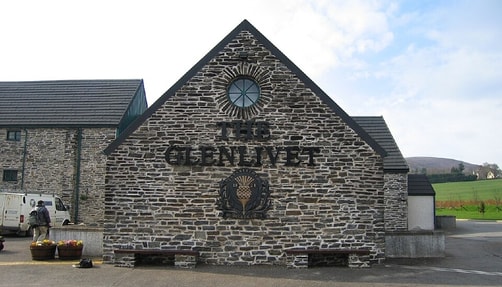
The Glenlivet distillery in Scotland
Photo Credit: Wikimedia CommonsNonetheless, it cannot be a coincidence that just one year later, parliament passed the Excise Act that effectively made the production of Scotch whisky profitable. That meant illegal distilleries could go legitimate and still earn money. Despite King George IV being an overall fairly unpopular king by some accounts, to this day, there remains a plaque in the Port of Leith that reads, “Geo IV Rex / O Felicem Diem,” meaning “Oh, happy day!”
The Glenlivet as we know it was among the first to be “founded” in 1824. Other distilleries waited a while, sensing a trap, and continued to operate illicitly. Among those who were officially licensed in that decade are famous household names like Macallan, Johnnie Walker, Laphroaig, Glendronach, my Old Pulteney, and Lagavulin. In the following decade, Talisker, Dalmore, and Annandale were officially founded, and those are just a few of the many.
So, next time you sit down with your Glencairn glass, check the year on that bottle. Chances are, your distillery is a good bit older than what that label says.


