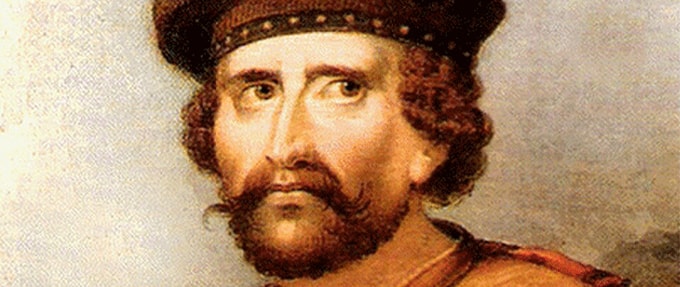

Called the “Scottish Robin Hood,” Rob Roy MacGregor is the kind of larger-than-life hero of which movies (there have been many) and novels (there have been many more) are made.
But what many fail to consider, is that he was a real person who lived in the Scottish Highlands in the late 17th and early 18th century, fighting in historic battles, stealing cattle, and becoming a legend in his own lifetime.
What was the real Rob Roy like, and how does he differ from the tall tales that surround him?
A Drink and a Legend
In 1894, a bartender at New York’s Waldorf Astoria combined Scotch whiskey, bitters, and vermouth to create a new drink called the Rob Roy, named for the premiere of an operetta about the Scottish folk hero at the nearby Harold Square Theatre. At least, that’s according to a history of the drink, which suggests that the popular cocktail has held on ever since, partly because “they’re simple to make.”
But not everyone gets a cocktail named after them, and to find out why Rob Roy earned such an honor, one must first look to the operetta. Written by composer Reginald De Koven and lyricist Harry B. Smith, the show was far from the first time that Rob Roy’s exploits had been transposed to story and song.
In fact, the first novel fictionalizing Rob Roy’s adventures was published during his lifetime. The Highland Rogue was released anonymously in 1723, probably as part of an attempt to help him win a pardon for his various crimes, as MacGregor was, at that time, sitting in a prison cell awaiting exile to Barbados. While the novel has since been attributed to the prolific English writer Daniel Defoe (author of Robinson Crusoe, among others), it was signed only with the initials “E.B.,” and its provenance remains disputed.
The book that truly secured MacGregor’s place in the literary canon was Sir Walter Scott’s 1817 novel, simply titled Rob Roy. It is from the events of this novel that many of the subsequent adaptations of MacGregor’s life are drawn. Scott’s novel inspired the operetta, which inspired the drink, not to mention numerous films: a silent adaptation in 1922, Walt Disney’s Rob Roy: The Highland Rogue in 1953, and the 1995 version starring Liam Neeson as the titular character, among others.
Two Rob Roys
“There are two Rob Roys,” writes David Stevenson in his 2004 book, The Hunt for Rob Roy: The Man and the Myths. “One lived and breathed. The other is a good story, a lively tale set in the past.”
The real Robert MacGregor was born at Glengyle in 1671, in what was then the Kingdom of Scotland. “In Gaelic, his name is Raibeart Ruadh MacGriogair—the Ruadh meaning red (because of his red hair), and this was anglicized to Robert Roy. He became known as Red Rob.”
According to the Encyclopedia Britannica, Rob Roy and his father joined the Jacobite revolution, which gripped Scotland from 1689 until 1692, in an attempt to restore the deposed King James II to the throne. When the uprising began, Rob Roy was only 18 years old, yet he fought in battles at Killiecrankie and Dunkeld, where fighting “raged for over 16 hours and resulted in the tired Jacobites admitting defeat.”
Was he a Jacobite loyalist or, as Britannica has it, “a freebooter with uncertain loyalty to James” who was “probably also engaged in cattle stealing and blackmail, old and at that time still honorable Highland practices?” Like so much about Rob Roy, that depends upon which account of his life you read.
By 1693, the MacGregor name had been outlawed, and Rob Roy took his mother’s maiden name of Campbell. “Since his lands lay between those of the rival houses of Argyll and Montrose,” Britannica writes, “for a time he was able to play one off against the other to his own advantage.” That is, until the 1st Duke of Montrose “succeeded in entangling him in debt, and by 1712 Rob was ruined.”
The Scottish Robin Hood
It is the conflict between Rob Roy MacGregor and the Duke of Montrose that forms much of his legend. Rob Roy’s own accounts claimed that the duke had forced him into the position of outlaw through nefarious means, and Rob and his clan lived under the protection of the rival Duke of Argyll while engaging in raids against Montrose.
Despite divided allegiances (Argyll was a leader of the Scottish government troops, who opposed the Jacobites), Rob Roy took part in at least two further Jacobite uprising attempts, one in 1715 and again in 1719. Some say his divided loyalties led him to sit out the 1715 hostilities, while the Encyclopedia Britannica says that he “was distrusted by both sides and plundered each impartially.” Which was it? Again, it depends on who you ask.
According to some accounts, Rob Roy was badly wounded in the 1719 battle, though others dispute this. Whatever the case may be, Rob survived these battles and continued his feud against Montrose at least until 1722, when he was forced to surrender and was confined in London’s Newgate Prison. There, he awaited exile to Barbados that never came, as Rob Roy was pardoned in 1727 and lived out his remaining years at his home in Inverlochlarig Beg. He died in 1734, at the age of 63.
Was Rob Roy’s 1727 pardon already the result of his outsized reputation, a legend that would grow in subsequent years? The 1723 publication of The Highland Rogue suggests it might have been.
Whatever the case, the “two Rob Roys” loom large in Scottish history and folklore, and in Anglophone culture all over the world, where we can still drink a cocktail named for the kilt-wearing folk hero whenever we feel like it—so long as we have Scotch whiskey, vermouth, and some bitters…
Featured image: W.H. Worthington / Wikimedia Commons


