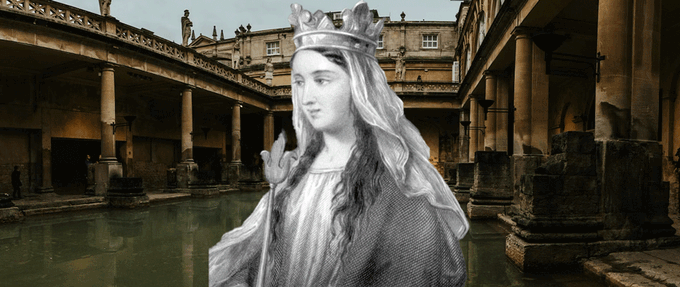
Empress Matilda is remembered as the strong-willed and intelligent woman who almost became the first Queen of England to reign in her own right. She was the only daughter of Henry I, King of England and Duke of Normandy, and Queen Matilda of Scotland, and, controversially, the only legitimate heir to the English throne. Empress Matilda’s battle for the throne would throw England into civil war for decades and ultimately decide the fate of the next generation of English monarchs.
Matilda’s Early Life
At the age of seven, Matilda was betrothed to Henry V of the Holy Roman-Germanic Empire in an effort to establish a military alliance that would bolster England’s defenses against France and provide ample financial support to fund Henry V’s appointment as Emperor. Matilda was crowned Queen of Rome in 1110, at age eight, and sent to the custody of Archbishop of Trier, Bruno, to learn Germanic language and the polity necessary for her new role.
In 1114, Henry V married Matilda and thus began his campaign to establish himself as emperor. The Catholic Church and many nobles revolted against Henry V’s rule—Pope Paschal even attempted to excommunicate him.
This attempt pushed Henry V to relocate his forces to Rome to retaliate against the papacy and drive Pope Paschal out of the city, ultimately allowing Henry V to handpick a new Pope. This move solidified Henry V’s place as Emperor and, in extension, crowned Matilda Empress of the Holy Roman-Germanic Empire.
The 16-year-old Empress Matilda was left to preside over her husband’s territories in Italy while Henry V returned to Germany. Matilda and Henry V were reunited a few years before Henry V’s death in 1125.
Having borne Henry V no children, Empress Matilda was called back to her father’s court in England after her husband’s death, where she was to take her place as next in line for the English throne. At just 23, her future was a mystery.
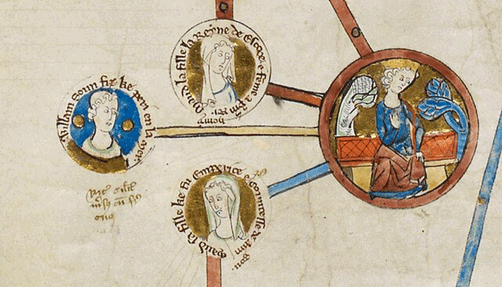
 Photo Credit: Wikimedia Commons
Claim to The Throne
In 1120, Empress Matilda became her father’s sole heir following the deaths of her brother, William the Aetheling, and her mother, Queen Matilda of Scotland. King Henry I failed to produce additional heirs in his second marriage, and was forced to persuade the baronage to accept Empress Matilda as his successor—marking the first time a woman was chosen as heir to the throne of England or the duchy of Normandy.
Despite her status as sole heir, the baronage was hesitant to recognize Matilda’s claim to the throne. Both her gender and the competing claims of Henry I’s nephew, Stephen of Blois, and illegitimate son, Robert of Gloucester, posed a threat to Matilda’s place in the line of succession.
The people of England were hesitant to recognize the legitimacy of a ruler who had spent only a small fraction of her life in England. Once Matilda was married to her second husband, Geoffrey Plantagenet, Count of Anjou, there was further consternation about her being married to a noble from outside of Engladn.
The Anarchy
When Henry I died in 1135, Matilda inherited the English throne and was set to be crowned the first queen. Before Matilda could assume her new title, however, her cousin, Stephen of Blois, staged a coup against her in an attempt to usurp the throne. Stephen was crowned King of England at Winchester in 1135, but Matilda was not easily defeated.
Organizing her campaign at Oxford Castle, Matilda contested Stephen’s rule and, with the support of her uncle, David I of Scotland, and her half-brother, Robert of Gloucester, fought for her right to rule. The Anarchy, as Stephen and Matilda’s war would come to be known, lasted nearly two decades until the heirs could reach an agreement that would restore peace to England.
During the Anarchy, Stephen was captured by Matilda’s forces and deposed, allowing Matilda to rule as “Lady of the English” for a short time. Before her coronation, however, the people of London grew frustrated with Matilda’s ignorance of their needs and an angry mob forced her back to Oxford.
After fleeing to Oxford, Matilda had no choice but to release Stephen of Blois in exchange for the release of her ally, Robert of Gloucester.
Stephen, once released, immediately rallied his forces and besieged the city of Oxford in an attempt to starve Matilda out of the castle and into their trap.
Stephen held the city for three months before Empress Matilda was able to make her grand escape, camouflaged against the December snow and treading miles on foot and across a frozen river before reaching safety at Abingdon-Upon-Thames.
For the next decade, Stephen and Matilda reached a stalemate. Matilda controlled most of southwest England and Stephen controlled the southeast and midlands, with the rest of the country falling under dominion of local barons.
The country was in chaos. As Matthew Lewis writes in Stephen and Matilda’s Civil War, any nobles who rebelled against Stephen could simply seek out Matilda. There was no imperative to obey Steven’s rule while simply deflecting to Empress Matilda’s cause to avoid punishment or exile remained an option.
Eventually, seeking peace for England, Stephen and Matilda signed the Treaty of Wallingford and agreed that Stephen would remain on the throne until his death, after which Matilda’s son, Henry II, would succeed him and begin the reign of the Plantagenet kings.
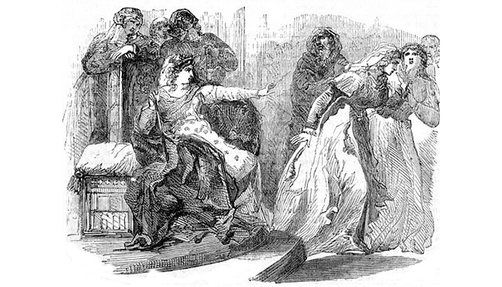 Photo Credit: Wikimedia Commons
Empress Matilda’s Legacy
Empress Matilda should have been England’s first female monarch, but history would not see an English queen until Bloody Mary, nearly a century after Matilda’s death. Though she never became the Queen of England, Matilda continued to fight for her place on the throne. The question remains whether Matilda’s claim would have been verified regardless of Stephen of Blois’s involvement on the basis of her sex alone. Would England have been ready to kneel to a Queen? It has been posited that Empress Matilda’s unapologetic ambition and fiery temperament alienated the people she was meant to serve. Nevertheless, Empress Matilda’s determination and dedication to her cause provided a beacon of inspiration to female claimants in the years to come. In She-Wolves, Helen Castor surmises Matilda’s perseverance perfectly, reminding readers that, while man ruled over woman, Matilda was one of many women who sought to rule a nation—and though she failed, her legacy succeeded.
Sources: EBSCO, Britannica, Museum of Oxford


