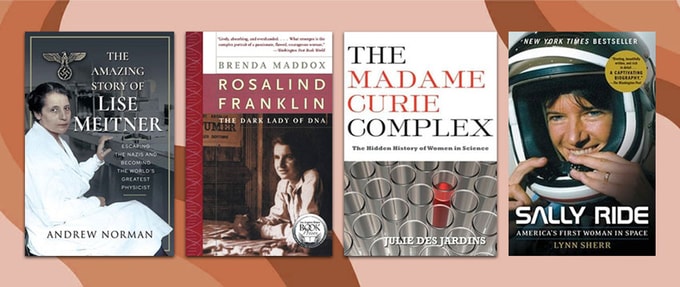

The progress of science has often hinged on the contributions of women, which, sadly enough, have often been erased or overlooked in the annals of history. The gender gap in STEM fields is still apparent, with women being paid much less, as well as their efforts being far less valued than those of men.
In fact, patriarchy continues to promote the scientific disciplines as characterized by rationality and objectivity, and therefore “antithetical” to the disposition of women who are often perceived as being “emotional” and “irrational”—though we know that isn’t really the case.
Thankfully, with education, advocacy and awareness, the historical role of women in pioneering science, as well as the obstacles and harassment they continue to face, can come to light, inspiring more girls to pursue STEM subjects, along with society taking steps to minimize workplace discrimination.
If you’re curious to learn more about women in science, these books can be a great entry point!
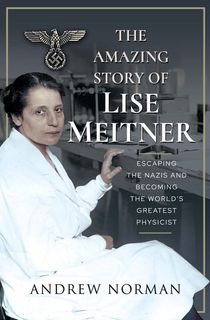
The Amazing Story of Lise Meitner
Elise "Lise" Meitner was an iconic Austrian and Swedish physicist whose research was pivotal in the discovery of nuclear fission. Though she became the first woman to become a full professor of physics in Germany, she soon had to abandon her position and flee due to the Nazi regime.
Andrew Norman’s thrilling book offers an insight into Lise’s life, how she helped her colleagues uncover new secrets in the world of atoms, and how her achievements were belittled and denied by other scientists. And while that’s often the case when working in a male-dominated profession, Norman’s meticulously-researched book is sure to put Lise back in the history books.
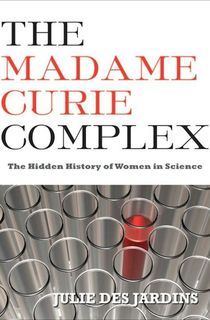
The Madame Curie Complex
Marie Curie is arguably one of the most well-known female scientists—not only was she the first woman to win the Nobel Prize, she was also the first person to win the Nobel Prize twice.
However, she wasn’t the only woman working in the field, and that’s the subject of Julie Des Jardins’ pathbreaking book, The Madame Curie Complex, wherein she explores the lives of several female scientists, such as Jane Goodall and Rosalind Franklin, along with Curie, and successfully dismantles the idea of the “lone male genius," reminding the readers that women, visibly and invisibly, have always made significant contributions to our understanding of science.
Overall, an engrossing and illuminating read.

The Immortal Life of Henrietta Lacks
Alongside gender inequality, racial discrimination has also played a role in medical research, which is perhaps best exemplified by the case of Henrietta Lacks. Lacks was an African-American woman who underwent treatment for cervical cancer, and some of her cells were then cultured by George Otto Gey, leading to the creation of the immortal HeLa cell line, still extensively used in research.
However, neither Lacks nor her family were made aware of this until much later, nor were they ever compensated, raising vital questions about medical ethics, privacy, and consent. Rebecca Skoot’s book not only details the family’s painful history, but also highlights racial politics in medicine. A very absorbing and impactful read.

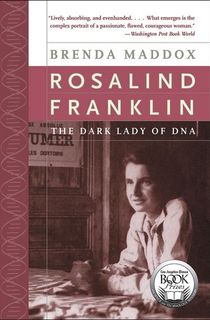
Rosalind Franklin
Like countless other female scientists, Rosalind Franklin played a crucial role in the discovery and understanding of DNA, yet her achievements were deliberately ascribed to her male colleagues, and thus, she even missed out on a Nobel Prize in Chemistry. She’s often referred to as the “Dark Lady of DNA”.
Brenda Maddox’s comprehensive biography details Franklin’s life and achievements—how at the age of 15, she’d already made up her mind to be a scientist, and yet she remained unacknowledged for most of her life. Be it the science behind how DNA works or details of Franklin’s personal life—Maddox captures it all with a lucid and vivid intensity.

Hidden Figures: The American Dream and the Untold Story of the Black Women Mathematicians Who Helped Win the Space Race
Extremely well-researched and incisively written, Shetterly’s book spans from the 1930s to 1960s, and chronicles of the role of three African-American women in advancing science. Be it solving problems of mathematics, engineering, or science, these women overcame racial and gender discrimination, and paved the way for key scientific breakthroughs. An underrated must-read.


Sally Ride: America's First Woman in Space
Sally Ride was the first American woman to venture into space, chosen by NASA for the seventh shuttle mission. She inspired several generations of women into becoming astronauts, and her sudden death from cancer in 2012 led to a public outpouring of grief.
Lynn Sherr’s decisive book provides a glimpse into Sally’s fascinating life, from her childhood to her influential career as one of the first female astronauts. Fast-paced and candid, this book promises to be an utterly engaging read.

Feature Image: Vecteezy


