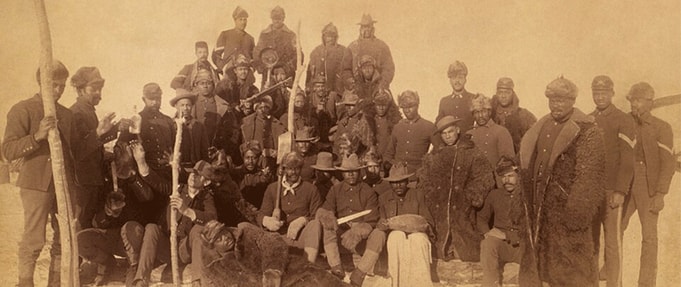
Even if you’re unfamiliar with what role the Buffalo Soldiers played in history, they have become deeply ingrained in popular culture. Take the 1997 television movie Buffalo Soldiers starring Danny Glover, Spike Lee’s 2008 World War II drama Miracle at St. Anna, or most famously, Bob Marley’s song, “Buffalo Soldiers.”
You’ve likely sung along to the latter’s lyrics without knowing they offer a glimpse into the life of the all-black U.S regiment: “There was a Buffalo Soldier / In the heart of America / Stolen from Africa, brought to America / Fighting on arrival, fighting for survival” (lines 2-5).
Established by Congress in 1886, the Buffalo Soldiers were regiments of African American men serving on the western frontier. As Marley sings, the troops were made up of former enslaved men, “freemen,” and Civil War soldiers who, throughout the era of the “Indian Wars,” would go on to fight in 177 battles.
From the American Civil War to World War II, the Buffalo Soldiers played a crucial role in all the nation’s major wars. Although they left an incredible mark that has been immortalized in film and culture, their historical impact is less recognized.
How Were the Buffalo Soldiers Formed?
In 1886, Congress passed legislation allowing African Americans to enlist in America’s peacetime military. Although these six regiments, later consolidated into four—the 9th and 10th Cavalry, as well as the 24th and 25th Infantry—were all-black, they were led mainly by white U.S. Army Officers.
However, the Smithsonian elaborates there were three exceptions: West Point graduates Henry O. Flipper, John Hanks Alexander, and Charles Young, all of whom were black. Among the men were the approximately 180,000 African Americans who served in the Union Army during the Civil War.
How Did the Buffalo Soldiers Get Their Name?
Less clear is how the Buffalo Soldiers got their name, though there are theories. The most famous of which is that Native Americans coined the term when noting that the soldiers’ dark curly hair resembled a buffalo mane, or that they fought like the revered Great Plains buffalo. Also considered was the fact that the Buffalo Soldiers wore heavy buffalo-hide coats during the winter.
Either way, the soldiers adopted the name, making it their moniker by World War I, when the 92nd Infantry Division used the buffalo as its unit patch.
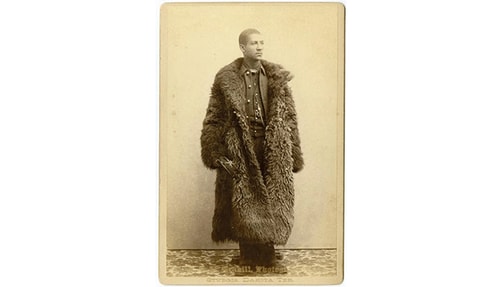

25th Infantry soldier wearing a buffalo robe (circa 1886).
Photo Credit: John C. H. Grabill / SmithsonianWho Did the Buffalo Soldiers Fight Against?
As the United States pushed forth on its quest for western expansion, the Buffalo Soldiers primarily fought against Native American tribes, including the Apache, Comanche, Cheyenne, and Sioux, in the “Indian Wars.” The irony, as underscored by the Smithsonian, is not lost: “African-American soldiers fighting native people on behalf of a government that accepted neither group as equals.”
But it’s important to note that the all-black regiments’ knowledge of the government’s violent displacement of Indigenous peoples was likely very limited. In the 1890s, when the American-Indian Wars ended, History elaborates that the Buffalo Soldiers fought in the 1898 Spanish-American War, the 1899-1902 Philippine-American Wars, and aided in General John J. Pershing’s 1916-1917 hunt for the Mexican revolutionary Pancho Villa.
Discrimination and racism are largely why the Buffalo Soldiers’ involvement in the nation’s conflicts was downplayed then and into the present. During World War I, President Woodrow Wilson, who promoted racial inequality and even segregated the federal offices, had black regiments excluded from the American Expedition Force. Throughout the war, the Buffalo Soldiers were replaced under French command, the first time U.S troops had been placed under foreign control.
In 1948, President Harry Truman eliminated all racial segregation, including in America’s armed forces. The 92nd Infantry Division, also called the “Buffalo Division,” saw its last combat during the invasion of Italy, while another, including the original Buffalo Soldier 25th Infantry Regiment, fought through the Pacific theater.
In 1952, the last segregated regiments were disbanded during the Korean War and consolidated into other units. For a collection of Buffalo Soldiers by decade, including the Medal of Honor recipients, click here.
What Did the Buffalo Soldiers Do?
Apart from being skilled troops, the Buffalo Soldiers were responsible for building roads and improving infrastructure, as well as protecting settlers and U.S. mail during western expansion. Between 1891 and 1913, they also served as some of the first national park rangers, when the army was the official administrator of Yosemite and Sequoia National Parks.
As a part of their duties, they fended off illegal grazing, poachers, timber thieves, and wildfires. They were also involved in the construction of the first trail to the top of Mount Whitney—the tallest mountain in the contiguous United States. Although most of the officers were white, Charles Young, the third African American graduate of West Point, would become the first African American national park superintendent.
Without police, the Buffalo Soldiers often corralled rowdier towns, most famously in two of the largest range conflicts in the American Old West. Range wars were fought between cattle ranchers, often fighting for land, water, livestock—anything to be found in the open range. In the notable 1892 Johnson County War in Wyoming, where small farmers were up against wealthy ranchers and hired gunmen, President Benjamin Harrison ordered the regiment in to squash the violence.
Mark Matthews, the oldest living Buffalo Soldier, died on September 6, 2005, at 111. Today, there are monuments and numerous museum exhibits at both the Buffalo Soldiers National Museum and the Smithsonian that celebrate the countless contributions of these African American soldiers.
Featured image: Wikimedia Commons


