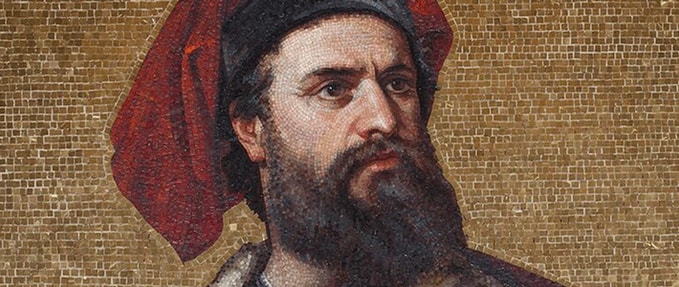

The first European to document the Silk Road, Marco Polo, rose to fame with The Travels of Marco Polo. Dictated to the writer and editor Rustichello da Pisa, his cellmate while serving time in Genoa for commanding a Venetian war galley, he shared his descriptions of faraway lands—although the truth behind his expeditions continues to be debated.
Can we trust a man who claimed to have seen a unicorn in Indonesia? There’s even a book called Did Marco Polo Go to China? by historian Frances Wood, arguing he never got past Persia. Nevertheless, the explorer is largely credited with bridging the gap between Europe and Asia, forever changing how the world interacts through trade routes, cross-continental diplomacy, and more.
But how exactly did a Venetian merchant come to be received by Kublai Khan, successful Mongolian emperor and grandson of Genghis Khan? How much truth is there to descriptions of Asia, through then largely undocumented territories, like the Pamir Mountains and the Gobi Desert? Find out more below.
Marco Polo's Early Life
Marco Polo’s early years remain largely unknown, other than that he was born into a wealthy merchant family in the Italian city-state of Venice around 1254. At the time, Venice was a rapidly growing maritime power, while the Mongol conquest of Asia had reached new limits. Under Kublai Khan, the Empire now encompassed China, all the way to Russia and the Levant.
Recognized throughout the world for their ruthless methods, the Mongols discovered that it was better to collect tribute from travelers along the Silk Road and other trade routes than to kill them. Marco’s father, Niccolò, and his uncle Maffeo were among such European traders, capitalizing on these newly established ties.
The Polos had already established themselves in the Levant and through the Black Sea, with Marco’s uncle, whom he was named after, even owning property in Constantinople. When Marco was around six, his father and uncle Maffeo embarked on a long-term trading expedition. In the meantime, Marco was raised by his mother, and, after she died, by relatives.
First, they spent time in Constantinople (now Istanbul, Turkey), then headed to the port city of Soldaia (now Sudka, Ukraine). But with the Byzantine reconquest of Constantinople in 1261, they likely couldn’t return home and instead turned east. They spent three years in Bukhara (now Uzbekistan) trading in rich items like silk, gems, and spices before, at the encouragement of a Mongolian embassy, visiting Kublai Khan. There, according to History, Khan quizzed them on European affairs and, impressed, appointed them as his emissaries to the pope.
Finally, the men returned to Venice, where Niccolò learned his wife had passed away during his absence. He hadn’t seen his son, Marco, for nine years—who was then around 15. Marco, who, according to EBSCO, had begun to think of himself as an orphan, was happy to hear of his father’s travels abroad—and this became formative to his future ambitions.
At Kublai Khan’s Court
Two years later, in 1268, Pope Clement IV died. In the meantime, while they were waiting for another pope to be elected, Niccolò and Maffeo decided to return to the court of Kublai Khan—this time with Marco by their side.
On the way, they traveled through some of the world’s most intense terrain, from snowy mountains to scorching deserts, all later documented in his book. Under the Khan’s protection, they were able to see Islamic regions close up, in a way few European Christians had before. Once the Polos reached Khanbalik (now Beijing, China), where the Khan held court, Marco had matured into adulthood—with a unique education under his belt.
Armed with the late pope’s messages and oil acquired from the lamp burning at Jesus Christ’s said-to-be tomb in Jerusalem, the group received a warm introduction from the Khan. According to Marco, the Polos were to become some of the Khan’s favorites, with Marco, in particular, becoming one of his most trusted emissaries. On this point in particular, there is much debate.
Although the Khan often assigned foreigners to manage conquered lands for political reasons, many people believe Marco exaggerated the esteem in which the Polos were held at court. Nonetheless, the Polos stayed at court for 17 years, proving that, at least to some extent, they were of great value to the Khan.
According to Marco’s book, the Khan wouldn’t allow them to return home because he relied on their services. But, fearing what would happen when the emperor passed, the Polos sought a way out. The opportunity presented itself when they were called to escort a young princess to her intended husband, Arghun, the Mongol ruler of Persia.
In 1292, the Polos, along with 14 boats, sailed from Zaitun (now Quanzhou, China), and arrived in Persia 18 months later—only to discover Arghun was dead. Instead, the princess married his son, and the Polos stayed with Arghun’s brother for nine months before heading back to Venice. They arrived home in 1295, a year after Kublai’s death, and the beginning of the end for the Mongol Empire.
Marco Polo’s Homecoming
Many of the Polos’ relatives, having not heard from them for many years, assumed they were dead. But when they arrived in Venice, Marco and his family were delighted with a banquet. Shortly after, Marco was taken prisoner by the Genoese, rivals of the Venetians at sea, after a battle on the Mediterranean. He was thus imprisoned in Genoa, where, to his great luck, he was placed in a cell with Rustichello of Pisa, a semi-famous writer of the time.
The pair collaborated on a manuscript, completed in 1298, called “Description of the World.” Now famously known as The Travels of Marco Polo. Accounts of his time at Kublai Khan’s court, his journeys across unfamiliar lands, innovations that had yet to reach Europe—both accurate and exaggerated—lined the pages.
In 1299, Marco was allowed to return home when a Genoese-Venetian peace treaty was reached. His book was likely in circulation then. After his time in prison, he would go on to live a quiet life, marrying Donata Badoer and having three daughters. He lived out the rest of his life among Venetian aristocratic circles and died in 1324, at around 70 years old.
We may never know for certain what was true or fabricated in Marco’s adventures, especially given that everything we know comes from him or other Venetian sources. According to History, no Asian documentation even mentions him. But what we can know for certain is his impact on ties between Europe and Asia—forging, whether by intent or not, harmful ideologies like “Western man as conqueror,” which would prevail with explorers like Christopher Columbus.


