These days, it can be difficult, even for those who live there, to imagine what Africa must have been like in the years before European colonial rule reshaped the continent—and continues, even today, to color how we talk and think about it, in ways both big and small. Yet European colonialism in Africa is a relatively recent thing.
As late as the 1870s, European powers controlled as little as 10% of the continent, trading primarily with locals via small colonies along the coast. All that changed toward the end of the 19th century, as advances in technology and medicine, changes in international markets, a rise of European nationalism, and other factors drove a “scramble” that would see nearly the entire continent under the rule of European colonial powers by 1913.
What Caused the Scramble for Africa?
A variety of factors influenced the timing of the so-called “Scramble for Africa.” Still, one of the most important is a seemingly innocuous event: the development of quinine, an effective treatment against malaria.
Made from the bark of South American cinchona trees, early forms of quinine had been known to the Indigenous peoples of Peru and surrounding countries for centuries, and had spread to Europe by the 17th century, if not before. By the late 19th century, quinine was widely accessible to Europeans, and has been cited as a key factor in allowing colonists to swarm into central Africa. This continent had previously been known as the “white man’s grave,” due to the many deaths from malaria and other tropical diseases.
The same industrial revolution that allowed for greater accessibility of quinine also contributed to the “Scramble for Africa” in other ways. Innovations in transportation and communication technology made it easier and safer for colonial powers to operate across the globe. At the same time, shrinking markets drove ever-increasing demand for raw materials, and control of international waterways became vital to global trade.
A rise in nationalistic sentiment throughout much of Europe also led to a movement of “New Imperialism.” Colonies gave European nations greater power abroad and acted as useful bargaining chips during geopolitical negotiations. Besides being anchor points for military bases, they provided raw troop power, and many of the colonizing countries used soldiers drawn from their colonies. This practice would continue through the coming World Wars.
Attempts to justify all this included references to the “White Man’s Burden,” the title of a poem written by Rudyard Kipling in 1899, referring specifically to the Philippine-American War. In the poem, Kipling praises imperialism as a means of bettering people against their will, exhorting the reader to “take up the White Man’s burden” of “civilizing” the inhabitants of colonial territories, referred to as “your new-caught sullen peoples, half devil and half child.”
When Did the Scramble for Africa Begin?
European interests in Africa existed before 1870, and relatively small colonies had been established along the continent’s coast, including Portuguese Angola and Mozambique, French Algeria, and Britain’s Cape Colony. As colonial expansion deeper into the continent became more viable, and interest in African territories grew, the seeds for the “scramble” had been planted.
There were many important precursors, but if anything marks the most significant turning point in the “Scramble for Africa,” it might be the Berlin Conference, convened by Otto von Bismarck in 1884. The Berlin Conference was the site of a variety of diplomatic negotiations, including the adoption of the General Act of Berlin, which regulated European colonization of Africa—formalizing the already ongoing “scramble.”
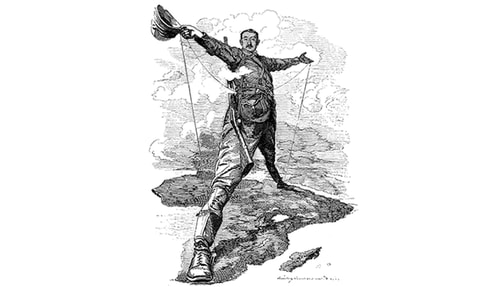

Caricature of Cecil John Rhodes (c. 1892).
Photo Credit: Wikimedia Commons14 colonial powers attended the conference: Germany, Austria-Hungary, Spain, Denmark, the United States, France, the UK, Italy, the Netherlands, Portugal, Russia, Sweden-Norway, the Ottoman Empire, and the International Congo Society, an organization created by King Leopold II of Belgium to control his already extant colonial interests in the Congo. Most of these would become major players, though a few, including the United States and Russia, left without having secured any “zones of interest” on the continent.
While the “Scramble for Africa” was already underway by 1884—and was, indeed, the main impetus for convening the Berlin Conference in the first place—the General Act of Berlin formalized what had been, until then, a disparate and largely informal movement toward greater colonial control of the continent, and set the stage for the transformation of Africa.
Why Did the Scramble for Africa End? And What Happened After?
By the start of the 20th century, European colonial powers controlled more than one-fifth of the land area of the entire planet. However, events were already underway that would spell the end of formal European colonial power as it had existed during the “scramble.”
On June 28, 1914, Archduke Franz Ferdinand and his wife were assassinated in Sarajevo, an event which would prove to be the match thrown into a powder keg of international tensions that would ignite the First World War. The result was one of the deadliest conflicts in history, which would cost more than 15 million lives and result in major shifts to European nations. Resource-intensive, the war also drew power away from European colonial holdings.
It was followed in short order by World War II, an even more massive and deadly conflagration, with a death toll north of 70 million—ranked by most historians as the deadliest war in history. This Second World War also reshaped the globe considerably and led to massive changes in the distribution of power and economic and political control around the world.
Over the years that followed, most of the previously held African colonies gradually gained at least formal independence. By 1963, the Organization of African Unity (OAU) had formed, with some 33 signatory countries, to try to counter colonial influence. Among the decisions made by the OAU was for newly independent African nations to mostly keep their colonial borders.
Despite the relatively short time that Africa spent under European colonial rule, the “Scramble for Africa” had seismic knock-on effects that continue to be felt today. Even after they had declared their independence, many African nations remained structurally dependent on their former colonizers due to a variety of economic and social factors, often imposed during their colonial period.
From the borders of the nations themselves to the languages spoken within them to economic, diplomatic, and trade relationships, the nature and state of Africa was indelibly reshaped by its brief tenure of formal colonial control. It is impossible to know what the continent might have looked like without the “Scramble for Africa”—and while the historic “scramble” may be long over, European and American interests in the continent still continue to have a major impact on African society.
Featured image: Wikimedia Commons


