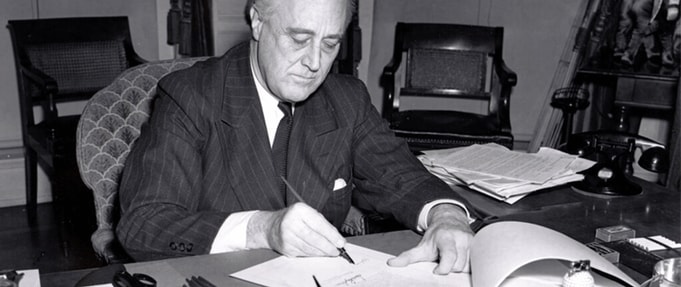

Historians widely regard Franklin Delano Roosevelt (FDR) as one of the most influential American presidents. He served four consecutive terms, remaining the longest-serving president, and played a major role in some of the nation’s most important events of the 20th century. Yet his response to the Great Depression remains one of the most defining aspects of his time in office.
The only son of a wealthy New York family, FDR was born in 1882 and received a first-class education. He trained in law and broke into New York Democratic politics, becoming a member of the State Senate in 1910. There, he led an opposition group against Tammany Hall and instead supported Woodrow Wilson’s presidential candidacy.
Because of his help, President Wilson rewarded the young politician with a top government job: Assistant Secretary of the U.S. Navy. Over the next few years, his progressive politics were deeply influenced by Woodrow Wilson and Theodore Roosevelt, the 26th president, who was a distant relative and uncle to his wife, Eleanor.
In 1920, FDR ran for vice president, but his party lost, and the Republicans held the presidency for the next 12 years. He returned to practicing law until, in 1928, he was elected the governor of New York—when the nation was on the verge of the Great Depression. When the period hit, he created new government programs to help people who lost their jobs—demonstrating his characteristic willingness to experiment and try new approaches, even if they didn’t always succeed.
After seeing his proactive measures in New York in 1932, the Democratic Party nominated FDR for president. By promising a “New Deal” for the “forgotten man,” he ousted Herbert Hoover and the previous laissez-faire political philosophy—but Americans knew little of what was to come.
A New Kind of Government
The phrase First Hundred Days originated during FDR’s presidency. From March 9th, to June 16, 1933, much of his New Deal legislation was enacted—including 15 major pieces of legislation. Over the next eight years, he established what Professor Thomas Kessner, writing for the Gilder Lehrman Institute of American History, called “the scaffolding for a federal welfare system providing relief, unemployment insurance, and old-age pensions.”
Kessner adds that, by establishing the “alphabet agencies,” that is, the National Recovery Administration (NRA), the Agricultural Adjustment ACT (AAA), and others, he regulated “agriculture, industrial policy, labor, and banking and investment, vastly expanding federal authority over the daily lives of citizens.”
But according to History.com, in an article discussing FDR’s controversies, the Supreme Court ruled that many of these new initiatives were unconstitutional—including the National Industrial Recovery Act, the law that established the NRA and sought to set fair rules for businesses, wages, and working conditions. The government lacked the legal power to make these kinds of laws.
In response, when he was reelected in 1936, FDR tried to court-pack by proposing to Congress that he appoint a new justice for each who hadn’t retired by 70—expanding the Court to 15 members. The measure was, of course, blocked, but the president still had the opportunity to appoint eight new Supreme Court Justices over his time in office.
FDR quickly addressed the nation’s crippling financial situation by further establishing agencies like the Works Progress Administration (WPA) and the Civilian Conservation Corps (CCC) that sought to reduce unemployment. According to Britannica, the WPA produced 8.5 million jobs, with its construction projects creating more than 650,000 miles of roads, 125,000 public buildings, 75,000 bridges, and 8,000 parks.
From 1933 to 1944, Roosevelt launched his “Fireside Chats,” a series of evening radio addresses. Recognizing radio’s power to bypass critical newspapers, he spoke directly to Americans in their living rooms. Across the 30 broadcasts, he addressed his New Deal policies, aiming to provide information and reduce chaos, and later prepared the nation for its entry into World War II.
Another New Deal
After some of his initiatives were struck down, FDR pivoted to Social Security and the Wagner Act—collectively called the “Second New Deal.” New Deal programs are often split into three major categories: relief, recovery, and reform. During this wave, recovery programs were established, intended to rebuild the economy, increase agricultural prices, and create long-term employment.
The Wagner Act of 1935, in particular, was created to protect private-sector employees’ rights to form unions, bargain collectively, and strike. The Fair Labor Standards Act was the first U.S. law to impose compulsory federal regulation of wages and hours. Finally, the Social Security laws of 1935 and 1939 created a safety net funded by worker and employer taxes to help people in financial need.
It’s important to note the New Deal didn’t address systemic racial discrimination. In fact, in early 1939, when two senators proposed a law that would hold government officials responsible if their negligence contributed to a lynching, FDR refused to support the bill. Despite declaring he wasn’t racist, he chose not to fight Southern politicians over civil rights laws because he didn’t want to ruin his own political power.
A Complicated Legacy
In 1937, FDR viewed the Great Depression as virtually over, and pulled back demand-side support—including cutting federal spending, raising Social Security payroll taxes, and tightening credit, among other measures. As a result, unemployment, which had fallen from 25% in 1933 to around 14% by 1937, jumped back toward 19% in 1938. In what became known as the “Roosevelt Recession,” the economy didn’t recover until massive government defense mobilization for World War II.
Today, most historians agree the New Deal alone didn’t end the Depression, though it left a lasting mark on American economic life. During his initial presidential campaign in 1932, before he had been given the Democratic nomination, FDR broadcast a promise to the working class: “These unhappy times call for the building of plans that rest upon the forgotten [...] build from the bottom up and not from the top down, that put their faith once more in the forgotten man at the bottom of the economic pyramid.”
But, nearly a decade later, as the war effort succeeded where his own programs had fallen short, how much of that promise had actually been kept?


