
Anyone who has ever trod the boards—and probably most of us who haven’t—is aware of the grim reputation surrounding Shakespeare’s Macbeth. Originally performed as early as 1606, Macbeth is widely regarded as one of Shakespeare’s darkest and eeriest plays, and tradition holds that the play itself is cursed.
In fact, the superstition surrounding Macbeth runs so deep that some refuse to even refer to it by name, simply calling it “the Scottish play.” But where did this sinister reputation come from?
Willard A. Heaps, author of Superstition, has a theory: “This persistent belief concerning Macbeth was based on two riots during performances, one in London and one in New York City, during the first half of the nineteenth century, when Shakespearean actors and plays enjoyed great popularity.”
Whether or not they are at the root of Macbeth’s cursed reputation, the two riots are definitely real, and provide a tragic backdrop for the play’s notoriety…
The Old Price Riots of 1809
Until 1843, the performance of “serious drama” in England was restricted to a handful of “patent theaters,” including the Theatre Royal on Drury Lane, which burned down in February 1809, and the Covent Garden Theatre. Like the theater on Drury Lane, the Covent Garden theater had burned down earlier, in September of 1808.
Unlike Drury Lane, however, Covent Garden was rebuilt, thanks partly to a public subscription introduced by the Duke of York and Albany and the Duke of Northumberland. Unfortunately, the cost of rebuilding the Covent Garden theater put the management in a bit of a bind. They felt they had to raise prices to recoup the losses from the fire, which had also destroyed many of the sets, costumes, and scripts. The public was… less than thrilled.
Opening night at the newly restored Covent Garden Theatre was a production of Macbeth, but even before the curtain went up, the audience allegedly began to chant, “Old prices! Old prices! Old prices!” According to Heaps, “None of the lines in the five acts of the play could be heard above the din.”
When the curtain came down, the audience refused to leave, and the police were ultimately called in. That wasn’t the end of the story, however. It was only the beginning. The so-called Old Price Riots raged for a massive 66 days, claiming the lives of as many as 20 people. Audiences heckled the performers and brawled with constabulary in the streets, while the theater’s owners called in a semi-retired former boxer to try to help keep the peace—a move which backfired spectacularly, leading to more violence.
Ultimately, the Covent Garden Theatre’s owners restored the old prices and issued a public apology. But that wasn’t the end of the misfortunes surrounding productions of Macbeth.
The Astor Place Riot of 1849
40 years later and on the far side of the Atlantic, another tragedy unfolded—one that would, perhaps, be enough to seal the play’s unlucky reputation.
This one occurred at the Astor Place Opera House in Manhattan, and has its roots in a rivalry between two actors. “Well, there’s this antagonism between Forrest and Macready that goes back really to Forrest’s first tour of England in the 1830s,” writes University of Pittsburgh professor emeritus of theater Bruce McConachie, describing the feud between American actor Edwin Forrest and British actor William Macready—both of whom were at the height of their popularity in 1849.
“Among their supporters,” writes the Folger Shakespeare Library, “the dispute reflected a growing split in the American public. Forrest was the hero of the working man and the lower classes; Macready was praised by wealthy Americans and literary opinion leaders.”
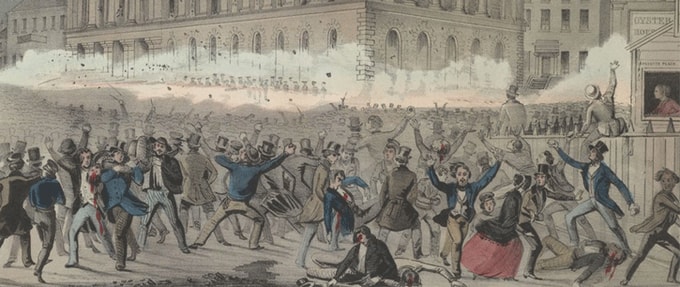
As Macready prepared to perform Macbeth at the Astor Place Opera House, Forrest was scheduled to perform the same play just a few blocks away. By the time the curtain came up at Astor Place, thousands of Forrest’s supporters had descended on the opera house.
“They are re-fighting, in a way, the Revolutionary War,” writes McConachie. “Macready seems to be the ‘pet of princes,’ as he’s called in their propaganda, and they denounce Macready as a symbol of aristocratic oppression. Not simply English oppression, but the oppression faced by working men, patriotic working men, by their own employers […] so the dynamics of the riot take on the proportions of genuine class antagonism. When all of this erupts in 1849, as many of the newspapers say at the time, it’s ‘the rich against the poor.’”
Tensions had already been rising for some time, and Macready’s first performance of Macbeth was met with jeers, hisses, and attendees pelting the stage with “rotten eggs, pennies, vegetables, and fruits,” not to mention “pieces of broken chairs.” Fearing the events could reach a breaking point, city authorities placed 150 police officers inside the theater. Outside were another hundred police, as well as 350 troops from the militia, including cavalry and light artillery.
Despite this, as many as 10,000 people descended on the theater and were met with firepower. At least 22 rioters were killed in the ensuing melee, and many more were wounded—the largest number of civilian casualties due to military action since the Revolutionary War. The rioters got their own back, however, injuring more than 50 police officers and as many as 140 members of the militia.
“Inside the theater, meanwhile, Macready struggled through the performance,” according to the Folger Shakespeare Library, with other sources alleging that he had to perform in pantomime because he couldn’t be heard over the din, “then fled, never to appear in an American theater again.”
The end of the Astor Place Riot marked the theater’s decline—it was given names like “DisAstor Place” and the “Massacre Opera House”—and a schism in American popular entertainment, as a growing divide emerged between “highbrow” and “lowbrow” art.
It may have also been the final nail in the coffin of Macbeth’s haunted reputation. After giving an overview of the two riots, Heaps concludes that “The belief of Shakespearean actors that Macbeth is an unlucky play may have some basis in view of its tragic history.”
Featured image: Digital Public Library of America


