In the first week of October 2026, the Archaeological Legacy Institute (ALI), Purdue Research Foundation (PRF), and Purdue University will travel to the South Pacific in an attempt to solve the disappearance of Amelia Earhart's plane during her mission to become the first female pilot to fly around the world.
The object believed to be her Lockheed Model 10E Electra plane was first spotted in 2020 in Apple Maps satellite imagery at the potential crash site in Nikumaroro Lagoon, an island 400 miles south of her initial target in the middle of the Pacific Ocean.
The ALI also obtained older satellite images and found the object first appeared in 2015, shortly after a cyclone passed by the island. It's believed the severe storm removed sediment that had covered the object, making it visible from above.
The Archaeology Channel stated, “This Object in the satellite images is exactly the right size to represent the fuselage and tail of the Electra. It also appears to be very reflective and is likely to be metallic."
The expedition plans to examine and potentially confirm that the Taraia Object, a commonly used name to describe the visual anomaly, is Earhart's missing plane.
The expedition will include three weeks of travel, and is led by Richard Pettigrew, executive director of ALI. Alongside him is a 17-person crew, including Purdue representatives, personnel from RECON Offshore, an archaeological firm, individuals who have worked on the island with The International Group for Historic Aircraft Recovery (TIGHAR), and others, including ALI staff.
Expedition members will assemble in Tarawa, Kiribati, on Oct. 6, then sail for six days to arrive at Nikumaroro and spend the following days on the small island in the search effort.
Who was Amelia Earhart?
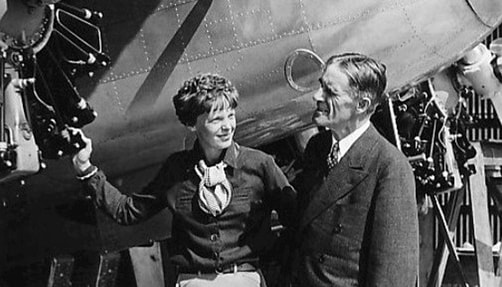

Amelia Earhart and Dr. Edward C. Elliott, president of Purdue University, standing with the Lockheed Electra she later disappeared in.
Photo Credit: Wikimedia CommonsAmelia Earhart (1897–1937) was an American aviator who became one of the most famous pilots of the 20th century. Her interest in aviation began after seeing military pilots in Toronto in 1918 while serving as a Red Cross nurse's aide. After taking her first flight in California in 1920, she began taking flying lessons with instructor Anita Snook. To pay for her lessons, she worked a variety of jobs, including as a telephone company clerk and photographer.
In 1923, at age 25, she was the 16th woman to obtain a pilot’s license. While focusing on flying, Earhart also wrote poetry, served as aviation editor for Hearst’s Cosmopolitan, and designed flight suits for the Ninety-Nines, an organization of women pilots of which she was president.
She made her first solo flight in 1921; she bought her first airplane in 1922, and that year she set a record as the first female pilot to fly at 14,000ft. Earhart became an international celebrity in 1928 as the first woman to fly across the Atlantic, although she was a passenger on that flight. Four years later, she became the first woman and second person to fly nonstop and solo across the Atlantic, completing the flight from Newfoundland to Northern Ireland in May 1932.
She continued setting aviation records, including becoming the first person to fly solo from Hawaii to the U.S. mainland in 1935 and establishing a speed record between Mexico City and Washington, D.C.
In 1937, she disappeared over the Pacific Ocean while attempting to circumnavigate the globe.
The Journey Begins
Earhart's first attempt to circumnavigate the globe began on March 17, 1937, flying westward from Oakland, CA. That attempt ended on March 20 when her Lockheed Electra crashed during takeoff at Luke Field in Honolulu. The aircraft then underwent extensive repairs.
For the second attempt, Earhart chose navigator Fred Noonan, an experienced Pan American Airways navigator. The revised journey would travel eastward, with Earhart and Noonan departing Oakland on May 21 and reaching Miami before beginning the major international portion of the flight on June 1.
She deliberately chose a southern route rather than the more commonly attempted route through the northern Pacific, avoiding the poor weather between Siberia and Alaska. The tradeoff was a series of long flights over open water, making careful navigation and fuel management essential.
By June 29, Earhart and Noonan had reached Lae, New Guinea, having traveled approximately 22,000 miles, with roughly 7,000 miles remaining. Their next flight would be one of the most difficult: a 2,556-mile journey from Lae to Howland Island, a tiny Pacific island where they planned to refuel.
Howland was only about two miles long and one mile wide, making it an exceptionally difficult destination to locate from the air. The Coast Guard cutter Itasca was stationed offshore to provide radio assistance and fuel support.
But with low fuel, radio transmission issues, and a tiny island as their next landing point, finding Howland Island was becoming a race against time. Earhart planned the route in 34 legs, and when they disappeared, they were on the 31st leg.
The Disappearance of Amelia Earhart
Earhart and Noonan departed Lae, New Guinea, at 10 a.m. local time on July 2, 1937, beginning the 2,556-mile flight to Howland Island. The tiny island was their next destination and a necessary refueling stop, but as they approached, communication with the Itasca, the Coast Guard cutter waiting near Howland, became increasingly difficult.
At 7:42 a.m., Earhart reported that they were nearing Howland but could not see the island. As the flight continued, she reported that they were running low on fuel and continued trying to establish contact with the Itasca.
Then, in one of her final radio transmissions, Earhart told the Itasca:
“We must be on you now but cannot see you. Running out of gas. Only one half hour left. Been unable to reach you by radio. We are flying at one thousand feet.”
Shortly afterward, Earhart's transmissions stopped. Despite an extensive search by the U.S. Navy and Coast Guard, neither Earhart, Noonan, nor their Lockheed Electra was found.
One theory holds that Earhart and Noonan may have reached Nikumaroro, an uninhabited island roughly 400 miles southeast of Howland. According to this hypothesis, they landed the Electra on the island's reef and stayed with the aircraft for several days, using its radio to send distress calls in hopes of rescue. Radio operators around the Pacific recorded 121 radio messages, of which TIGHAR analysis found that 57 are credible as coming from the Electra.
Eventually, rising tides may have carried the aircraft off the reef, breaking it apart and scattering its components into the surrounding waters. One piece of the landing gear may have become lodged in the reef and later appeared in a 1937 photograph known as the Bevington Object.
In the decades since 1937, daily tidal currents deposited thick layers of sediment on top of the plane's remnants, ultimately hiding the remaining pieces from view, even to anyone walking by.
Whether the Electra actually reached Nikumaroro remains unproven. But the possibility has fueled decades of searches for the missing plane, including the latest investigation into the Taraia Object.
What is Purdue's Relation to Earhart?
In 1934, Purdue President Edward C. Elliott heard Amelia speak at the 4th annual Women’s Conference on Current Problems in New York City. In her speech, Earhart encouraged women to be anything they wanted to be and pursue careers traditionally held by men. President Elliott was so impressed with her message that he invited her to Purdue to speak to the students.
After that initial speech, he offered her a position at Purdue as a visiting professor and consultant in the Department of Aeronautical Engineering, as well as a career counselor in the Office of the Dean of Women. She accepted the offer and spent a few short weeks on campus in 1935, 1936, and 1937.
When Earhart considered flying around the equator, Purdue supported her goal by funding the Lockheed Electra as part of their pioneering efforts in aviation.
Today, Purdue University continues Earhart's legacy by funding the Taraia Object Expedition with the Archaeological Legacy Institute.
The Taraia Object
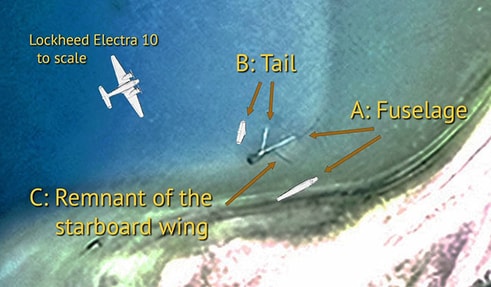
Taraia Object Satellite Image.
Photo Credit: Heritage Broadcasting Service/Archaeological Legacy InstituteThe Taraia Object is the commonly used name for a visual anomaly in the lagoon of Nikumaroro Island in the South Pacific Ocean. The object appears in satellite images, aerial photos, drone footage, and video footage of the lagoon. It lies directly east of the Tatiman Passage, which connects the lagoon to the open ocean.
In a press conference from Purdue University shared on YouTube, Pettigrew said: “There’s something in the lagoon that shouldn’t be there. We see this in satellite imagery, and upon further research we see it in other imagery from earlier times."
"It’s important for us to go there and look at it," he said. "We have to identify it. We have to confirm the hypothesis.”
There are also considerable clues that this object is the Lockheed Electra, such as a 1938 aerial photograph that likely shows the Object in a nearby location compared to today’s recent satellite images. In addition, a U.S. Navy Pilot who visited the island during WWII saw British colonizers using an aircraft control cable as a fishing line, which they said came from a plane wreck on the island when they arrived.
More importantly, no other airplanes have been known to have been lost on or near Nikumaroro.
What Will Take Place During the Expedition?
The expedition will spend five days on Nikumaroro examining the Taraia Object and determining what lies beneath the lagoon sediment.
The team will first document the site with drone photography, videos, and still images before disturbing the area. Researchers will then use magnetometers and sonar devices to map the object and determine its exact location and size.
A hydroprobe (a pipe with water flowing through it) will reach the object through the sediment and gather information about its composition and shape. Once researchers have a clear idea of what the object could be, they will use a hydraulic dredge to carefully remove the surrounding sediment and expose enough of the object to identify it.
If the exposed material is aircraft aluminum and matches the construction and rivet patterns of Earhart’s Lockheed Electra, they will know they have found the remains of Earhart’s aircraft.
The team will also survey nearby areas of Nikumaroro for aircraft debris or other material that waves may have carried ashore.
The expedition is scheduled to return to Tarawa around October 22, with the team flying home the following day. If the Taraia Object is identified as Earhart’s Electra, additional expeditions would be needed to excavate and document the wreckage fully.
A larger archaeological excavation could begin in 2027, with plans to recover and preserve the aircraft potentially beginning as early as 2027 or 2028.
“Finding Amelia Earhart’s Electra aircraft would be the discovery of a lifetime,” Pettigrew said.


