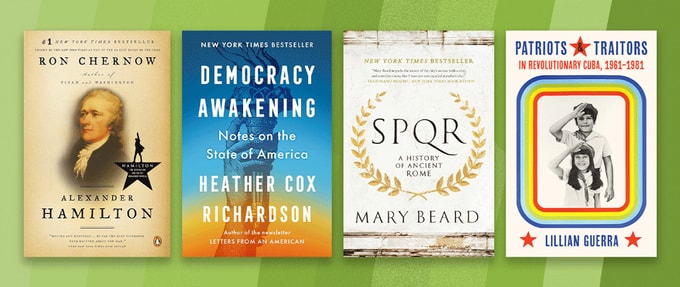
They say that history is written by the victors, and that is often true. But history isn’t a fixed object that, once written, remains set in stone. History is something that we explore, reevaluate, relitigate, and reexamine—an ever-changing tableau that is continually reshaped by new perspectives.
For many of us, however, history is something we studied in school and may later develop a hobbyist’s interest in—meaning we lack the depth of expertise and experience necessary to reconfigure our understanding of history. For that, we frequently rely on professional historians who both examine old ways of thinking and find new approaches to existing facts to shed new light on ancient (and not-so-ancient) history.
Sometimes, these new approaches reinforce what we already believe; other times, they may challenge everything we thought we knew about the past. In either event, these public historians and thinkers shape the public’s perception of history, rewriting what history is for those who don’t spend all their time studying it.
In the past, they often did this through books, lectures, or appearances on the talk-show circuit. Today, while many leading historical thinkers still write books, they also disseminate their ideas through Substacks and other online newsletters, podcasts, TED Talks, YouTube channels, and simply on social media. Despite, or perhaps because of, these varied approaches, public-facing historians have never been more important to our understanding of history, and their impact has never been more varied.
We’ve assembled five of the leading public historians whose work is shaping policy, discourse, and public opinion in the English-speaking world today. Some may be obvious, while others might surprise you.
Heather Cox Richardson
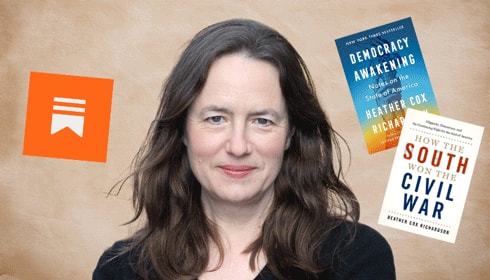
 Photo Credit: Wikimedia Commons
In 2019, Heather Cox Richardson, a professor of history at Boston College, started publishing a nightly newsletter called Letters from an American. Beginning as an exploration of the historical context of the impeachment inquiry into Donald Trump, Letters from an American became an account of contemporary political events viewed through a historical lens—one that many Americans relied on during the pandemic.
By 2025, it had more than 2.6 million subscribers, making it one of the most popular Substacks in the world. Even before she began writing Letters from an American, however, Richardson was no stranger to serving as the public face of American history. In addition to teaching courses on topics ranging from the Civil War to the American West, she is the author of seven books on history and politics, the most recent of which, Democracy Awakening: Notes on the State of America, is drawn from her popular Substack.
Democracy Awakening
How the South Won the Civil War
Ron Chernow
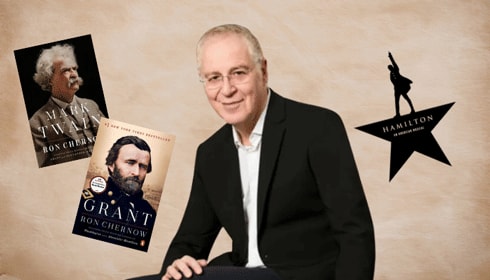 Photo Credit: Beowulf Sheehan
Former freelance journalist-turned-historical biographer Ron Chernow won the Pulitzer Prize and the American History Book Prize for his 2010 biography of the first President of the United States, Washington: A Life. However, the event that would catapult him to popular stardom as a historian was still to come.
A few years before writing his Pulitzer Prize-winning biography of Washington, Chernow had written another biography of a founding father, simply titled Alexander Hamilton. In 2015, playwright Lin-Manuel Miranda adapted the book into the mega-hit Broadway musical Hamilton—and the rest, as they say, is history.
Chernow worked on the musical as a historical consultant, thereby cementing his legacy as one of the leading chroniclers of American history. In addition to Hamilton and Washington, Chernow has written numerous other bestselling historical biographies, including those of Mark Twain, Ulysses S. Grant, and John D. Rockefeller.

Washington: A Life


Alexander Hamilton

Mary Beard
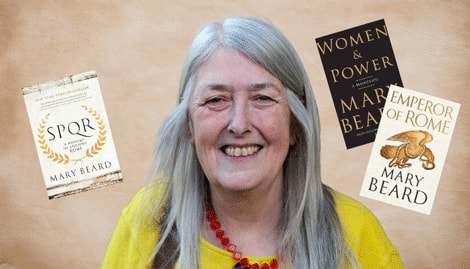 Photo Credit: David Levenson
Described by The New Yorker as “learned but accessible,” sometimes controversial historian Mary Beard’s many television appearances have helped cement her as “Britain’s best-known classicist.” Her 2008 book Pompeii: The Life of a Roman Town did much to usher her into the spotlight and helped to change the public’s ideas about what life was like in ancient Rome.
Though her career was often plagued with controversy—she was more than once heaped with death threats and other abuse after claims made on social media, including in 2017, after she explained that Roman Britain may have been more ethnically diverse than many believe—she was also no stranger to fighting to have her voice heard.
When she first started teaching classics at Newnham College in Cambridge, she was the only woman in her department. Despite that, she went on to become one of the most popular public historians in the world, publishing numerous books and making countless TV appearances over the years.
SPQR: A History of Ancient Rome
Women & Power: A Manifesto
Lillian Guerra
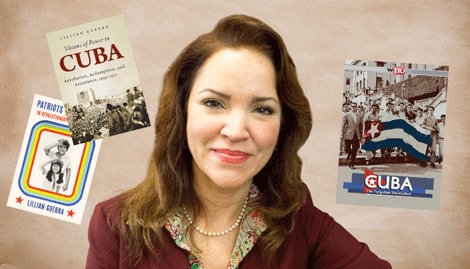 Photo Credit: Lillian Guerra
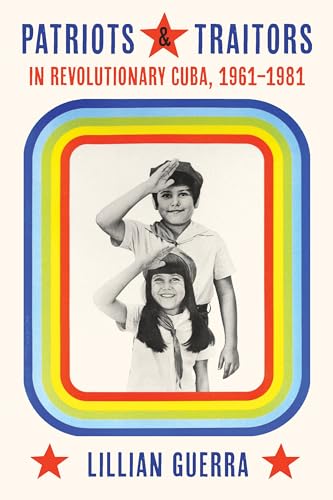
“As a historian, I knew that I would never find a single answer,” writes Lillian Guerra in her 2005 book The Myth of Jose Marti. Born in New York to Cuban parents and raised in Marion, Kansas, Guerra became an expert on Cuba and Puerto Rican history. Today, she is the director of the Cuba Program at the University of Florida.
The author of five books (and counting), she has served as an advisor and lead scholar on several films, including the Emmy-winning American Public Television documentary Cuba: The Forgotten Revolution. She is regularly consulted by the media to speak on issues of Cuban history, and has given lectures and keynote speeches everywhere from Harvard, Stanford, and Yale to LA’s J. Paul Getty Museum.
Throughout her career, she has made a considerable contribution to changing how the world views Cuba, the island nation’s tumultuous political history, and America’s involvement therein.
The Myth of José Martí
Patriots and Traitors in Revolutionary Cuba
Derek Guy
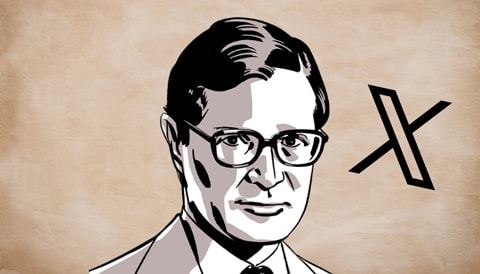 Photo Credit: Derek Guy
“The Menswear Guy” may not be what we usually think of as a historian, but Derek Guy’s frequent tweet threads and other social media posts about the history of men’s fashion have probably had a bigger impact on the public’s understanding of how and why we dress the way we do than any hundred books on the subject.
Since his tweets about the sartorial choices of politicians and other public figures first went viral in 2022, Guy has contributed pieces to publications ranging from GQ and Esquire to Foreign Policy, Politico, and The Nation, and has been named among “the definitive index of people shaping the global fashion industry.”
He has also drawn the attention, and sometimes the ire, of major public figures, such as when he shared his own family’s immigration story (born in Vancouver, Guy is the son of Vietnamese refugees), prompting the official accounts of both Vice President J.D. Vance and the Department of Homeland Security to post memes implicitly threatening him with deportation.
Featured image: Thei Reza / Canva


