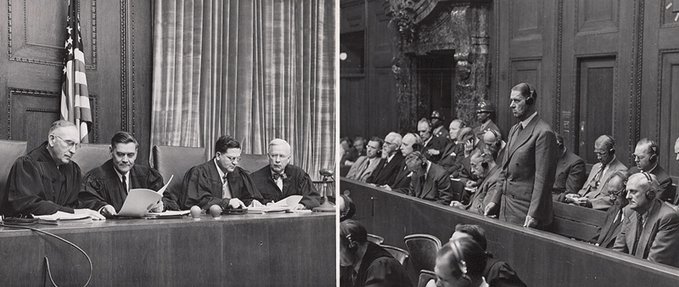
“The privilege of opening the first trial in history for crimes against the peace of the world imposes a grave responsibility,” Supreme Court justice Robert H. Jackson said in his opening statements at what became known as the Nuremberg trials. “The wrongs which we seek to condemn and punish have been so calculated, so malignant, and so devastating, that civilization cannot tolerate their being ignored, because it cannot survive their being repeated.”
For years prior to the trials, the world had been gripped by the devasatation of World War II. The Nazis had invaded many countries across Europe, and killed millions of people, many of them noncombatants and even German citizens.
On May 8, 1945, Germany surrendered unconditionally in Berlin, bringing an end to the war in Europe. A little over six months later, some of the most important surviving leaders of the Nazi regime were tried by the newly formed International Military Tribunal (IMT) at the Palace of Justice in the German city of Nuremberg.
What was the Purpose of the Nuremberg Trials?
“For the first time in history, military, economic, and political leaders identified as Major Offenders would be held to account for the actions of their government and military and its crimes against humanity and peace,” states an article at the National WWII Museum in New Orleans.
Even before the end of the war, opinions about what should be done to the surviving Nazis varied. Representatives from the Soviet Union advocated for a show trial—one in which the verdict was already established—to showcase the crimes which the Nazis had committed. The United Kingdom, meanwhile, favored summary executions, citing the failure of trials held following the first World War.
Ultimately, the Allied forces agreed to the format the Nuremberg trials would take, forming the IMT and drafting the Nuremberg charter, which laid out the offenses that would be prosecuted, and the way the trial would unfold.
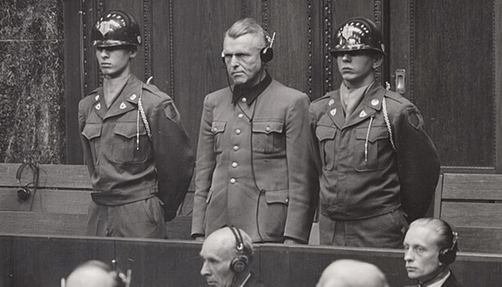
 Photo Credit: Wikimedia Commons
The purpose of the tribunal was not just to bring Nazi war criminals to justice, but to assemble irrefutable evidence of their crimes, offer an object lesson to the German populace, and establish and legitimize international law, including such concepts as the “crime of aggression,” crimes against humanity, and the idea of genocide, a term coined by Polish-Jewish lawyer Raphael Lemkin between 1941 and 1943.
As such, the Nuremberg trials have been seen as “the true beginning of international criminal law.”
Who was Tried at the Nuremberg Trials?
Several of the most prominent figures in the Nazi Party had taken their own lives or otherwise perished before the end of the fighting in Europe. Among these were Adolf Hitler, Heinrich Himmler, and Joseph Goebbels.
However, more than 20 leading figures of Nazi Germany were tried at the Palace of Justice in Nuremberg, among them former military leaders, cabinet ministers, and even important business leaders such as Albert Speer, Gustav Krupp, and former Reichsbank president Hjalmer Schacht.
Among the most infamous of the defendants at the Nuremberg trials were Hermann Goring, the former commander of the Luftwaffe, as well as Hitler’s deputy Rudolf Hess.
Also put on trial were seven organizations, including the leadership of the Nazi Party, the Gestapo, the paramilitary SS, SA, and SD, and the general staff and high command of the German military.
The idea was that if these organizations could be declared criminal, it would expedite further convictions, while also allowing prosecutors to punish Nazis without condemning the entire German populace.
The full list of defendants at the Nuremberg trials were: Martin Bormann, the former Nazi Party Secretary, who was tried in absentia and later found to have died before the trial took place; Karl Donitz, leader of the Kriegsmarine; Hans Frank, Governer-General of occupied Poland; Wilhelm Frick, Hitler’s former Minister of the Interior; Hans Fritzsche of the Nazi Propaganda Ministry; Walther Funk, Hitler’s former Minister of Economics; Herman Goring; Rudolf Hess; Alfred Jodl, a high-ranking general; SS leader Ernst Kaltenbrunner; Wilhelm Keitel, Hitler’s de facto defense minister; industrialist Gustav Krupp; Robert Ley, the head of the German Labor Front; former foreign affairs minister Konstantin von Neurath; former German chancellor Franz von Papen; Erich Raeder, former commander of the Kriegsmarine; former Minister of Foreign Affairs Joachim von Ribbentrop; racial theorist Alfred Rosenberg; Fritz Sauckel, who oversaw part of the Nazi program of forced labor; economist Hjalmar Schacht; Hitler Youth leader Baldur von Schirach; Arthur Seyss-Inquart, who was instrumental in the annexation of Austria; Hitler’s close friend, Albert Speer; and Julius Streicher, who published the antisemitic newspaper Der Sturmer.
What Happened at the Nuremberg Trials?
The Nuremberg trials were designed to resemble normal criminal trials. Presided over by judges drawn from the Allied nations, they featured prosecutors, also from among the Allies, while each of the defendants was allowed an attorney. The intent was to show the proceedings as legitimate criminal proceedings, rather than victors taking revenge upon a defeated foe.
The Nuremberg trials lasted 295 days. Prosecutors from several countries gave testimony, with many focusing on physical and documentary evidence, rather than witness accounts. Prosecutors from the United States showed films of the liberation of the concentration camps, which shocked many in the courtroom with their horrors. The defense attorneys for the various accused also presented their cases.
“War is essentially an evil thing,” the tribunal stated, in delivering its verdicts. “Its consequences are not confined to the belligerent States alone, but affect the whole world. To initiate a war of aggression, therefore, is not only an international crime; it is the supreme international crime, differing only from other war crimes in that it contains within itself the accumulated evil of the whole.”
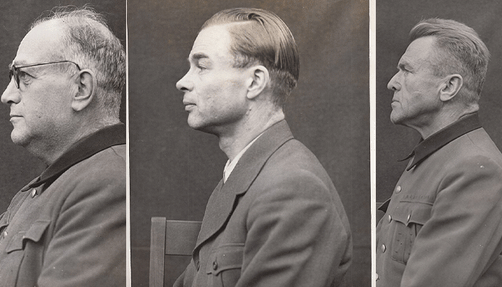 Photo Credit: Wikimedia Commons
Ultimately, 19 of the defendants were found guilty of various war crimes and crimes against humanity, while only three were acquitted. Of those found guilty, 12 were sentenced to death, three to life imprisonment, and four to prison terms of 20 years or less. 10 of those sentenced to death were executed by hanging on October 16, 1946. Hermann Goring took his own life the night before.
Only four of the organizations put on trial were ultimately declared criminal: the Leadership Corps of the Nazi Party, the Gestapo, the SS, and the SD. Even then, for anyone to subsequently be tried for membership in these organizations, it was ruled that willing membership and knowledge of the criminal purposes of the group had to be proved by the prosecution.
Those defendants who were sentenced to prison time served out their sentences in Spandau Prison in West Berlin, which was turned over to the control of the Allies. By 1966, Rudolf Hess was the last of these, and the 600-cell prison continued to be maintained, operated, and staffed for its lone prisoner until Hess’s death by apparent suicide in 1987, at the age of 93.
Further Trials and the Legacy of Nuremberg
The initial plan had been for several additional trials to follow the original hearings at Nuremberg, but the Allies were unable to agree upon logistics. Instead, 12 subsequent military tribunals were held solely by the United States, but convened in the same courtroom where the Nuremberg trials took place. These tribunals took place between December of 1946 and April of 1949, and included the prosecution of more than 175 Germans arrested as war criminals by the United States.
The tribunals were grouped by type. For example, the Doctors’ Trial saw the prosecution of 23 Nazi physicians, while the Judges’ Trial focused on Nazi jurists. Other trials targeted industrialists who had helped in the war effort and utilized slave labor, specific military and government leaders, and those who had been involved in “racial cleansing” and resettlement activities.
Ultimately, more than 140 were found guilty, and a few more were sentenced to death, including several members of the SS. Not all the sentenced executions were carried out, with some commuted to prison terms, while others were eventually released outright.
The Nuremberg trials were also followed by the International Military Tribunal for the Far East, also known as the Tokyo Trial, which took place in Tokyo in 1946, with the similar intent of trying the leaders of imperial Japan for war crimes, crimes against peace, and crimes against humanity during World War II. The Tokyo Trial, which took place from April of 1946 until November of 1948, prosecuted 28 Japanese political and military leaders.
Perhaps the most significant legacy of the Nuremberg trials, however, has nothing to do with who was charged there, or what the verdicts were. Instead, the trials have been seen by many as the “true beginning of international criminal law.”
By December of 1946, the United Nations General Assembly had unanimously passed a resolution affirming “the principles of international law recognized by the Charter of the Nuremberg Tribunal.” The International Law Commission drafted the “Nuremberg principles” in 1950, partly as an attempt to codify international criminal law, and a permanent International Criminal Court was proposed as early as 1953, though it would not be established until 2002.


