
When you watch a movie or TV show that is ostensibly “based on a true story,” it’s important to remember that “based on” are the active words there.
Any student of history knows that creative liberties are the name of the game when it comes to historical adaptations, and a list of the movies and shows that got history right would be much shorter than a list of those that got history wrong.
Then again, there are minor historical inaccuracies, such as inauthentic costuming choices or a modern-day item spotted in the background of a shot, and then there are movies and TV shows that seem to make up history from whole cloth. Here are a few of the most galling historical inaccuracies in hit movies and TV shows…
Gladiator
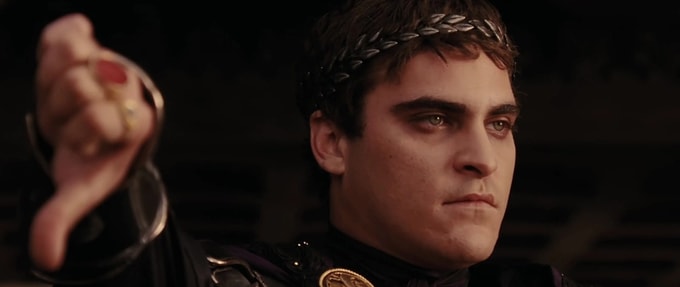
Gladiator nabbed five Academy Awards, including Best Picture and a Best Actor statue for star Russell Crowe. This story of a Roman general turned slave and gladiator also raked in nearly half-a-billion at the box office, becoming one of the highest-grossing films of 2000. One accolade that it won’t ever win, though, is one for historical accuracy.
The Inaccuracies: Despite director Ridley Scott’s intentions to produce a more historically accurate portrait of ancient Rome, it would probably be easier to list the few things that Gladiator gets right than the many it gets wrong. Besides the usual crop of historical anachronisms, the main changes that Gladiator makes to history concern the Roman emperor Commodus, played by Joaquin Phoenix.
In the film, Commodus murders his father, Marcus Aurelius, in order to become emperor after learning that his father hopes to return the empire to a republic. He is later slain himself in the gladiatorial arena. In reality, Marcus Aurelius died of an epidemic, there was no indication that he had any such political intent, and he and Commodus actually co-ruled the empire for several years before his death. While Commodus did fight as a gladiator, however, he died under very different circumstances.
As for Russell Crowe’s character, Maximus, who slays Commodus in the arena? He didn’t exist at all.
Pocahontas
The 33rd full-length animated feature in the so-called “Disney canon,” Pocahontas was part of what was known as the “Disney Renaissance,” a string of animated blockbusters which also included The Little Mermaid, Beauty and the Beast, Aladdin, and The Lion King. It tells a fictionalized version of the legend of Pocahontas, a Powhatan woman who allegedly saved the life of John Smith, an English settler. In the film, the two become romantically involved.
The Inaccuracies: We don’t generally look to Disney cartoons for historical accuracy, but according to animator Tom Sito, the crew “tried hard to be historically correct and to accurately portray the culture of Virginia’s Algonquins.” Historical inaccuracies abound right from the start, though.
The biggest ones concern Pocahontas herself, whose real name was Matoaka or Amonute—Pocahontas was a nickname. The real Pocahontas would have been around 10 or 11 years old at the time the film takes place, and though she later married a different Englishman, there is no record that she was ever romantically involved with John Smith.
Hidalgo
Starring Viggo Mortensen fresh off his success in Lord of the Rings and released by Disney under their Touchstone Pictures label, this adventure film was set up to be a blockbuster, even if it ended up barely returning its budget at the box office. Based on the memoirs of American long distance rider Frank Hopkins, the film follows him to Arabia, where he competes in the “Ocean of Fire,” an annual 3,000-mile race where Hopkins pits his mustang Hidalgo against pure-blooded Arabian horses.
The Inaccuracies: Few movies have ever stretched their “based on a true story” premises further than Hidalgo. Unpublished during his lifetime, Hopkins’ memoirs seem to be largely a work of fiction, and many scholars have called him a con artist. While the movie embellishes everything from the details of his Lakota ancestry to his (putative) work with Buffalo Bill’s Wild West show, the most egregious inaccuracy is the race which makes up the film’s main plot.
Not only did Hopkins never participate in any such race, much less win it… the race itself didn’t even exist.
Peaky Blinders
Originally airing on BBC One, Peaky Blinders tells the story of the Shelbys, a fictional crime family in Birmingham following the First World War. The series became a critical and commercial success so popular that it was hypothesized to have affected the choice of baby names in the UK.
The Inaccuracies: Here’s the thing: The Peaky Blinders were a real street gang in Birmingham, and they probably did dress at least a little bit like their small screen namesakes. It’s not even that unusual that the Shelbys at the heart of the story were not the real leaders of the gang but are, in fact, a made-up family.
Perhaps more galling for history buffs, however, the Peaky Blinders were mainly active a few decades before the show starts, and by the beginning of the series, which takes place immediately after the end of the First World War, the Peaky Blinders had mostly been supplanted by larger gangs. Also, in spite of the popular myth, the name doesn’t come from them sewing razor blades into the brims of their caps.
The Conqueror
Intended as a star-studded historical epic, this sprawling biopic of Genghis Khan has been widely panned as one of the worst movies ever made, and it won its star, John Wayne, a posthumous Golden Turkey Award for Worst Casting.
The Inaccuracies: Let’s start with the elephant in the room: John Wayne allegedly lobbied hard to get the role of Genghis Khan, and, unfortunately, casting white actors in non-white roles was still commonplace in 1950s Hollywood. Even with those caveats, however, Wayne seems to be hilariously miscast as the Mongolian warlord. Biographer Michael Munn later wrote that even Wayne realized he wasn’t cut out for the role, and said that the film taught him “not to make an ass of yourself trying to play parts you’re not suited for.”
Of course, Wayne’s performance is far from alone in the historical inaccuracies department. Take Anne Hayward, who plays Genghis Khan’s first wife. In the film, she is the daughter of a Tartar enemy who is taken by the Mongols and eventually falls in love with Wayne’s Khan. In real life, the two were from friendly tribes, and were betrothed as children, when the boy who would become Genghis Khan as only around nine years old.


