
Often throughout history, it took a brave voice willing to threaten the status quo to make a change. From a young woman risking her life to expose racial terror to two reporters breaking down a network of governmental corruption, these nine investigative journalists uncovered abuses of power, ultimately changing history’s course.
Nellie Bly: Ten Days in a Mad-House
In 1887, Nellie Bly went undercover as a patient in a mental health asylum as part of an exposé for the New York World, spotlighting its terrible conditions, systemic abuse, and overall neglect.
While there, she worked on a series that became Ten Days in the Mad-House, ultimately raising awareness about the treatment of mental health patients and prompting improvements to institutional conditions.
Through her hard-hitting stories, she broke gender barriers and inspired a wave of female journalists. Paving the way for a practice we now recognize as investigative journalism, she continued to report on wrongdoing in New York, covered World War I from Europe, and famously traveled around the world in 72 days, setting a world record at the time.
Ida B. Wells: Southern Horrors
After three of her friends were lynched by a white mob in Memphis in 1892, Ida B. Wells decided to launch an investigation. Through groundbreaking pamphlets like Southern Horrors and The Red Record, Wells documented hundreds of lynchings and dismantled the white narratives used to justify racial terror, namely that Black men were being executed for attacking white women.
In reality, she found that lynchings were used as a way to punish Black Americans who were achieving success, whether competing with white businesses or refusing to be subservient. Additionally, Wells co-founded the NAACP (National Association for the Advancement of Colored People) and established the National Association of Colored Women, among many other pioneering achievements.
Ida Tarbell: The History of the Standard Oil Company
Ida Tarbell was one of the most influential muckraking journalists at the turn of the 20th century—a practice that emerged in response to Gilded Age excess and sought to expose institutional corruption. While working for McClure’s Magazine, she wrote a series of installments on John D. Rockefeller’s Standard Oil Company, exposing its brutal tactics.
From revealing predatory pricing to secret railroad deals, her reporting inflamed public outrage, ultimately leading to the landmark 1911 U.S. Supreme Court ruling that broke Standard Oil into 34 separate companies under the Sherman Antitrust Act. Her work was solidified into a two-volume book, The History of the Standard Oil Company, published in 1904.
Seymour Hersh: My Lai Massacre
On November 12, 1969, Seymour Hersh broke the story of the My Lai Massacre. He had received information from military sources and eventually tracked down details about Lt. William Calley, who commanded Charlie Company, 1st Battalion, 20th Infantry Regiment.
He found that between 200 and 500 South Vietnamese civilians, mostly women, children, and elderly men, were murdered by U.S. soldiers—and, following the original investigation, had been covered up. At least 30 members participated in the atrocity, but only Calley was charged with killing 22 civilians and sentenced to life imprisonment, though his sentence was later reduced.
Hersh’s coverage earned him the 1970 Pulitzer Prize for International Reporting. He would go on to cover the Watergate scandal for The New York Times throughout the 1970s, and, in 2004, he revealed the U.S. military’s torture of prisoners at the Abu Ghraib prison in Iraq.
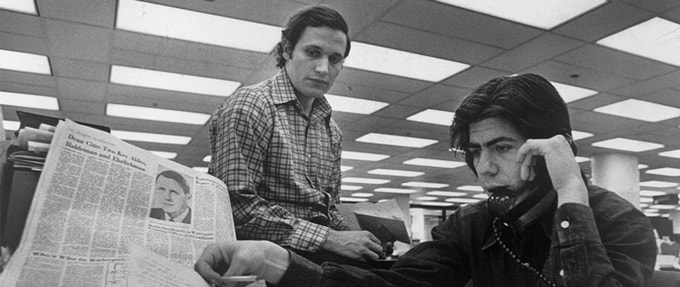
Bob Woodward and Carl Bernstein: Watergate
Two young Metro reporters, working for The Washington Post, Bob Woodward and Carl Bernstein, were assigned to cover a minor burglary at the Democratic National Committee headquarters in the Watergate complex in June 1972.
Guided by a confidential source, later revealed to be FBI Deputy Director Mark Felt, they connected the burglary to illegal campaign slush funds. Ultimately, they revealed how the break-in was just scratching the surface, and, in fact, part of a much bigger operation of dirty tricks involving spying on Democratic campaigns, planting false stories, and more.
Their reporting won The Washington Post a Pulitzer Prize and generated congressional pressure that directly led to President Richard Nixon’s resignation on August 9, 1974.
Ronan Farrow: Catch and Kill
Ronan Farrow was among the wave of reporters who unleashed the #MeToo movement. In 2017, his landmark reporting, which won him the 2018 Pulitzer Prize, contained the first on-the-record accounts of rape and sexual assault against Hollywood producer Harvey Weinstein.
Farrow revealed how Weinstein hired private intelligence agencies, like Black Cube, for undercover agents that intimidated journalists, blocking any reporting on his misconduct. In his 2019 book Catch and Kill, named after the journalistic practice where a media organization buys the exclusive rights to a sensitive story, Farrow further showed how NBC News executives tried to thwart and extinguish his investigation.
Anna Politkovskaya: A Dirty War
Working for the independent newspaper Novaya Gazeta, Anna Politkovskaya reported from the front lines of Russia’s Second Chechen War. Her investigation exposed human rights abuses, including war crimes, extrajudicial killings, torture centers, and forced disappearances carried out by Russian forces. She became a voice for civilian victims.
In books such as Putin’s Russia, she made her opposition to the leader clear, criticizing his dismantling of democratic institutions and press freedom in Russia. After years of threats and an attempted poisoning, Politkovskaya was shot dead in the elevator of her apartment building on October 7, 2006. Although several men were convicted, the masterminds who ordered the killing have never been revealed.
Daphne Caruana Galizia: Malta Corruption
Reporter, editor, columnist, and blogger, Daphne Caruana Galizia reported on political events in Malta. But she became known internationally for her investigation of the Panama Papers—a massive 2016 leak of millions of confidential documents from the Panamanian law firm Mossack Fonseca.
She used the leak to investigate Malta’s own corruption, and found that senior members of Malta’s government, including then-Prime Minister Joseph Muscat’s inner circle, tied offshore shell companies in Panama to local accounts and deals, including 17 Black.
On 16 October 2017, after years of intimidation, Galizia was assassinated near her home with a car bomb, leading to public outrage. In December 2017, three men were arrested, and Yorgen Fenech, the owner of the Dubai-based company 17 Black, was arrested two years later in connection with her killing.
Maria Ressa: Rappler and the Duterte Drug War
Filipino-American journalist Maria Ressa is known for co-founding Rappler in 2012, the Manila-based digital media company that investigates government policies and human rights abuses. After former president Rodrigo Duterte took office, she covered the mass killings carried out in his anti-drug campaign.
She tracked accounts across social media that pushed a pro-government agenda and argued that Facebook played a key role in threatening democracy. In 2019, she was arrested on a government-filed cyber libel charge tied to a 2012 article and convicted in 2020.
Nevertheless, she shared the 2021 Nobel Peace Prize with Russian journalist Dmitry Muratov for “their efforts to safeguard freedom of expression, which is a precondition for democracy and lasting peace.”
Featured image: Bettmann Archive


