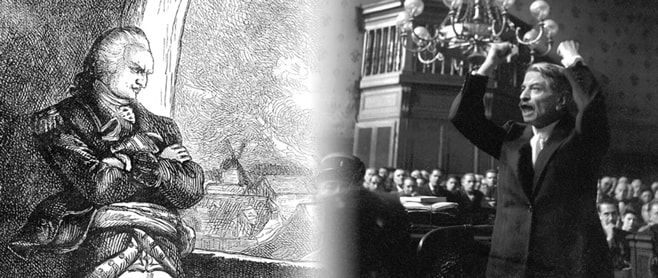
Whether for power, money, or fame, many figures throughout history have had no problem stabbing their allies in the back.
From a once-heroic revolutionary who facilitated a puppet government to an American showgirl who broadcast Nazi propaganda, these people betrayed their countries—and most did not live to tell the tale.
Ephialtes of Trachis
Beginning in Ancient Greece, Ephialtes of Trachis was a renegade who famously betrayed King Leonidas and his forces at the Battle of Thermopylae in 480 BCE. The allied Greek land forces, totaling around 4,200 men, chose Thermopylae, a narrow coastal mountain pass, to block the advance of the larger Persian army.
The gap between the Trachinian Cliffs and the Malian Gulf was narrow, but it led to the main road behind the Greeks. Ephialtes revealed the trail to Xerxes, the Persian leader, who used the advantage to launch a surprise attack on the Greeks. He expected a reward from the Persians for his betrayal, but it amounted to nothing when they were later defeated at the Battle of Salamis.
He fled with a reward now put out for his head, but Athenades of Tracis killed him for an unrelated reason around 470 BCE. Nonetheless, they celebrated him, and today he is remembered for slaying the traitor.
Marcus Junius Brutus
Brutus’ betrayal is immortalized in one of William Shakespeare’s most famous plays, Julius Caesar. Recognizing his friend among his assassins, the dictator of the Roman Republic says, “Et tu, Brute?” translating to “And you, Brutus?”
Brutus was a Roman senator said to have descended from the founder of the Roman Republic—the city’s established government, where elected officials and a Senate ruled instead of a king. His mother, Servilia, was an influential woman in Rome and widely known as Julius Caesar’s lover. Some historians suggest Brutus was actually their child, which may have contributed to Caesar’s deep affection for him.
Whether or not he was his father, Caesar served as a father figure to him, even pardoning Brutus when he fought against him at the Battle of Pharsalus in 48 BCE, and later appointing him governor of Gaul. But Brutus rejected Caesar’s authoritative power when he assumed the title of dictator.
Brutus, joining a group of senators, assassinated Caesar on March 15, 44 BCE, stabbing him 23 times. Although Shakespeare’s famous line is fiction, it’s said he cried out, “And you, my child?” when he saw Brutus among the frenzy of faces.
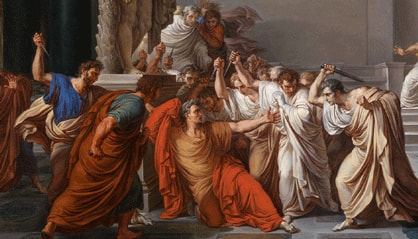

The Death of Julius Caesar by Vincenzo Camuccini
Photo Credit: Vincenzo Camuccini / Wikimedia CommonsGeorge Plantagenet
On February 18, 1478, his brother, King Edward IV, found George Plantagenet guilty of “unnatural and disloyal treason” and had him executed in the Tower of London. When his older brother became Edward IV, the first Yorkist king, George was created Duke of Clarence and remained his brother’s heir for nine years.
It seems that maintaining the potential for power all that time made George an ill-tempered man. During the Wars of the Roses, he joined his father-in-law, the Earl of Warwick, to rebel against Edward IV, briefly siding with the Lancastrians before returning to the Yorkists. Later, when his wife died in 1476, George had one of her lady’s maids tried and executed for poisoning—an authority he didn’t have.
When George burst into a council meeting, Edward ordered his arrest. During the trial, it was revealed he had additionally been plotting against the king, spreading rumors about his illegitimacy, and retaining Lancastrian succession documents to seize power. Some stories claim that George was drowned in a vat of wine, but that will remain a mystery, as he was executed in private.
Mir Jafar
Serving as commander-in-chief of the Bengali army under Nawab Siraj-ud-Daulah, Mir Jafar betrayed him at the Battle of Plassey in 1757, with drastic consequences. As put by writer Morgan Dunn, “History is rarely decided by individuals, but sometimes one person’s actions at the right moment can decide the fate of millions.”
In June 1757, Mir Jafar made a secret pact with British commander Robert Clive, withholding many of his troops from the Bengali army and allowing a much smaller British force to win. For his treason, Britain established him as the first dependent, or in other words, puppet, Nawab of Bengal.
Across the Indian subcontinent, his name is interchangeable with traitor: Mir Jafar in Bengali and Meer Jafar in Urdu. Effectively, he opened the door for nearly 200 years of British colonial power.
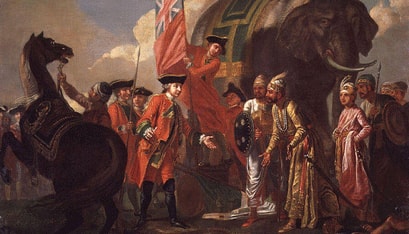
Robert Clive meets with Mir Jafar after Plassey.
Photo Credit: Francis Hayman / Wikimedia CommonsBenedict Arnold
Benedict Arnold is widely regarded as America’s most famous traitor—his name having become synonymous with deception. At first, he was a hero of the Revolutionary War: he helped capture the British garrison at Fort Ticonderoga in 1775; he blocked a British invasion of New York; and finally, he played a significant role in facilitating the surrender of British General John Burgoyne’s army at Saratoga.
But in 1779, feeling he never received the recognition he deserved for his contributions, he began negotiating with the British. Eventually, he, in exchange for money and command of the British army, turned over the U.S. post at West Point. When the plot was revealed, he fled to a British ship and later led forces in raids against his own former countrymen in Virginia and Connecticut.
Vidkun Quisling
In several North European languages, the term “quisling” has become a synonym for “traitor,” after Vidkun Quisling. Early in his career, Quisling served as a Norwegian military officer, a diplomat in the Soviet Union, and Norway’s Minister of Defense from 1931 to 1933. But when the Agrarian Party didn’t reappoint him as party leader at the end of his term, he decided to form his own party: Nasjonal Samling (National Unity).
The party was fascist, founded on “a corporatist vision of society” and “an emphasis on nationalism,” among other far-right beliefs. But the party did not win elections. With the start of World War II in 1939, Norway became important to Nazi Germany’s strategy. In December 1939, Quisling met with Erich Raeder, head of the German navy, and then Hitler.
After suggesting the British planned to move into Norway, he helped spur the German invasion on April 9, 1940. Quisling took to the airwaves, facilitating the first-ever attempted coup d’état by radio, urging Norwegians to welcome the Germans, and declared himself prime minister. Six days later, Nazi leadership made him step down, and instead, in 1942, appointed him prime minister of a Nasjonalregjering (National Government), essentially a puppet state under German control.
Under his regime, anti-Jewish laws were established and facilitated the deportation of hundreds of Norwegian Jews to Nazi concentration camps. Following the liberation of Norway in May, he was convicted of high treason, embezzlement, murder, and executed by firing squad on October 24, 1945.
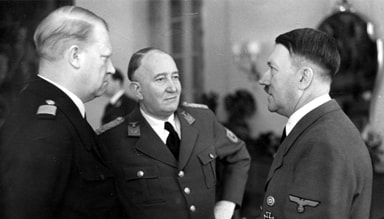
Adolf Hitler meets the Norwegian Prime Minister Vidkun Quisling.
Photo Credit: National Digital ArchivesPierre Laval
A French politician and statesman, Pierre Laval led the Vichy government, the French state, in collaborating with Germany during World War II. He served as the Prime Minister of France for two terms, from 1931-1932 and 1935-1936. Certain that the Nazis would win, as Chief of State, he decided that France’s best course would be to support the 1940 armistice with Nazi Germany, helping to dismantle the Third Republic, the democratic regime.
In exchange for French prisoners of war, he conscripted hundreds of thousands of French workers to German industrial plants. He also ordered French police to hunt down Jewish people, deporting roughly 77,000 Jews to Nazi concentration and extermination camps. Finally, he also permitted the creation of the pro-Nazi Milice and allowed the Gestapo to seek out members of the French Resistance.
After the Allied liberation of France, he fled Germany, Austria, then Spain, before surrendering to U.S. forces and being extradited to France. There, he was convicted of high treason and executed by a firing squad in Paris on October 15, 1945.
Mildred Gillars
Known by the nickname “Axis Sally,” Mildred Gillars became the first woman convicted of treason against the United States. Born in Portland, Maine, she moved to Europe in 1934, and, in 1940, was hired by German state radio. Once the U.S. entered the war, she signed an oath to the Nazi regime.
Hosting shows like Home Sweet Home, Midge at the Mike, GI’s Letter-box, and the famous 1944 D-Day radio drama Vision of Invasion—in which Gillard’s plays an American mother who dreams her son dies violently—her broadcasts induced homesickness and fear among Allied soldiers.
In 1946, she was captured in Berlin and sent to America to be put on trial. In March 1949, she was convicted and spent 12 years in prison before being paroled in 1961.
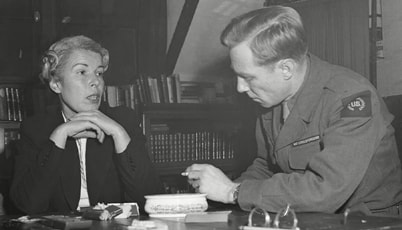
Mildred Gillars sits in her cell for an interview with a reporter.
Photo Credit: Baatz/AP/REX/ShutterstockWang Jingwei
In China, Wang Jingwei’s name has become synonymous with the word Hanjian, traitor. At first, he was a heroic revolutionary who played a key role in overthrowing the Qing dynasty. But his trajectory took a turn when, during the Second Sino-Japanese War, he became dissatisfied with his role under Chiang Kai-shek.
When Japan invaded China in 1937, they committed atrocities, including the Nanjing Massacre—a six-week campaign of murder, sexual violence, arson, and looting. Jingwei wanted to negotiate peace with Japan, but his colleagues wouldn’t listen. So, in 1940, he decided to administer a “Japanese-controlled puppet government in Nanjing.”
In the later years of the war, his health declined, and he died in 1944 without facing any consequences. Today, his legacy remains very complex.
Sidney Reilly
Ian Fleming’s iconic James Bond drew inspiration from Sidney Reilly, born Sigmund/Shlomo Rosenblum in Odessa (then part of the Russian Empire), who became known as the “Ace of Spies.” While traveling in Brazil, Reilly befriended British Army Officers, who recommended him to British intelligence in London in 1869. There, he officially changed his name.
As part of Britain’s Secret Intelligence Service (MI6), he completed several missions over the years—many of which he himself is believed to have exaggerated. From reporting on Russian oil developments in Baku to, famously, disguising himself as a priest on the French Riviera in 1905 to secure Britain’s future energy resources.
Following the Russian Revolution in 1918, Reilly was sent to Russia to gather intelligence. There, alongside British diplomat Robert Bruce Lockhart, he helped facilitate a covert plan to overthrow the Bolshevik leadership. In August 1818, his plans fell through when an unrelated assassination attempt on Vladimir Lenin launched the “Red Terror,” a massive Soviet crackdown.
Reilly narrowly managed to escape, but was sentenced to death. Although MI6 dismissed him in 1920, he continued trying to topple the Soviet regime. Setting a trap known as Operation Trust, Reilly was captured by the Soviet secret police and, by direct orders of Joseph Stalin, was executed with a shot to the back of the head.


