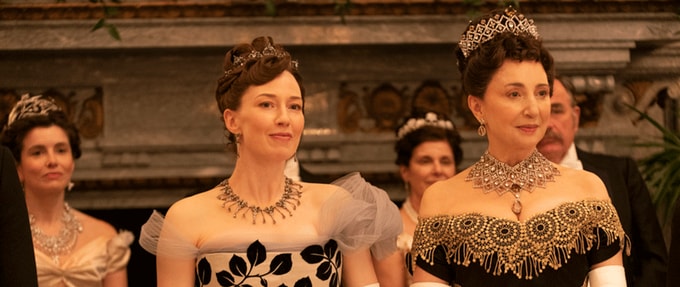
The Gilded Age is everyone’s favorite drama, where “nothing happens.” Although some may see that as a criticism, fans love the show’s low stakes, where feuds and disputes over social etiquette become high drama.
However, the newest season, which premiered on HBO on November 1st, has introduced some bigger plot swings, including marital strain while navigating the effects of addiction and capitalism. Still, the show has remained true to its charming core, introducing more theater-caliber cast members and intricate costumes (don’t even get us started on Peggy’s wedding dress!).
Rooted in 1880s New York City and Newport, Rhode Island, the show spotlights the clash between new wealth and old money. Some fans may be surprised to find out that, although The Gilded Age invents characters and dramatizes timelines, the overarching conflicts and many of the historical figures are, in fact, grounded in truth.
Want to find out who’s based on whom? Read on to discover what The Gilded Age gets right and wrong during this glittering facade in American history.
Trailer for The Gilded Age Season 4
Characters
Bertha Russell
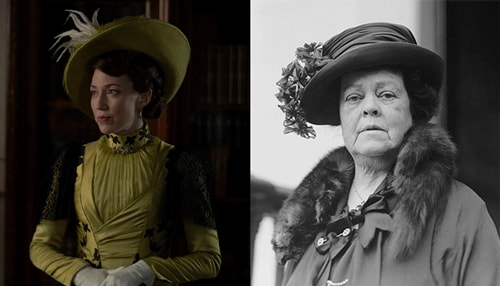
 Photo Credit: HBO and Wikimedia Commons
Bertha Russell, played by Carrie Coon, is not only the central lead of The Gilded Age, but is also heavily based on the real-life socialite Alva Vanderbilt. Born into a wealthy Southern family, their fortune came from cotton and was therefore tied to enslaved labor. When the American Civil War ended in 1865, slavery ended as an economic institution. Her family relocated to New York City, and Alva learned just how tough Manhattan’s elite social circle was to infiltrate.
At 22, she married William Kissam Vanderbilt, grandson of railroad tycoon Cornelius ‘Commodore’ Vanderbilt, whose father became the richest American in 1877—as evidence of the family’s extreme wealth. Alva’s charm and social wit, combined with the Vanderbilts’ vast fortune, allowed them to spring to the upper echelons of society—but not without a fight.
First, she had to conquer Mrs. Astor, the gatekeeper of New York’s elite. As the popular legend goes, and as played out in the season 1 finale, Vanderbilt planned a costume party for her housewarming, but since Astor had never called on Vanderbilt, she decided at the last minute to tell Astor’s youngest daughter she couldn’t attend. Astor had no choice but to attend and, as such, allow Vanderbilt into high society. As the New York Times reported on the family’s legacy in 1899, “The wealth of the Vanderbilt family had become so powerful in New York [...] that the oldest Knickerbocker families were gradually forced to surrender.”
If the show continues to stick to real life, Mr. and Mrs. Russell are on a doomed path. In 1895, Alva sought to separate from her husband, given he had been spending much time away from home, with romantic liaisons in Europe, at a time when divorce was highly stigmatized. It’s reported in Anderson Cooper and Katherine Howe’s bestselling book, Vanderbilt, that she boasted, “I was the first girl of my ‘set’ to marry a Vanderbilt. Then I was the first society woman to ask for a divorce, and within a year ever so many others had followed my example.”
George Russell
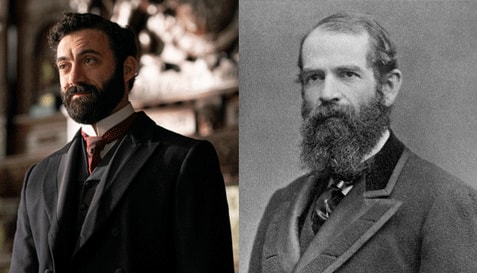 Photo Credit: HBO and Wikimedia Commons
However, there may still be hope for the Russells, as George is primarily based on Jay Gould, rather than a Vanderbilt. Regarded as one of the foremost “robber barons” of the Gilded Age, the term given to powerful industrialists who built vast fortunes using monopolistic trusts and worker exploitation, Gould’s ruthlessness is often mirrored in Mr. Russell.
Although Gould was one of the richest men during the era, he had few admirers. As Greg Steinmetz writes in American Rascal, “[Gould] would bring pain to everyone with money in the market” to turn a profit. In season 1, we do see Russell bribe New York City aldermen with railroad stock deals, but he may possess more humanity than his real-life counterpart, as seen when he stops guards from firing on workers at his mills.
Russell’s dream is to build a transcontinental railroad, linking the coasts of the United States—which Gould never accomplished, though he gained control of key western lines. Either way, Russell reflects the capitalist demands of the Gilded Age: the belief that the American Dream was possible and should be attained by any means necessary.
Gladys Russell
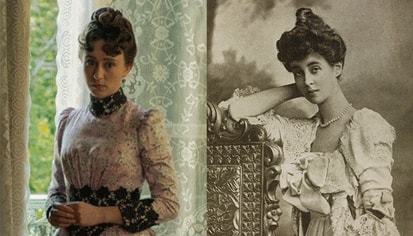 Photo Credit: HBO and Wikimedia Commons
One of the most accurate and tragic depictions in The Gilded Age is of Gladys Russell as the highly sought-after heiress, Consuelo Vanderbilt. Young Consuelo longed to marry for love, but her mother, Alva Vanderbilt, wanted her to marry for status—much like the mother-daughter dynamics of Gladys and Bertha. She was forced to wed the 9th Duke of Marlborough at 19, in the same way Gladys was essentially sold to the 5th Duke of Buckingham in season 3.
Luckily for Mrs. Russell and her meddling, the couple ends up happy together, but such was not the case for her real-life counterpart. It was a loveless marriage, with the duke solely concerned with money: he made the Vanderbilts pay him a dowry of $2.5 million (over $75 million today). As noted in Vogue, Consuelo arrived almost 20 minutes late to her own wedding and cried down the aisle. In England, she was just as unhappy, writing of her nightly dinners with the Duke, “How I learned to dread and hate these dinners, how ominous and wearisome they loomed at the end of a long day.”
Years later, they separated—as divorce needed to be “for cause.” After what she called a “humiliating” process of proving his infidelity, she was finally able to divorce the Duke in 1920 and, thankfully, found true love and happiness with the French aviator Jacques Balsa. Consuelo shared the truth behind their unhappy marriage and her mother’s extreme social ambition in her memoir, The Glitter and the Gold, first published in 1953.
Caroline Astor
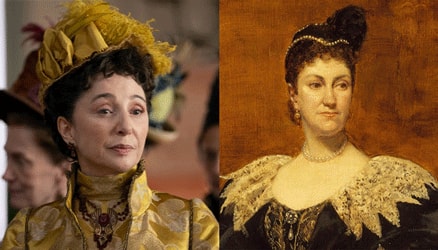 Photo Credit: HBO and Wikimedia Commons
Mrs. Astor, portrayed by Donna Murphy, was indeed a real person. Although others held the family name, only one was considered the Mrs. Astor: Caroline “Lina” Schmerhorn. Regarded as the undisputed queen of New York’s Gilded Age, she, alongside her social companion Ward McAllister—who appears as Nathan Lane in the show—created “The Four Hundred.” Another member of the high-powered group shares the same name inside and outside the show; Mamie Fish was known as the “fun-maker,” who boasted unconventional entertainment and playful gossip.
They were among the people the “Mystic Rose” (a nickname McAllister gave Astor) deemed socially acceptable and who could comfortably fit inside her Fifth Avenue ballroom. Astor was a champion of old money and tradition, serving as the gatekeeper of what was proper behavior in society. Born into a wealthy family that was part of New York City’s Dutch aristocracy, known as Knickerbocker, her father, Abraham Schermerhorn, was worth half a million dollars from shipping at the time of her birth.
She married William Backhouse Astor and became the senior matriarch of the Astor Family, as the show depicts, making their fortune through the fur trade, then opium, and then investing in New York real estate. The Vanderbilts and their new money, who, as previously mentioned, are embodied by the Russells, were a threat to Astor and her status. She found Railroad money, earned rather than inherited, to be distasteful. But with the Vanderbilt family’s rising status, and the ball showdown, Astor had no choice but to accept them into society.
Peggy Scott
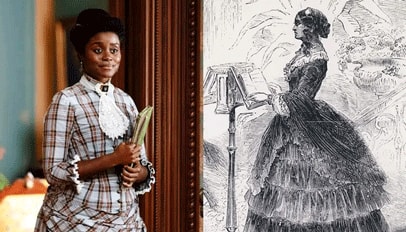 Photo Credit: HBO and API/Gamma-Rapho
Although not based on a single, real person, Peggy Scott, played by Denée Benton, is rather a composite of several prominent, historically significant Black women. Erica Armstrong Dunbar, a history professor and consultant for the show, told the Los Angeles Times that Julian Fellowes, the show’s creator, “was intentional about drawing from multiple women's lives in order to create a fictional character who embodies the spirit of the 1880s for young Black women in the elite.”
Following the Emancipation Proclamation, the Gilded Age provided new opportunities for many Black Americans across business, education, and real estate ownership. Scott was inspired by several trailblazers of the era, including journalist, civil rights activist, and anti-lynching leader Ida B. Wells, as well as Susana McKinney Steward, the first Black female doctor in New York.
But perhaps the biggest influence was drawn from Julia C. Collins, whose novel, The Curse of Caste; or The Slave Pride, published in 1865, is widely regarded as the first novel written by an African American woman. Moving beyond the representation of post-Civil War hardship, though still important, The Gilded Age has been praised for highlighting the daily lives of a prosperous Black middle and upper class in 1880s New York.
T. Thomas Fortune
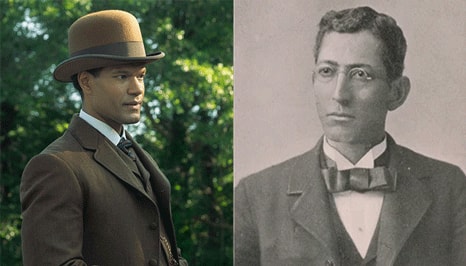 Photo Credit: HBO and Wikimedia Commons
T. Thomas Fortune (Sullivan Jones), who plays Peggy’s editor and brief love interest, was a real-life journalist, publisher, and civil rights leader. He was born into slavery, and when freed during the Emancipation Proclamation, he went on to study law and journalism at Howard University during the 1970s.
Across his career, he became a dominant voice at America’s leading Black newspapers, including The People’s Advocate, The New York Age, and The New York Globe. Notably, he served as managing editor of The New York Age for many years and authored several impactful works, including Black and White. In 1887, he co-founded the National Afro-American League, the direct precursor to the NAACP.
Clara Barton
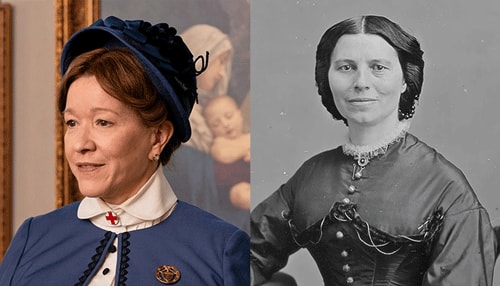 Photo Credit: HBO and Wikimedia Commons
Appearing briefly across three episodes in season 1, Clara Barton (Linda Emond) was a real-life Civil War nurse who founded the American Red Cross. She appears in The Gilded Age to fundraise for her new organization among New York’s wealthy “old” society women. As the first president of the American branch of the Red Cross, she went on to lead for 23 years.
She became known as the “Angel of the Battlefield” during the Civil War, delivering supplies and caring for wounded soldiers on the front lines, such as Antietam and Fredericksburg. After the war, she ran the Office of Correspondence, where it’s reported that she helped identify over 22,000 deceased soldiers, providing closure to the families.
Events
Union Strike
While season 2 of The Gilded Age centers on a fictionalized strike against industrialist George Russell, creator Julian Fellowes shared that it draws inspiration from the 1892 Homestead steel strike. In the show, steelworkers in Pittsburgh go on strike, with Fellowes saying, “You realize that people were earning their living and putting their lives at risk every day. I wanted to expose that in the show but also examine it.”
In real history, the conflict at Andrew Carnegie’s steel mill in Homestead, Pennsylvania, turned into a bloody battle, with casualties that cost the union public support. However, the show takes a different approach, with Russell playing a more sympathetic character as he negotiates with the union leader, Bill Henderson (Darren Goldstein).
Although Russell tries to buy Henderson off, Henderson does not budge and instead represents the needs of his fellow workers: they work 12-hour days in unsafe conditions and are paid little. Russell and his colleagues attempt to break the strike by bringing in new workers, but the union members block the entrance. The Governor’s Militia is preparing to shoot down the strikers, but Russell, in a rare show of humanity from the tough businessman, tells them to stand down.
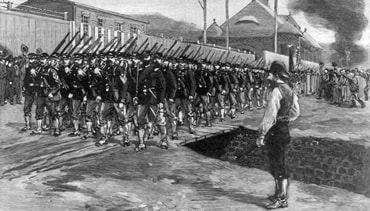 Photo Credit: Wikimedia Commons
In reality, as the confrontation between robber baron Andrew Carnegie and the Amalgamated Association of Iron and Steel Workers unfolded, Carnegie decided to put Henry Frick, chairman of the Carnegie Steel Company, in charge of the facility. Carnegie gave Frick permission to do whatever he needed to before he set off on a trip to Scotland during the confrontation.
It was Frick, acting in Carnegie’s interests, who cut wages, locked out union workers, and brought in Pinkerton guards from the Pinkerton National Detective Agency (industrialists of the time frequently hired them as private security to break strikes). It’s reported that 10 people were killed—seven workers and three Pinkerton guards—during the July 6, 1892 clash. Later that month, anarchist Alexander Berkman, outraged, shot and stabbed Frick, though Frick survived.
Ultimately, Carnegie Steel reopened the mill with replacements and non-union workers, imposing lower wages and 12-hour shifts instead of the original 8. After the union voted to end its opposition in November 1892, the outcome severely weakened the Amalgamated Association and set back steel unionization for decades.
The Brooklyn Bridge
Halfway through season 2, Larry Russell (Harry Richardson), Bertha and George Russell’s son, discovers an extraordinary secret: a woman oversaw the making of the Brooklyn Bridge. Emily Warren Roebling (Liz Wisan) was, in fact, a real person who stepped in as project supervisor, overseeing construction for over a decade after her husband, Chief Engineer Washington Roebling, became bedridden with decompression sickness.
Her father-in-law, John A. Roebling, designed the bridge before dying in 1869, and Emily became the first person to cross it when it opened in 1883. Although she didn’t complete the project alone, as the show suggests, she played a key role and had to work in secret to protect her husband’s position—his illness was not public knowledge, and news of a woman directing major engineering work would, unfortunately, threaten all that had been accomplished. At this time, women didn’t even have the right to vote or hold office, let alone oversee a project as extensive as the Brooklyn Bridge.
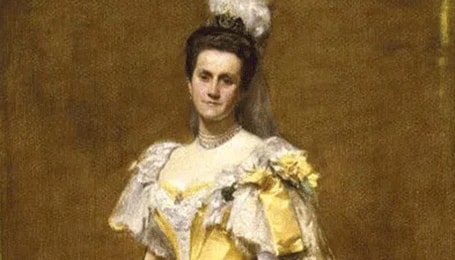 Photo Credit: Wikimedia Commons
As the historian David McCullough wrote in The Great Bridge, Roebling “was quite literally [her husband’s] eyes, his legs, his good right arm.” Washington wrote later, praising his wife, “I thought I would succumb, but I had a strong tower to lean upon, my wife, a woman of infinite tact and wisest counsel.”
Her role in the process was recorded in the New York Times, when she met with contractors, providing materials for the bridge: “Their surprise was great when Mrs. Roebling sat down with them, and by her knowledge of engineering helped them out with their patterns and cleared away difficulties that had for weeks been puzzling their brains.”
The “Opera War”
Season 2 features an opera-war plotline, pitting “old money” and the rising “new money” families against each other. And as creator Julian Fellowes shares, the confrontation was not far from reality: “I read that they decided to open on the same night, so the fight between the two opera houses was a direct one and New York society had to choose who to support.”
As played out in season 1, the Academy’s biggest patron, Caroline Astor, goes head-to-head with Bertha Russell. When Russell learns there will be no box opening for her at the Academy anytime soon, she decides to support the Metropolitan Opera, dividing New York society in the process.
Although the series of events is fictionalized, producer David Crockett adds, “As New York grew and there were more people in that class who wanted to be seen, the Academy didn’t have enough boxes.” He continues, “So, that group—which was centered around the Vanderbilts, Astors, and Morgans—decided to build a new opera house, and there was rivalry there.” In reality, the situation was not nearly as antic driven as that of The Gilded Age, but “such a wonderful image,” as Fellowes says, nonetheless.
Featured image: HBO


