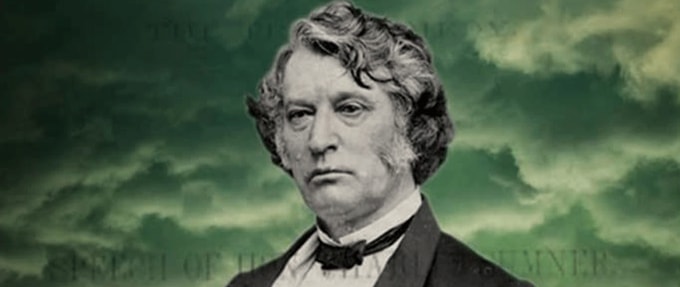
Hailed as a leader of the abolitionist movement, Charles Sumner dedicated his impactful career to fiercely fighting for the equal treatment of Black Americans. Born in Boston in 1811, Sumner was raised by his father, Charles Pinckney Sumner, and mother, Relief Jacob Sumner. His father was a Harvard-educated anti-slavery advocate, who instilled abolitionist ideals in a young, ambitious Sumner.
Surrounded by Black Bostonians during his childhood and adolescent years, Sumner became increasingly driven to join abolitionist efforts as an adult. Continuing the Harvard legacy, Sumner received his degree from Harvard Law in 1834 and went on to serve as a United States senator, representing Massachusetts, from 1851 until his death in 1874.
As a powerful force in American politics, Sumner was relentless in his pursuit to end slavery, making him a leading man in the North, but a detested man in the South. A proponent of the “equality before the law” philosophy, Sumner fought in opposition to the “Slave Power” that controlled the federal government during the antebellum era.
In 1856, his venomous speeches against Southern pillars of power attracted the attention of Preston Brooks, a house representative from South Carolina. During an intense anti-slavery debate, Sumner made various controversial comments about South Carolina senator Andrew Butler, Brooks's first cousin once removed. Brooks was enraged by Sumner’s words about his relative and set out to make a point out of his condemnation of Sumner’s “Crime against Kansas” speech.
On May 22, 1856, Brooks entered the Senate chamber with two men and approached Sumner, maliciously swinging at him with a cane. Sumner’s gushing blood left him blinded and defenseless, struggling on the ground. Brooks continued to beat him mercilessly, with bystanders failing to intervene, until the cane broke. The attack nearly killed Sumner, and it would be years before he returned to reclaim his seat in the Senate.
The violent incident would go on to be known as a driving force in the polarization that preceded the Civil War, with Sumner hailed as a martyr in the North and Brooks hailed as a hero in the South.
In this Pulitzer prize-winning biography, David Herbert Donald offers a fascinating deep dive into Charles Sumner’s life and career as national tensions built towards the Civil War.
For a glimpse into national bestseller Charles Sumner and the Coming of the Civil War, read on—then download the book today.
____________________

____________________
Charles Sumner and the Coming of the Civil War
CHAPTER ELEVEN: THE CRIME AGAINST KANSAS
“Mr. Sumner has added a cubit to his stature,” the New York Tribune declared, as the debate ended. Letters of praise began pouring in. About half of them lauded “the inspiring eloquence and lofty moral tone which characterized and ran through this triumphant senatorial achievement,” and the rest rejoiced in the way Sumner “Lashed Those Demagogues.” “Your speech,” the loyal Longfellow wrote, “is the greatest voice on the greatest subject that has been uttered.”
Many politicians, however, were troubled by the harshness of Sumner’s language. Seward had advised Sumner to eliminate all his personal attacks and disapproved also of his gratuitous assault against the honor of South Carolina. Even Republican stalwarts like Wilson and Ben Wade regretted the vindictiveness of Sumner’s tone. “Language equally intemperate and bitter is sometimes heard from a notorious parliamentary blackguard,” Edward Everett thought, “but from a man of character of any party I have never seen any thing so offensive.”
Most Democrats and nearly all Southerners were outspokenly hostile. The Washington Star declared that Sumner’s “personal vilification and abuse of Senator Butler…caused a blush of shame to mantle the cheeks of all present who respect the character of the body before whom it was uttered; because it was wholly unjust and untrue, and, in style, far better suited to some low doggery.” In street-corner conversations in Washington, always a hotbed of proslavery interests, Southerners could discuss only the insults Sumner had offered the South and the redress that should be taken. One Tennessee Congressman announced: “Mr. Sumner ought to be knocked down, and his face jumped into.”
The danger that these sentiments might erupt in personal violence against Sumner was not lost upon his friends. Troubled by Douglas’s question: “Is it his object to provoke some of us to kick him…?” Representative John A. Bingham, a Republican from Ohio, warned Wilson just after the speech to protect his colleague. Wilson gathered Anson Burlingame and Schuyler Colfax, both Republicans in the House, and told Sumner: “I am going home with you today—several of us are going home with you.”
Unafraid, and rather vexed by what he considered unnecessary precautions, Sumner replied: “None of that, Wilson.” He slipped out a side door of the Capitol unattended, accompanied Seward, who was on his way to catch the omnibus, a few blocks, and then walked to his lodgings alone.
But the alarm of Sumner’s friends was not excessive. Though no attacks were made upon him on May 20, Southerners were still angrily discussing his speech. A South Carolinian, it was said, “could not go into a parlor, or drawing-room, or to a dinner party, where he did not find an implied reproach that there was an unmanly submission to an insult to his State and his countrymen.”
Congressman Preston S. Brooks, of South Carolina, flinched sensitively under these reproaches. Now serving his second term in the House of Representatives, Brooks was not known as one of the Southern fire-eaters. He had pursued a moderate course during the Kansas-Nebraska debates of 1854 and was even taunted in his home state for being “a little too national.” A man of very moderate ability, his one claim to fame was his half-humorous proposal that congressmen be required to check their firearms in the cloakroom before appearing on the House floor. Six feet tall and weighing about 170 pounds, with a proud military bearing that reminded observers of his Mexican War service, and a handsome, though rather juvenile, face, the thirty-six-year-old Brooks had won many friends in Congress “by his obliging disposition and his conciliatory temper, not less than by his cordial and agreeable manners.” But, under his placid exterior, there burned a smoldering hatred of abolitionists, a proud devotion to the South and to South Carolina, an intense loyalty to his family, and a determination to live by the code of a gentleman.
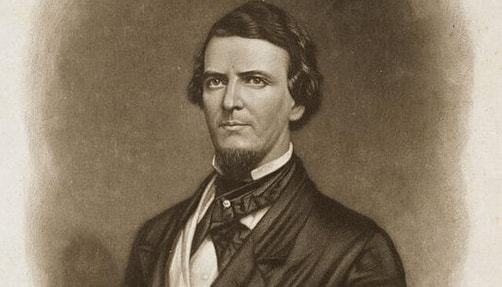

Preston S. Brooks, Representative in Congress of the U.S. from South Carolina
Photo Credit: Wikimedia CommonsAlong with many other representatives, Brooks had gone over to the Senate chamber on May 19, when Sumner began his oration, and he remained long enough, apparently, to hear Sumner call Butler, who was Brooks’s cousin, the Don Quixote of slavery. Of Sumner’s remarks on the second day Brooks knew only by report, but that apparently was enough to convince him that the Massachusetts senator had “insulted South Carolina and Judge Butler grossly.” By the code of Southern chivalry Butler, when he returned from South Carolina, would be obliged to flog Sumner. Realizing that his cousin was old and that Sumner was “a very powerful man,” Brooks concluded: “I felt it to be my duty to relieve Butler and avenge the insult to my State.” But with curious deliberateness he waited until he could read the published version of Sumner’s speech, on May 21, before definitely deciding to take action.
Finding the speech as offensive as rumor had reported, Brooks determined to proceed according to the Southern code duello. Though he believed Sumner’s remarks clearly slanderous, he did not even think of bringing legal action. No Southern gentleman considered a law suit the proper redress for a slur upon his own good name or upon that of a member of his family. Though Brooks had fought a duel in his youth, he did not consider challenging Sumner to a fight. In the first place, he knew that Sumner would not accept, as “the moral tone of mind that would lead a man to become a Black Republican would make him incapable of courage.” Secondly, he thought that Sumner might report the challenge to the police, in which event Brooks would become liable “to legal penalties more severe than would be imposed for a simple assault and battery.” But chiefly Brooks refrained from challenging Sumner because, according to the code of the Old South, a duel must be between social equals; to call Sumner out to the field of honor would be to give him, in Southern eyes, a social respectability he could not otherwise attain.
“To punish an insulting inferior,” the Southern code ruled, “one used not a pistol or sword but a cane or horsewhip.” Brooks coolly explored these possibilities. “I…speculated somewhat as to whether I should employ a horsewhip or a cowhide,” he declared later; “but knowing that the Senator was my superior in strength, it occurred to me that he might wrest it from my hand, and then…I might have been compelled to do that which I would have regretted the balance of my natural life.” In other words, “it was expressly to avoid taking life that I used an ordinary cane.” The instrument he selected was a gutta-percha walking stick, presented to him several months earlier by a friend. Weighing eleven and one-half ounces, the cane had a gold head; it tapered from a thickness of one inch at the large end to three quarters of an inch at the small, and had a hollow core of about three eighths of an inch.
Having selected his weapon, Brooks had merely to pick the time and place for chastising Sumner. On Wednesday morning, May 21, he chose a seat in the Capitol grounds, waiting for Sumner to pass on his way to the Senate, and paced back and forth between it and the steps of the Capitol. Meeting him as he turned away from the steps, Representative Henry A. Edmundson, of Virginia, hailed him: “You are going the wrong way for the discharge of your duties.” Brooks asked his friend to walk with him, and as they paced along, he declared that “Sumner had been very insulting to his State, and that he had determined to punish him, unless he made an ample apology.” “It was time,” he continued, “for southern men to stop this coarse abuse used by the Abolitionists against the southern people and States, and…he should not feel that he was representing his State properly if he permitted such things to be said.” Edmundson asked how he could be of assistance. “I wish you merely to be present, and if a difficulty should occur, to take no part in it,” Brooks replied. “Sumner may have friends with him, and I want a friend of mine to be with me to do me justice.” The two representatives remained at their observation post until twelve thirty, but when Sumner did not appear, they concluded that their prey had eluded them, and they walked into the Capitol.
Foiled, Brooks spent the rest of the day brooding about the “insult” to his state and his family, and he grew more than ever resolved that “it ought to be promptly resented.” That night he told Representatives Lawrence M. Keitt and James L. Orr, both close political associates from South Carolina, of his purpose “to ‘disgrace’ the Senator with the South by a flagellation.” What they advised is not known, but Brooks left them resolved “that he could not overlook the insult.” So angry that he slept scarcely at all, he was up early the next morning to seek his revenge.
By eleven o’clock he was waiting in the porter’s lodge at the entrance to the Capitol grounds, again ready to intercept Sumner as he entered the building. He planned to assault the senator there, if Sumner followed his customary practice and walked to the Capitol; if he came by carriage, Brooks intended to cut through the grounds, run up the flight of steps and through the Capitol so as to meet him in the space behind the building where the carriages stopped. Passing by the lodge on his way to the House, Edmundson spied Brooks and greeted him: “You are looking out.” When Brooks explained his plan, the Virginia congressman cannily suggested a flaw: “The exertion and fatigue of passing up so many flights of steps would render him unable to contend with Mr. Sumner, should a personal conflict take place,” especially as “no doubt Mr. Sumner was physically a stronger man than himself.”
Perhaps the reasoning convinced Brooks, or perhaps he concluded, as the noon hour for the convening of Congress approached, that he had again missed his quarry. In either case, he walked along with Edmundson up to the Capitol rotunda, where the Virginian went to his duties in the House, and Brooks “determined to keep [an] eye on Mr. Sumner.” He found the Senate in session, but both houses were scheduled to adjourn at an early hour because of the recent death of Representative John G. Miller, of Missouri. While Senator Henry S. Geyer pronounced a eulogy upon his deceased colleague, Brooks stood in the lobby on the opposite side of the main aisle from where Sumner was sitting.
As the House adjourned earlier than the Senate that day, Edmundson came over to the Senate chamber, where he saw Brooks and where, in the vestibule, he met Keitt and proposed that they leave. “No,” said Keitt, “I cannot leave till Brooks does,” and he disappeared behind the screen back of the Vice-President’s chair, where he began talking with one of his constituents.
At 12:45 the Senate adjourned, and most of the members left the chamber, though several stood talking in the vestibule and in the cloakroom. Sumner stayed at his desk, pen in hand, franking copies of his “Crime against Kansas” speech. Several visitors tried to interrupt him, but he promptly and briefly dismissed them, declaring that he was busy.
Impatiently Brooks awaited his opportunity. Until the room could be cleared, he took a desk in the back row of the chamber, across the aisle and three seats removed from Sumner. Wilson, when leaving, caught his eye, recognized him, and gave a polite bow. When Edmundson came up and jokingly asked Brooks if he were now a senator, the South Carolinian, fuming with anger, replied that he could not approach Sumner while there were ladies present, and he pointed to a pretty but persistent female conversationalist who had taken a seat in the lobby not far from where Sumner was sitting. He had already tried, unsuccessfully, to get the sergeant-at-arms to remove the lady. Finally, exclaiming that “he would stand this thing no longer,” he rose and went into the vestibule, where he planned to send a message asking Sumner to come outside. Edmundson, following him, argued that such a move would do no good, as Sumner undoubtedly would only send for Brooks to come to his desk. When Edmundson stopped to speak to a friend, Brooks went back into the Senate, where Sumner was still busily writing.
Finding the lobby at last clear of women, Brooks proceeded upon his errand. Operating, as he thought, “under the highest sense of duty,” he approached the front of the desk where Sumner still sat behind a large pile of documents, “writing very rapidly, with his head very close to the desk,” his armchair drawn up close and his legs entirely under the desk. With cool self-possession and formal politeness, Brooks addressed him: “Mr. Sumner.”
Sumner did not get up, but merely raised his head to identify his visitor. Nearsightedness, for which he was too vain to wear glasses, made the figure before him indistinct, but perfect vision would not have warned him, as he did not know Brooks by sight.
“I have read your speech twice over carefully,” Brooks began in a low voice. “It is a libel on South Carolina, and Mr. Butler, who is a relative of mine—” As Sumner seemed about to rise, Brooks interrupted himself to give Sumner “a slight blow” with the smaller end of his cane. Stunned, Sumner instinctively threw out his arms to protect his head, and Brooks felt “compelled to strike him harder than he had intended.” He began to rain down blows, and, he boasted: “Every lick went where I intended.” In the excitement, Brooks forgot that he had set out only to flog Sumner, and began to strike him on the head “as hard as he could.”
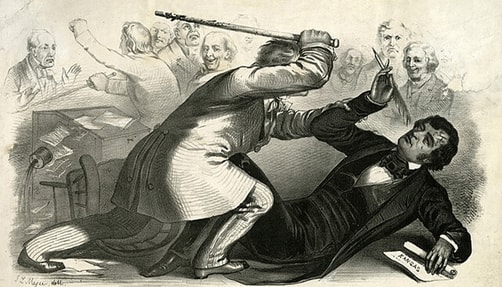 Photo Credit: Wikimedia Commons
Dazed by the first blow, Sumner of course could not remember that in order to rise from his desk, which was bolted to the floor by an iron plate and heavy screws, he had to push back his chair, which was on rollers. Perhaps half a dozen blows fell on his head and shoulders while he was still pinioned. Eyes blinded with blood, “almost unconsciously, acting under the instinct of self-defence,” he then made a mighty effort to rise, and, with the pressure of his thighs, ripped the desk from the floor. Staggering forward, he now offered an even better target for Brooks, who, avoiding Sumner’s outstretched arms, beat down “to the full extent of his power.” So heavy were his blows that the gutta-percha cane, which he had carefully selected because he “fancied it would not break,” snapped, but, with the portion remaining in his hand, he continued to pour on rapid blows. The strokes “made a good deal more noise after the stick was broken than before. They sounded as if the end of the stick was split.”
As soon as Sumner was free from the desk, he moved blindly “down the narrow passage-way, under the impetuous drive of his adversary, with his hands uplifted.” As “Brooks continued his blows rapidly with the part of the stick he held in his hand,” Sumner lost consciousness and “was reeling around against the seats, backwards and forwards.” “His whole manner seemed…like a person in convulsions; his arms were thrown around as if unconsciously.” Knocking over another desk, diagonally in front of his own, he seemed about to fall when Brooks reached out and with one hand held Sumner up by the lapel of his coat while he continued to strike him with the other. By this time the cane had shivered to pieces. Sumner, “entirely insensible” and “reeling and staggering about,” was about to fall in the aisle. “I…gave him about 30 first rate stripes,” Brooks summarized. “Towards the last he bellowed like a calf. I wore my cane out completely but saved the Head which is gold.”
The beating had taken place in less than one minute. The sound made by Brooks’s cane had at once attracted the attention of everyone who remained in the Senate chamber, and most of them began rushing toward the fracas. Representatives Ambrose S. Murray and Edwin B. Morgan, who had been in conversation behind the screen that separated the Senate seats from the vestibule, were the first to arrive. While Morgan caught Sumner, Murray seized Brooks by the arm while in the act of striking, and tried to draw him back from his foe.
While Brooks struggled against this unexpected interference, the elderly Whig senator from Kentucky, John J. Crittenden, came up the aisle, expressed his “disapprobation of such violence in the Senate chamber,” and warned Brooks: “Don’t kill him.” Brooks, apparently realizing that he had far exceeded his original purpose, muttered: “I did not intend to kill him, but I did intend to whip him.”
Just as Crittenden was warning Brooks, Keitt, who had been near the clerk’s desk at the outset of the attack, bounded up the center aisle, with his “small cane…lifted above his head, as if he intended to strike.” “Let them alone, God damn you,” he shouted at Crittenden.
By this time Toombs, of Georgia, had come up, and he warned the infuriated Keitt not to strike Crittenden. He did nothing, however, to restrain Brooks, still struggling to escape from Murray and renew the assault on Sumner; “I approved it,” said Toombs later. Nor did Douglas, summoned from the anteroom by the scuffling, interfere. He at first thought of trying to “help put an end to the affray,” he declared, but “it occurred to my mind, in an instant, that my relations to Mr. Sumner were such that if I came into the Hall, my motives would be misconstrued, perhaps, and I sat down again.”
In a few seconds, friends led Brooks off into a side room, where they washed a small cut he had received above his eye from the recoil of his stick. Minutes later he and Keitt were walking together down Pennsylvania Avenue.
Meanwhile, Morgan, who had arrived at the same moment as Murray, had caught Sumner so that he was “saved…from falling as heavily upon the floor as he would otherwise have done.” While Brooks was being led off, Sumner, partially supported by Morgan, lay “at the side of the center aisle, his feet in the aisle, and he leaning partially against a chair.” He remained “as senseless as a corpse for several minutes, his head bleeding copiously from the frightful wounds, and the blood saturating his clothes.”
Within a few minutes Sumner regained consciousness. One of the pages gave him a glass of water, and somebody suggested that he should be carried to a sofa in the anteroom. Sumner said that he thought he could walk, requested that his hat be found and that the documents on his desk be taken care of, and, leaning upon Morgan and another man, stumbled into the anteroom. His face was covered with blood as he passed Louisiana Senator John Slidell, who “did not think it necessary to…make any advances toward him” or to express any sympathy. A few minutes later Dr. Cornelius Boyle, who had been hastily summoned, dressed the wounds, which were still bleeding profusely, and put two stitches in each.
Just as the doctor was finishing, Wilson, who had heard of the attack and had rushed back to the Capitol, arrived, and, helping Sumner into a carriage, took him to his lodgings and put him to bed. Sumner’s “shirt around the neck and collar was soaked with blood. The waistcoat had many marks of blood upon it; also the trowsers. The broadcloth coat was covered with blood on the shoulders so thickly that the blood had soaked through the cloth even through the padding, and appeared on the inside; there was also a great deal of blood on the back of the coat and its sides.”
About an hour later Dr. Boyle came to Sumner’s rooms to make a more thorough examination. He told the anxious friends waiting there “that such was the condition of Mr. Sumner it was absolutely necessary that he should be kept quiet, for he could not tell the extent of his injuries at that time.”
Before falling into a dazed sleep, Sumner remarked: “I could not believe that a thing like this was possible.”
Want to keep reading? Download Charles Sumner and the Coming of the Civil War today.
____________________
____________________
Charles Sumner and the Coming of the Civil War


