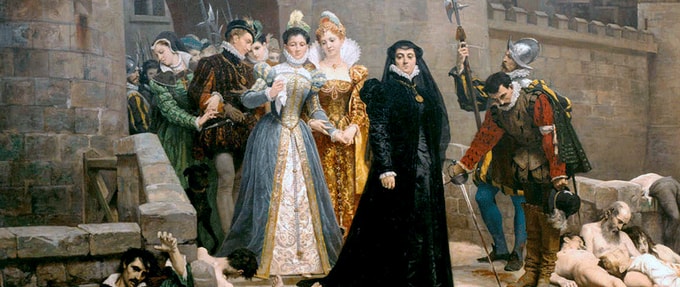
It’s almost impossible to look up Catherine de’ Medici without running into her nickname, the “Serpent Queen.” Cunning, manipulative, ruthless, cold—all adjectives that have been used to describe the queen, who stood behind her sons wielding power as they held the throne.
But how much of this reputation is earned? What did Catherine actually do to merit such a legend? Dive into the life of Catherine de’ Medici to see how much of the myth actually holds up.
A Medici Orphan
Before ushering in “the age of Catherine de’ Medici,” what the years her sons reigned have been called, Catherine had a tragic childhood. Born in Florence on April 13, 1519, to Lorenzo de Medici, the ruler of the kingdom of Florence, and his wife Madeleine de La Tour d’Auvergne, she would be an orphan within weeks. Her mother died from fever, while her father succumbed to injuries.
Catherine was put under the care of her grandmother, Alfonsina Orsini, and when she died in 1520, her aunt, Clarice de Medici. However, by 1527, the Medicis had fallen from favor and were overthrown by a faction that disapproved of Giulio de Medici, elected as Pope Clement VII in 1523.
Until tensions boiled over, Catherine grew up in several convents—at which point she was summoned by Clement to live with him in Rome. At just 14, Clement arranged her marriage to Henry, Duke of Orléans, the second son of King Francis I of France, in early 1533. The union marked a turning point for Catherine: she was now a member of the French royal family.
Third Wheel to the Throne
Following the death of Francis I in 1547, Catherine became the queen consort. But Henry’s devotion to his mistress Diane de Poitiers left Catherine sidelined. Despite devoting herself to Henry, he remained in love with his royal favorite, while gossip of her infertility surged—as Henry had illegitimate children with other mistresses.
After nearly a decade, the most unlikely person, Diane herself, actually helped the royal couple have children. Protecting her own position, as she worried Henry might take a younger wife, she pushed Henry back to Catherine’s bed. Beginning in 1554, they would have 10 children together, seven of whom lived into adulthood.
Her Time in Charge Arrives
When Henry II succumbed to his injuries during a jousting tournament in 1559, Catherine, who had been politically sidelined, had few experiences with real power. The exception was in 1552, when Henry, away at the siege of Metz, made Catherine regent. Although only for a brief time, Catherine drew on this experience when her son, Francis II, took the throne.
When Francis passed from illness in 1560, Charles IX, Catherine’s 10-year-old son, was next in line. Although a regency was decided to prevent Catherine from holding any power, she would rule alongside Antoine de Bourbon, the king of Navarre. According to HistoryExtra, “It was through her sons that Catherine built up her own political power.”
Eventually Charles IX came of age to rule on his own, but Catherine nevertheless assumed the title “queen mother of France,” and attended all governmental meetings, using her control over her son. She continued to do so when her next son, Henry III, became king, following Charles’s death in 1574.
The St. Bartholomew’s Day Massacre
Catherine’s time in power coincided with the French Wars of Religion, an intermittent civil war between Catholics and Huguenots since 1562, and she attempted to broker peace. Although many tend to paint Catherine as a monster who hated Protestants, such is not the truth. Yes, she was Catholic and would have preferred for her country to embrace Catholicism, but, above all, she strove to prioritize stability.
For months, Catherine had been negotiating the union of her daughter, Marguerite of Valois, to the Protestant Henry of Navarre—in the hopes of sealing Catholic-Huguenot peace. The wedding was set for August 18, 1572, and in the days preceding, huge numbers of influential Huguenots arrived in Paris—including their leader, Admiral Gaspard de Coligny, who had been previously targeted by the Guise family.
One of the most powerful noble families in France, the Guises had a long history with Catherine. Chiefly, when Catherine’s son Francis II became king in 1559, actual power was held by the Guise brothers rather than by Catherine, and they controlled his decisions. Trying to keep the country together, Catherine routinely clashed with their extremist Catholic ways.

 Photo Credit: Wikimedia Commons
On August 22, an assassination attempt was made against Coligny. He was shot and wounded, but not killed. Here is where accounts diverge—some historians suspect that Catherine may have authorized this attempt, whereas others argue there is no concrete evidence that she orchestrated the attack.
In the events that followed, Catherine and the crown are said to have had a more concrete influence. Reportedly fearing a Huguenot retaliation after the failed assassination attempt on their leader, Charles IX is said to have ordered, “Then kill them all! Kill them all!” So, in the week that followed, much of the Huguenot leadership was slaughtered—ultimately solidifying Catherine’s reputation, in the way it is today.
Why “Serpent Queen”?
Because Catherine and her sons didn’t end the religious civil wars, that would continue until 1598, and a blot on their reputations remained. As is a theme in history, Catherine took on much of the burden and was named the “Serpent Queen”—also the title of the historical drama television series based on her life, in which Samantha Morton plays the queen.
From the very start, Catherine’s Italian origins made her an outsider in the French court, compounded by her interest in astrology. She routinely sought out astronomers, including Nostradamus, to predict her future. Many saw this as embracing the occult, and thought she’d call upon such powers to eliminate her enemies and ruin the French people.
On the other hand, Catherine was a genuine patron of the arts, but was not recognized as such. She acquired a great deal of art, commissioning portraits from Jean Clouet and his son, Francis Clouet. She also had a great passion for architecture, ordering the expansion of iconic castles such as Montceaux-en-Brie and Chenonceau. But it is her dark reputation that many remember.
Her Final Years
In July 1586, Catherine underwent the journey to Saint-Brice near Cognac to negotiate with Navarre, the Protestant leader and heir presumptive to the throne, after failing to rein in the Guises. But, unable to find a path to de-escalation, the effort came to nothing.
In September 1588, Catherine became ill from a lung infection. The situation in France had become unmanageable, to the point that Henry III, her favorite son, had to flee Paris when it was taken over by the Guises. In December 1588, Henry III ordered Henry, Duke of Guise, and Louis, Cardinal of Guise, to be assassinated, which, as Catherine knew, marked the end of her reign. The French people would never forgive such treachery.
She died on January 5th, 1589, after the infection had spread—taking with her the Valois dynasty. Eight months later, Henry III was himself assassinated. But, as Britannica frames it, “her ultimate achievement was to have saved the kingdom just long enough to ensure the succession of the Bourbon Henry IV, by whom the royal authority was restored.”


