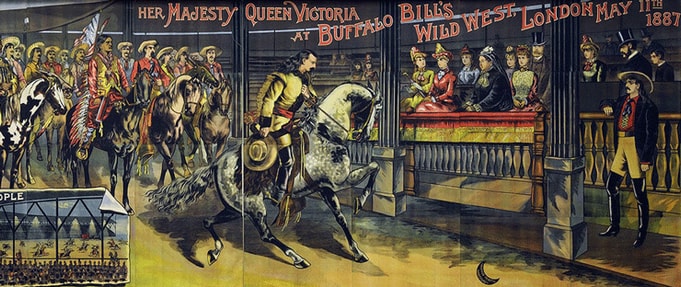
By the summer of 1887, London was busy celebrating Queen Victoria’s Golden Jubilee. Visitors poured into the city, and there always seemed to be something exciting happening—processions, reviews, concerts, public dinners. Yet one attraction drew attention for an entirely different reason.
It had come all the way from America. People arriving at Earl’s Court found scenes they normally associated with illustrated papers and adventure stories. Riders thundered past on horseback. Wagons rolled into the arena. There were mock attacks and displays of shooting that left spectators cheering.
At the center of the enterprise stood William F. Cody, though most visitors knew him simply as Buffalo Bill. For many in the crowd, this was probably the closest they expected to come to the American frontier.
The Wild West Comes to London
Cody’s Wild West had been entertaining audiences in the United States for several years before the decision was made to bring it overseas. He insisted it was an exhibition, not a circus—though newspaper writers seemed happy to use whichever description suited them.
Britain offered an obvious opportunity. The Golden Jubilee celebrations meant London was full of visitors from across the Empire, and there was no shortage of people looking for entertainment.
A large site at Earl’s Court was chosen for the performances. There needed to be room not only for spectators, but for horses, livestock, and the many people who traveled with the company.
Simply getting everything across the Atlantic had been an undertaking in itself. Cowboys arrived alongside Mexican vaqueros. There were scouts, sharpshooters, and Native American performers. Newspapers occasionally devoted almost as much attention to the animals as to the people. One writer expressed amazement at seeing buffalo grazing in West London.
It must have seemed extraordinary.
Visitors soon discovered that the Wild West Show occupied a category of its own.
There were displays of horsemanship and marksmanship. Riders demonstrated feats of skill in the saddle. Recreated stagecoach attacks brought cheers from the stands. Scenes supposedly drawn from frontier life sat alongside moments that were plainly intended to entertain.
Some critics wondered where history ended and theater began. Most people were seemingly content simply enjoying themselves.
Buffalo Bill appeared throughout the program dressed much as audiences expected him to be. The long hair, buckskin clothing, and pointed beard had become part of the classic image. By the 1880s, William Cody understood publicity better than many politicians.
Annie Oakley Wins Britain Over
One performer quickly became a favorite: Annie Oakley. At first glance, she did not look particularly imposing. Contemporary descriptions often remarked on her slight build and quiet manner. Then she picked up a rifle.
Newspaper reports delighted in describing her feats of accuracy. British audiences took to her immediately, and before long, she was receiving almost as much attention as Buffalo Bill himself.
Part of the attraction lay in the fact that many performers had lived lives close to those they portrayed. Cody had worked as a scout and hunted buffalo on the Plains. Others brought their own experiences with them.
Exactly where fact ended and showmanship began probably mattered less to audiences than it does to historians today.
A Royal Seal of Approval
Queen Victoria attended a performance in May of 1887, accompanied by members of the royal family and other distinguished guests. Her favorable comments afterward certainly did the show a few favors.
Victorian Britain took such things seriously. Newspapers devoted considerable attention to the royal visit, and public interest increased further. Members of European royalty attended in later months, while Buffalo Bill himself became something of an international celebrity.
He seemed equally comfortable entertaining princes and ordinary spectators. Photographs from the period show him with aristocrats one day and surrounded by performers and cowboys the next. He seemed comfortable in either setting.
The People Behind the Performance
British newspapers devoted considerable space to the Native American members of the company. Reporters described their appearance and habits in ways that tell us rather a lot about Victorian attitudes.
To many people, they represented a world that was already disappearing. Sitting Bull had traveled with Buffalo Bill in America a couple of years earlier, and his name still attracted attention despite never having visited Britain.
Curious members of the public followed performers through the streets, and journalists reported on details that would probably seem rather odd today.
Modern historians tend to view life within the show in a more complicated light. Some performers remained with Buffalo Bill for years and earned good wages, although difficult episodes from American history were inevitably reduced to scenes designed for paying audiences.
Such questions received little attention in 1887. People had bought tickets for entertainment, and entertainment was what they expected.
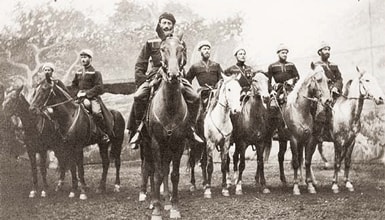

Georgische Reiter in Buffalo Bill's Wild West Show, London.
Photo Credit: Wikimedia CommonsTaking the Wild West on the Road
Success in London led to further appearances elsewhere. Birmingham and Manchester welcomed the company, and newspaper reports suggest the public remained as enthusiastic as ever.
Running the show was almost a feat in itself. So many people and animals had to be fed and moved from place to place that the logistics alone impressed observers.
Children loved it, although plenty of adults seemed to have been just as captivated. Posters, engravings, and photographs carried the images far beyond the showgrounds.
Without really intending to, Buffalo Bill was helping to export a particular vision of the American West.
The Frontier Becomes a Memory
There was an irony to the whole business. By the late 19th century, the frontier that audiences imagined was already changing. Railroads stretched farther west every year, and settlements continued to expand. The period being celebrated had never lasted very long.
Even in the late 19th century, there was an awareness that the world being presented belonged as much to memory as to the present day. That perhaps explains some of the appeal.
The Wild West Show offered excitement and adventure, but it also offered nostalgia. People were not simply watching a spectacle. They were being invited to witness a version of the past.
Later generations inherited many of those images. Hollywood would eventually make them familiar worldwide, though much of the visual language had already been popularized by Buffalo Bill.
The cowboy of popular culture owed William Cody a great deal.
An American Invasion
Buffalo Bill returned to Britain several times and remained famous well into the 20th century. Financial problems eventually caught up with him, and he died in 1917.
People remembered those visits for many years afterward. Most Victorians would never travel to America. They knew the country through newspapers, books, and their own imaginations. Then, for a few months in 1887, a version of the American frontier appeared in West London.
Not the real thing, perhaps. But close enough.
And when horses thundered around the arena, and Annie Oakley shattered another target, few people in the grandstands seemed to have been overly concerned about the distinction.
Want to read even more about Buffalo Bill? Check out these books and resources:
Buffalo Bill's Wild West
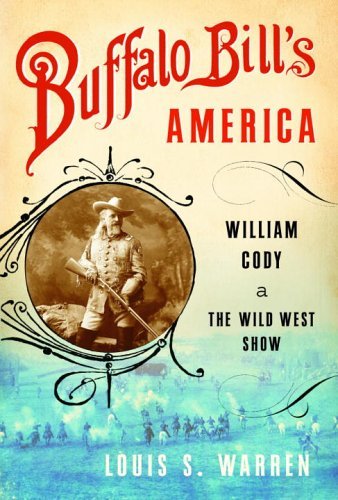
Buffalo Bill's America
Buffalo Bill Cody: The Man Behind the Legend
Buffalo Bill Center of the West
The Journals of Queen Victoria (Royal Archives)
Featured image: Mary Jester Allen Acquisition


