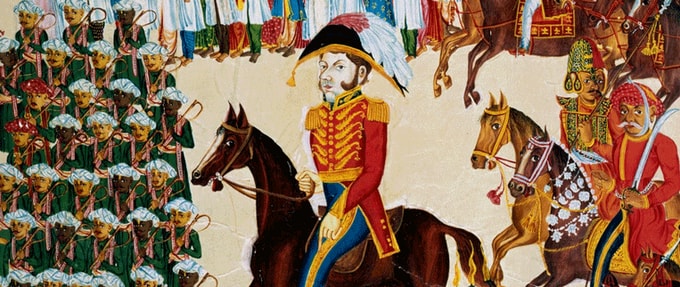
British colonial domination of the Indian subcontinent happened in stages, over two centuries. From the establishment of the East India Trading Company in 1600 to the direct imperial rule known as the British Raj in 1858, the perceived benefits—such as public health measures and infrastructure—were a mere smokescreen over economic exploitation, poverty, and rampant violence that ensued.
Indians grew tired of being treated like second-class citizens in their own country. With the rise of the Independence movement and its massive nonviolent protests, led by figures like Mahatma Gandhi, British rule ended.
Although it’ll soon be 80 years since India and Pakistan achieved independence, the Crown fundamentally reshaped the nations, and today’s economic inequality traces back to that period. As Elliot Ross argues in The Correspondent, “the laws, economic structures and cultural basis for European colonialism didn’t disappear when nations gained independence in the mid-20th century.”
East India Company and the 1857 Rebellion
After the Indian Rebellion of 1857, the East India Company (EIC) had lost its existing privileges. Control was dissolved and passed directly to the British Crown—in the person of Queen Victoria.
Known in India as the First War of Independence, the uprising was sparked by the new Pattern 1853 Enfield rifle cartridges. They required soldiers to bite off the end of the cartridges, rumored to be greased with cow or pork lard; consumption is forbidden in Muslim and Hinduism.
According to Britannica, Mangal Pandey, an EIC soldier, led a resistance and attacked British officers at the military garrison in Barrackpore. He was captured and executed. As the rumors of the cartridge spread, more soldiers resisted and were arrested. This punishment fuelled others to march to Delhi, where they nominally restored the Mughal emperor Bahadur Shah II to power.
The Crown Takes Power
At this point, it was clear that the EIC had lost control, and the British took power through the First Government of India Act, passed on August 2, 1858. The British Raj (meaning “rule,” “reign,” or “kingdom” in Sanskrit or Hindi) extended across modern-day India, Pakistan, Bangladesh, and Myanmar, and more.
Queen Victoria, who recently appointed herself Empress of India, created the Indian Civil Service (ICS) and partially recognized sovereignty, said to improve life, but in reality, the Raj was a more formal system of wealth extraction and racial oppression that had been happening for over a century.
The ICS, what Prime Minister Lloyd George called “the steel frame on which the whole structure of our government and of our administration in India rests,” was the British Raj's administrative body. 1,200 officers controlled a population of 300 million. Each ICS officer was placed in charge of a district, of which there were 424 in total, and each contained thousands of people. By concentrating judicial, revenue collection, and executive authority in a single local office, they became the supreme face of authority and power in any given area.
Participation in the program was initially limited to candidates who could take an entrance exam in London, meaning the odds were entirely stacked against Indians in governing. Even when Indians were eventually allowed to join, British personnel maintained top supervisory posts—under the notion that only they could successfully enforce colonial rule.
During the Raj, India was separated into two types of territory, as proclaimed in the Interpretation Act 1889: British India and Princely States. The British colonial government administered the former, while local indigenous monarchs ruled the latter under indirect British rule. Although rulers in the Princely States managed day-to-day governance and local laws, they ultimately operated under the ultimately authority of the British Crown—another way the British government gave Indian citizens a mere illusion of sovereignty.
The Rise of Mass Nationalism
With the establishment of the Raj, and even before, under the East India Company, anti-colonial movements gained traction, such as the Indian Association. They argued that Indians should have greater participation in administrative affairs. This paved the way for the founding of the Indian National Congress by nationalist leaders Dadabhai Naoroji and Surendranath Banerjee.
The Congress Party held its first meeting in December 1885 in Bombay (now Mumbai), discussing the changes needed in the colonial framework. At the start of the 20th century, the party became a nationwide movement, sparked by the Partition of Bengal in 1905, which split Bengal into a Hindu-majority west and a Muslim-majority east.
Within the party, a faction emerged that endorsed swadeshi (“of our own country”), calling on Indians to boycott British goods. Launched in 1905, the Swadeshi Movement built on this principle and became the first organized, collective action for independence.
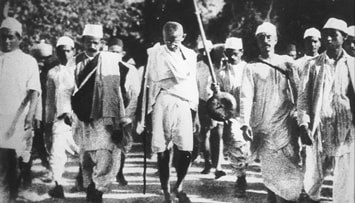
 Photo Credit: Wikimedia Commons
Gandhi Returns
In 1915, Gandhi returned to India from South Africa, bringing with him his philosophy of non-violent civil disobedience. Responding to mass violence, like the Jallianwala Bagh Massacre, where British troops opened fire on a crowd of unarmed Indians, killing hundreds, nonviolent protest took root, with many acts supported by the All India Congress Committee.
Formed in 1929, the Committee advocated that Indians avoid paying taxes in protest of British rule. The most notable among those demonstrations was the Salt March, led by Gandhi in 1930, lasting over 24 days, with participants walking over 240 miles, ultimately protesting the British salt monopoly.
The End of British Rule—in Name
In 1939, when World War II began, Britain made India join the effort without consulting elected Indian councils. The Congress Party declared it would not support Britain in the war unless it was granted independence, and in 1942 launched the Quit India Movement to support the cause. In response, British authorities arrested all of the leadership of the Congress Party, including Gandhi, who was not released until 1945.
At the end of the war, the British government decided to withdraw from India and passed an independence bill in July 1947. The subcontinent was then divided into two: a Hindu-majority India and a Muslim-majority Pakistan. In January 1950, India became an independent state and adopted the Constitution of India.
As stated, British colonialism has left a deep, multifaceted legacy upon India—one that was not retracted when British forces left. Under British rule, the nation shifted from a dominant global manufacturer of textiles and goods to an exporter of raw materials, while Britain extracted tax revenue for nearly two centuries. From 1765 to 1938, it’s estimated that Britain stole nearly $45 trillion from India.
The impact is more than just monetary—political strategies deliberately sought to strengthen tensions between religious groups, while imposing a colonial preference for Western aesthetics, established in one way through the ICS. But, as Mirha Butt argues, “decolonization is changing this,” as efforts are being made to replace British-era symbols and laws.
Featured image: Print Collector/Getty Images


