The United States is home to more than 2,600 National Historic Landmarks (NHLs), encompassing buildings, sites, structures, and objects that collectively illuminate America’s cultural, political, and social history. The first of these designations occurred on June 30th, 1960, with the recognition of the Sergeant Floyd Monument in Sioux City, Iowa.
While many landmarks appear straightforward at first glance, countless sites harbor lesser-known details often omitted from guidebooks. These hidden histories can offer a deeper, more nuanced window into the past, allowing us to reconsider familiar narratives in unexpected ways.
From hidden rooms to coded messages, take a closer look at what lies beneath the surface of the nation’s most famous and frequented landmarks.
Gateway Arch’s Hidden Time Capsule
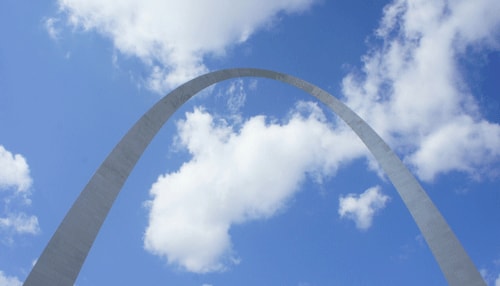
 Photo Credit: Canva
The nation’s tallest monument, the Gateway Arch in St. Louis, Missouri, has been welcoming visitors for over sixty years. But many may not realize there is a time capsule hidden within its cement walls. According to the National Park Service, before the final piece was installed, Mayor Alfonso Cervantes decided to put together “signatorium sheets.”
After signing the sheet himself, he distributed copies throughout St. Louis city and county, as well as at the park visitor center. On each sheet were roughly 100 signatures, with thousands of people participating. The time capsule was permanently welded into the arch on October 28, 1965, and holds over 762,000 signatures—it will remain there as long as the structure stands.
Mount Rushmore’s Secret Room
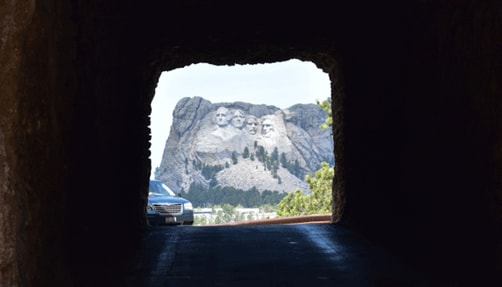 Photo Credit: Thomas Shockley / Canva
Originally, sculptor Gutzon Borglum wanted to create a description to commemorate the faces on Mount Rushmore, but quickly the plan fell through. The text could not be made big enough to be seen by onlookers, and once Jefferson’s head was relocated (a story for another time), that space was needed for Lincoln. Therefore, Borglum turned his efforts toward another dream: creating a hidden room within the mountain to hold documents and artifacts emblematic of America’s history.
Construction began in July 1938, and over the following year, a 70-foot tunnel was blasted into the mountain. However, progress halted in 1939, when Congress directed that work be conducted only on the faces. And with the onset of World War II and Borglum’s death in 1941, all work on the monument stopped. Finally, on August 9, 1998, the Hall of Records, a dream Borglum had conceived decades earlier, was completed when a repository of records was placed in the floor of the hall entry.
The repository contains sixteen porcelain enamel panels that describe how Mount Rushmore came to be and why the four presidents were selected for the memorial. In 1998, the chamber was sealed. Thus, no visitors have been inside the completed respiratory. That is for the people thousands of years from now to discover…
Lincoln Memorial’s Coded Letters
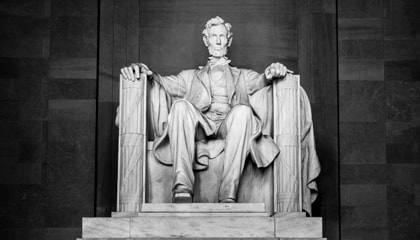 Photo Credit: Canva
The Lincoln Memorial is easily one of the nation’s most distinguishable landmarks, memorializing the 16th president of the United States in marble. If you’ve visited, you likely missed the letters "EBL" carved into the stone of the north wall. The initials stand for Evelyn Beatrice Longman, the sculptor who designed the memorial's ornamental border.
Longman would later become the first woman sculptor elected to the National Academy of Design, a rare and significant achievement at the time—one quietly embedded within one of the country’s most important monuments. There are many myths surrounding the Lincoln Memorial, most of them false, including the persistent rumor of a face carved into the back of Abraham Lincoln's head. But those are stories for another day.
The Off-Switch at Niagara Falls
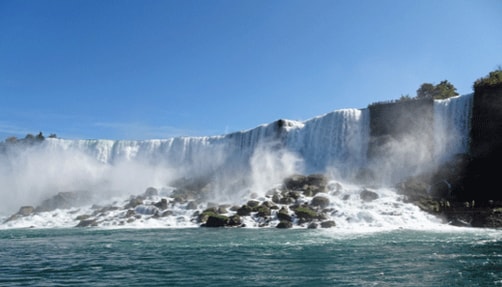 Photo Credit: Pexels / Canva
Okay, there’s not actually a faucet that can be turned off to stop the water flow. But, with the help of cofferdams, the falls can be diverted—such was the case in the summer of 1969. After significant rock falls between 1931 and 1954, a campaign led by Cliff Spieler, the Sunday editor of The Niagara Falls Gazette, took hold. If there were to be another major rockfall, the waterfall could be reduced from its tremendous source of hydroelectric power to a mere rapid.
Thus, the Albert Elia Construction Company, under the supervision of the U.S. Army Corps of Engineers, got to work, dumping more than 28,000 tons of rock. The result was a 600-foot-wide cofferdam that diverted water from the Niagara River toward Horseshoe Falls, also known as the Canadian Falls. A site that had never before been witnessed, the once-mighty American Falls had been reduced to a stream.
With no water, engineers studied the rockfalls and concluded that the rock debris was likely supporting them; thus, if the talus were removed, the falls could collapse. Once most of the rocks were removed and the American Falls were restored to their former glory, scientists installed concrete, boulders, and tendons to reinforce key areas. Today, it seems to be holding, with no significant rockfalls. Hopefully, the falls won’t have to be turned off again anytime soon.
The Grand Central Terminal’s Sky
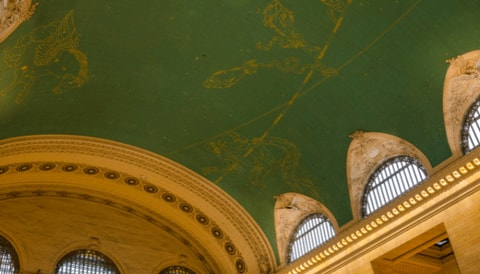 Photo Credit: Albert Pego / Canva
Beyond being an absolute marvel, the Grand Central Terminal is home to various secrets, including walkways, a hidden library and tennis court, foliage emblems linked to one of the nation’s most powerful families, and even a sonic curiosity. Yet there is one major feature that is routinely overlooked—more than that, it is widely regarded as an error.
Inside the Main Concourse, the ceiling is painted with the sky’s constellations. What many visitors miss is that they appear backwards. It’s often said that the artist was given a diagram from an atlas, but the star’s patterns were projected in reverse. The Vanderbilt family, who financed the station, quickly offered an alternate explanation: the artwork is meant to be viewed from a heavenly perspective, looking down upon Earth, hence the inverted sky.
Whether this was brilliant forethought or a convenient justification, either way, Grand Central proves that even mistakes can become legend.
Featured image: Canva


