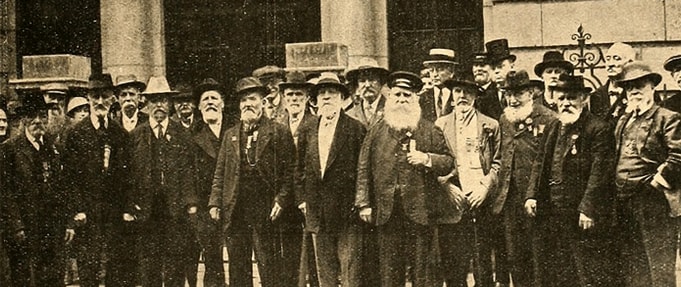
When the American Civil War ended in 1865, most accounts followed a familiar line. The men who fought remained in the United States and settled back into some form of ordinary life. Many stayed where they had served and built lives there. Others moved west, or south. Some simply drifted for a time.
But not all of them did—a small number crossed the Atlantic. Some had been born in Britain, left for America before the war, and returned years later, older and carrying something of what they had seen.
Others were American-born, but spent their later years in England for reasons that are not always clear in the record. Family, work, or simply circumstance. There was no single moment when this happened, and no obvious pattern to it.
Most of those who returned had served with Union forces, though some had fought on the Confederate side. That distinction rarely seemed to matter much once they were back in England, where the war itself felt distant.
For the most part, they slipped into the background of British life—but not completely…
The Men Who Came Back
The Civil War drew in large numbers of foreign-born men, including many from Britain. Some had only been in America a short while when the war began.
After the war, returning to England was not especially unusual, though it was rarely recorded in any structured way. A man might leave for America in the 1850s and turn up again in England 20 or 30 years later, with very little to show for what had happened in between.
They had served in regiments or naval crews made up of men from many backgrounds. The war they experienced was intense and often brief on a personal level. Back in England, it did not always settle into anything recognizable. There was no obvious place for it. Some spoke about it, while many remained silent.
Bermondsey and the London Branch
It was only much later that a more defined group began to take shape. In September 1910, in Bermondsey, South London, a man named John Davis brought together a group of Civil War veterans who had returned to England. Davis had been born in Hampshire, emigrated to the United States, and served in the Union Navy. He survived the loss of the USS Tulip in 1864, when much of the crew was killed. At some point after the war, he returned to England.
Years later, while working with the London City Mission, he began to notice something. Not all at once. More gradually. Men who had served in the same war, now living in London, often in quiet or difficult circumstances. The initial meeting he organized was small. Around two dozen men attended, most of them English-born veterans who had fought for the Union and later returned.
From that gathering, the London Branch of American Civil War Veterans emerged. It was never a large organization, and it does not seem to have been especially formal. What it offered was something simple. Recognition, perhaps. A place where shared experience did not need explaining.
There was also a practical side. Some of the men were in poor health or had fallen into poverty. The branch helped members, and sometimes their widows, pursue pensions from the United States. That gave it a purpose beyond memory. It continued for a time. Quietly.
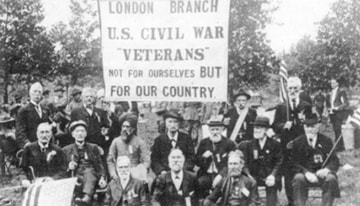

American Civil War veterans in London.
Photo Credit: Evan FleischerLives Between Two Countries
Among those connected to the London Branch were men whose lives did not sit neatly within one country or another. Maurice Wagg had been born in London, served in the US Navy, and received the Medal of Honor. After the war, he returned to England. Years later, his name appears again in connection with the Bermondsey group.
Others followed similar paths, though without the same recognition. Leaving one country, fighting in another, then returning to something that felt familiar but not quite the same. Even figures with more public lives intersected with this world. The actor-manager Sir Charles Wyndham, known on the London stage, had served during the war as an assistant surgeon under his real name, Charles Culverwell. He was present at the founding meeting, though he did not take on a formal role.
Most of the men were not notable figures. They worked where they could. Some managed well enough. Others did not. There was little to distinguish them unless you knew what to look for.
Beyond London
The Bermondsey branch provides a clear point of reference, but it was not the whole story. There are occasional mentions in local newspapers. On their own, they do not amount to much. Taken together, they begin to suggest a wider pattern.
In Leeds, researchers have identified men such as William Hails Glover and John Hindle Stafford, both born in Yorkshire, who served in Union regiments before returning. In Derby, other names appear, linked loosely to local veteran groups.
There is no clear sense of a structured network. Just individuals, spread out, with a shared past that surfaces now and again in the record.
What Was Left Behind
The clearest trace of all is found in cemeteries. Across England, there are graves that mark the lives of Civil War veterans. Some are clearly identified. Others are less obvious, requiring connections to be made between records in the United States and burial entries in Britain.
One late 19th-century pension list recorded several hundred recipients living in England, including veterans and widows. That alone suggests a presence larger than might be expected. More recent work has identified additional burial sites, though the exact number remains uncertain. What can be said, with some confidence, is that these cases are not isolated.
In London, Derby, Leeds, and elsewhere, similar patterns appear. Men who fought in the United States returned to England and lived out their later years with little recognition of what they had taken part in. By the time of the First World War, the Civil War had already slipped into the past.
For a time, though, it had been present in England in a quieter way. Not as a major historical force, but as something carried by individuals. Men who had crossed an ocean, fought in a war that defined another country, and then come back again.
The London Branch did not last. As its members aged and died, it faded with them. What remains is limited. A few records. Some graves. Occasional references that require a bit of effort to piece together. It is not a large story. But it is there.
Further Reading
“The London Branch of American Civil War Veterans, 1910–1933” by American Civil War Round Table UK
“Honouring the Last UK American Civil War Veterans” by American Civil War Round Table UK
“'Monumental Matters' in England” by Emerging Civil War
U.S. Federal Pension List (1899)
Featured image: Souvenir of Abraham Lincoln, 1920


