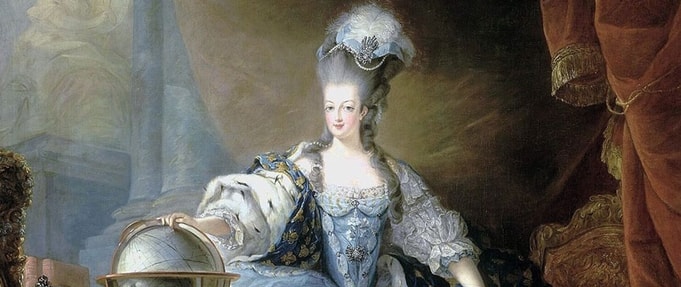
Marie Antoinette (1755–1793) was born in Vienna, Austria, the youngest daughter of Maria Theresa and Francis I, Holy Roman Emperor. Already a member of European royalty, she married France’s future King Louis XVI in 1770, when she was just 14 and he was 15.
As queen, Marie Antoinette became known for her lavish lifestyle and extravagant tastes, earning public resentment as France faced mounting financial troubles. Her husband’s indecisiveness and their early struggles to produce an heir also drew scrutiny. Over time, Marie Antoinette became a target of growing criticism, with rumors and political propaganda further damaging her reputation.
In 1785, the infamous Affair of the Diamond Necklace dealt another blow to the queen’s public image. Although she was not responsible for the scheme, the scandal deepened public distrust of the monarchy as France moved toward revolution. Her story would ultimately end at the guillotine, just months after Louis XVI was executed.
Marie Antoinette died on October 16, 1793, but her legacy has endured for more than two centuries. From the phrase “Let them eat cake,” which she never actually said, to her portrayal in films, biographies, and popular culture, her name remains synonymous with royal excess and the downfall of the French monarchy. She was at the center of one of history’s greatest transformations.
But who was Marie Antoinette?
Marie Antoinette and King Louis XVI: A Royal Marriage
In European monarchies, marriages were often arranged to strengthen political alliances and unite royal families. This was the case for Marie Antoinette and Louis-Auguste, the grandson of King Louis XV and future King Louis XVI.
Louis-Auguste was known as shy and withdrawn, while Marie was sociable and reportedly talented at music and dancing. As the youngest daughter of Maria Theresa and Francis I, Marie was not necessarily destined to marry the future king of France. However, after the deaths of her eligible older sisters, she was selected for the marriage while still a child.
In 1770, Marie was sent to France for the formal wedding ceremony. She was 14 and Louis was 15. The celebration drew thousands of guests, and a crowd numbering around 200,000 gathered to watch the concluding fireworks display.
At the Palace of Versailles, the young couple developed different interests. Louis enjoyed locksmithing and carpentry, while Marie developed a taste for fashion and luxury. She averaged over 200 dresses per year, and was particularly fond of flowers and chocolate. She was also known for her elaborate hairstyles and frequent attendance at dances.
Marie often began her mornings with hot chocolate prepared by a chocolate maker who lived on the palace grounds. She also enjoyed orange-blossom beverages served in specially crafted tea sets. These indulgences became part of the extravagant image that followed her throughout her time as queen.
While Marie embraced court life and its entertainments, Louis often retreated to his library, which housed a collection of approximately 8,000 books.
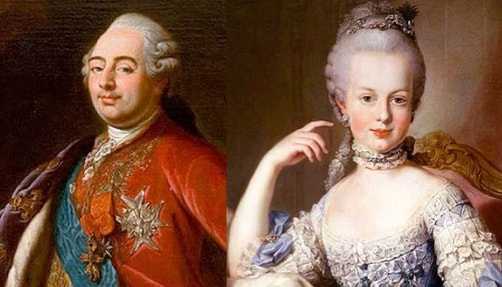
 Photo Credit: Parisology
The couple also faced difficulties in their private life. Royal marriages were expected to produce an heir, but Marie and Louis remained childless for their first seven years together. The delay became a political liability, raising questions about the future of the royal line and Louis's standing as king.
Eventually, Marie's mother sent her brother Joseph to France to investigate the situation. His visit helped prompt a change, and the couple subsequently had four children: Marie-Thérèse-Charlotte, Louis-Joseph, Louis-Charles, and Sophie-Béatrice. Their family life, however, was marked by tragedy, as three of the children died young.
The prolonged delay in producing an heir contributed to scrutiny of Louis's leadership. If the king appeared unable to fulfill expectations within his own marriage, critics questioned whether he could effectively govern the country.
Louis did pursue reforms, including greater religious tolerance and measures intended to ease the hardships faced by poorer citizens. He also supported the American Revolution, hoping to weaken Britain's power. However, France's financial difficulties and resistance from powerful interests complicated his efforts. Growing dissatisfaction with the monarchy and the existing social order would eventually help fuel the French Revolution.
Marie Antoinette, meanwhile, became a frequent target of political propaganda that portrayed her as ignorant and insensitive. Although she was known for her extravagant tastes, the local press and defamatory pamphlets further damaged her reputation and intensified public hostility toward her.
Her life was not without charitable acts. For example, Marie adopted her maid's daughter after the woman's death and reportedly took other children into her care, offering them alternatives to lives of service.
Together, Marie and Louis also contributed to charitable causes. Marie supported a home for unwed mothers, while the royal couple donated to organizations assisting vulnerable members of society, including the Maison Philanthropique, which aided the elderly, widowed, and blind. During the food shortages of the late 1780s, Marie also supported efforts to help struggling families.
Despite these acts of generosity, her extravagant image proved difficult to overcome. As France's financial crisis deepened and ordinary people faced hardship, the contrast between royal luxury and public suffering became an increasingly powerful source of resentment.
The Affair of the Diamond Necklace
In 1785, the Affair of the Diamond Necklace dealt another blow to Marie Antoinette’s already damaged public image. The necklace had originally been commissioned for King Louis XV, but he died before purchasing it, leaving the jewelers facing financial ruin. Hoping for a sale, they offered it to Marie Antoinette, who declined. The necklace was valued at a large sum, equivalent to an estimated $15 million today.
The scheme involved Cardinal de Rohan, who hoped to regain the queen’s favor, and a con artist named Jeanne de la Motte, who falsely claimed to act on Marie Antoinette’s behalf. After convincing Rohan that the queen secretly wanted to purchase the necklace, Jeanne obtained the jewelry through him and sold its diamonds. The deception came to light when the jewelers demanded payment from the queen.
Although Marie Antoinette had no involvement in the scheme, the scandal fueled public suspicions that she was dishonest and extravagant. The subsequent trial further damaged the monarchy’s reputation, reinforcing the perception that the royal court was corrupt and disconnected from the hardships facing ordinary French people. Though not a direct cause of the French Revolution, the affair intensified growing distrust of the monarchy.
The French Revolution and the Fall of the Monarchy
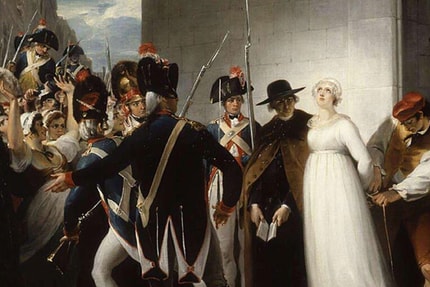 Photo Credit: Wikimedia Commons
The Affair of the Diamond Necklace was one of many factors that weakened confidence in the French monarchy. Mounting debt, food shortages, social inequality, and growing opposition to royal authority all contributed to the revolutionary movement that began in 1789.
The storming of the Bastille in July marked a turning point, ushering in a period of uncertainty for the royal family. Just months later, in October 1789, thousands of women marched from Paris to Versailles, demanding bread and forcing Louis XVI and Marie Antoinette to leave the palace for the Tuileries Palace in Paris. Though they remained monarchs, their freedom and authority diminished as revolutionary pressure grew.
In 1791, the royal family attempted to flee Paris, but their escape ended in Varennes, where they were recognized and apprehended. The failed flight further damaged public trust and strengthened calls to abolish the monarchy. In September 1792, France formally abolished the monarchy and established a republic. Louis XVI was executed in January 1793.
Marie Antoinette was imprisoned and separated from her children. Tried by the Revolutionary Tribunal, she was convicted of treason and sentenced to death. On October 16, 1793, she was taken to the guillotine and executed. Accounts of the scene describe crowds watching and cheering as her death marked the end of her life during one of France’s most turbulent periods.
The woman who had arrived at Versailles as a young Austrian archduchess and became Queen of France met her fate amid a revolution that transformed the country’s political future.
The Legacy of Marie Antoinette: Why Is She Still Famous Today?
More than two centuries after her execution, Marie Antoinette continues to fascinate audiences through films, biographies, historical studies, and fiction. Sofia Coppola’s 2006 film Marie Antoinette, starring Kirsten Dunst, offers a modern, punk-inspired take on the queen’s life, focusing on her youth, isolation at court, and eventual downfall. The 2012 French film Farewell, My Queen explores the final days at Versailles through the eyes of one of her attendants as revolution approaches.
Marie Antoinette has been portrayed as a villain, a fashion icon, and a tragic figure caught in a changing political world. One of the most enduring stories associated with her is the phrase, “Let them eat cake,” supposedly spoken in response to the suffering of the poor. However, there is no reliable evidence that she ever said it. The phrase appeared in an earlier account by philosopher Jean-Jacques Rousseau, who attributed a similar remark to an unnamed princess, before Marie Antoinette had even arrived in France.
Despite its questionable origins, the phrase became attached to Marie Antoinette’s legacy because it captured the perceived distance between royal privilege and ordinary people struggling to afford food. That contrast continues to give the story its power, turning the queen into a lasting symbol of inequality and the consequences of a monarchy that lost public trust.
Perhaps that is why Marie Antoinette continues to fascinate us. Beyond the myth, beyond the criticism, and beyond the image preserved in history books, there was a woman who found herself at the center of one of history’s greatest transformations. Her story reminds us that history is not only about the events that changed nations, but also about the human beings who lived through them.


