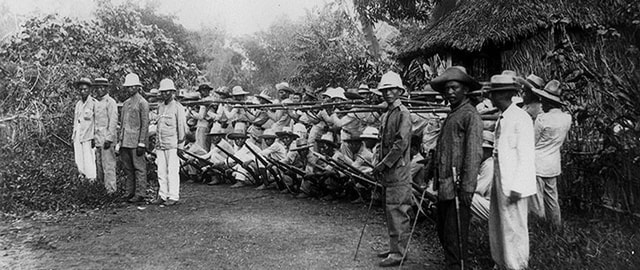

For over 300 years, Spain colonized the Philippines. With the end of the Spanish-American War came the end of Spanish rule—with one main caveat. The U.S. and Spain negotiated peace without Philippine involvement. Although the Treaty of Paris of December 1898 ended the conflict, Spain ceded the Philippines to the United States for $20 million: a colony that was never theirs to give.
Effectively, Filipinos who had fought for independence alongside revolutionary leader (and later president) Emilio Aguinaldo—allied with the U.S. against their common enemy—found themselves in the hands of a new colonizer. Despite their proclamation of Philippine independence on June 12, 1898, this newfound freedom would be undermined months later.
Rising Hope and its Fall
The Philippine-American War is easily one of America’s least known and undocumented conflicts. Also known as the Philippine Insurrection or Tagalog Insurgency, it began in early 1899 after the United States refused to recognize the Philippines’ independence—and, in fact, hardly considered it a possibility.
After the signing of the treaty, President McKinley issued a statement, according to Encyclopedia.com, declaring America’s intent to remain in the Philippines as a “benevolent assimilation” that substituted “the mild sway of justice and right for arbitrary rule.” After McKinley was assassinated and Roosevelt took over, he pushed the agenda further, labeling the Filipino resistance “insurrectos.”
In the words of Dylan Rodríguez, UC Riverside media and cultural studies professor, calling the conflict a war is a disservice: “It’s not diplomacy. It’s not occupation: It’s conquest.”
Since 1521, when Ferdinand Magellan arrived in the Philippines to spread Christianity around the world, the country has been under foreign rule. When American forces under Commodore George Dewey defeated the Spanish navy in May 1898, it seemed that 27-year-old Emilio Aguinaldo’s revolutionary movement had finally achieved what it had fought for since 1896.
As the Philippines’ first president, Aguinaldo established the Philippine Republic and declared the nation free.
War and its Losses
In the middle of the night, two American soldiers on nighttime duty came across three Filipino soldiers. When intentions became unclear, made worse by the language barrier, the Americans killed them. Filipino troops responded by firing on American lines, and not long after, war had broken out.
When Aguinaldo tried to stop the war, General Otis, the then military governor of the Philippines, reportedly replied that the “fighting, having begun, must go on to the grim end.”
By November 1899, the Filipino government, outmatched in open combat, turned to guerrilla warfare tactics. Meanwhile, the U.S. Army received assistance from the Indigenous Macabebe scouts, Filipinos who had previously served the Spanish regime and transferred their loyalty to the new occupiers.
In the words of JSTOR, “The war featured guerrilla warfare by the Filipinos and, on the American side, ‘concentration zones,’ scorched earth tactics, retaliation, and torture.” Over the next three years, according to Britannica, more than 4,300 Americans were killed in combat and from disease—while over 20,000 Filipino troops were killed. Estimates put the Filipino civilian losses at 200,000, though the true toll was likely far higher.
The Turning Point
The war’s turning point came on March 23, 1901, when U.S. Brig. Gen. Frederick Funston captured Aguinaldo in the mountains of northern Luzon. Funston, along with some of his officers, posed as prisoners of war and were taken to the headquarters by Macabebe scouts disguised as reinforcements. Aguinaldo was shocked to discover this was a ruse and to hear demands for his surrender. From there, they led him away to Manila.
Although Aguinaldo pledged his allegiance to the United States, the efforts would continue, and violently so. After a massacre of American troops, Brig. Gen. Jacob Smith ordered reprisals so indiscriminate he was later court-martialed and forced to retire.
On July 4, 1902, the U.S. declared the war over. But, like the independence before it, peace was only a declaration. Resistance under Simeón Ola, the war’s last standing general, wasn’t defeated until late 1903. Macario Sakay, who declared his own short-lived republic, evaded capture until 1906. An unconnected Moro resistance in the south continued sporadically until 1913.
A Long Fight for Independence
The United States maintained control of the islands until 1946, when President Truman issued Proclamation 2695 recognizing the Philippines as independent. But even then, this freedom came with terms: a 99-year agreement securing U.S. military bases and the Bell Trade Act, which tied the new republic’s economy to American terms.
During the war and after, anti-imperialists in the U.S. Senate made their thoughts known: that this was a clear act of American imperialism, in direct contradiction to the founding principles of the nation. Outside the Senate, opposition came from numerous sources, including former presidents Grover Cleveland and Benjamin Harrison, and Mark Twain, who became vice president of the national Anti-Imperialist League and wrote essays on what he called America stabbing “an ally in the back.”
In 1955, the Filipino government moved to correct course, replacing the Bell Trade Act—which had sacrificed much of the republic’s economic sovereignty—with the Laurel-Langley Agreement.
Although versions of history have attempted to depict these ties as a “relationship,” it’s important to recognize what it was: colonialism. The island’s culture changed directly as a result of American occupation, with the disestablishment of the Catholic Church as the state religion, and the opening of the door to American Protestant missionaries, as well as the adoption of English as a primary language of government.
It’s impossible to determine now just how many lives were lost—only that “ally” stopped being the right word long before independence actually arrived.


