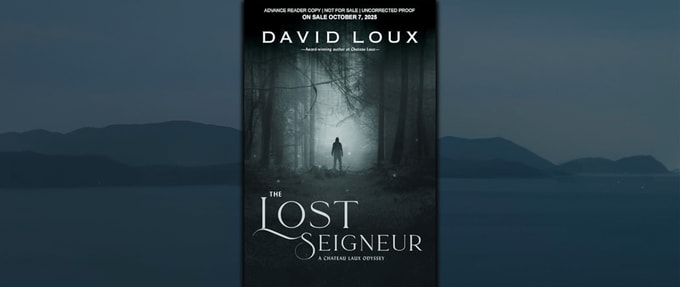

Set in the late 17th and early 18th centuries, David Loux’s The Lost Seigneur—the sweeping sequel to the award-winning Chateau Laux—follows Jean-Pierre du Laux, a French nobleman wrongfully imprisoned during an era of religious persecution. After decades of incarceration, Jean-Pierre embarks on a desperate journey across the Atlantic to find the family he lost, aided by an unlikely young companion.
While Jean-Pierre fights for his freedom, his family has carved out a life in the rugged Pennsylvania wilderness of "Penn’s Woods." But the frontier has brought its own horrors. Seven-year-old Magdalena has been rendered mute by the trauma of a fire and the brutal murder of her sister and niece. As she drifts through a world of silence, caught between her mother’s practicality and her father’s ancient legends, the arrival of mysterious Cathar travelers suggests that her voice—and her family’s legacy—may yet be restored.
Read on for a sneak peek at The Lost Seigneur, as Magdalena’s father uses a timeless fable to reach his silent daughter amidst the ghosts of the frontier.
The Lost Seigneur: A Chateau Laux Odyssey

During Jean-Pierre’s long incarceration, life had continued apace, and in far-off Penn’s Woods, a granddaughter he knew nothing about knelt next to her bed, clasped her hands, and implored God to explain why life had to be so hard. Magdalena was only seven at the time. It had been less than a year since the fire that killed her sister and her sister’s little baby, and she begged God to give her a reason why such tragedy had to happen.
With no response forthcoming, she finally got to her feet, dragging a heavy heart with her. Dressing dutifully, she paused at the window and watched as the sun seemed to cast first one leg and then the other over the heavily forested ridge to the east. First it skipped, then it hopped, and finally lifted in flight, and she shuffled in stockinged feet to the door and down the hall to the creaking stairs that seemed to her like a tunnel that burrowed into the earth.
Her mother stood at the stove, frying bacon in an iron skillet. That was the way it was in the mornings, the food preparation for a large family, frying the bacon and then the eggs, the toasting of yesterday’s bread. There were six place settings at the table, along with a pitcher of milk and lumps of butter.
Magdalena’s gaze drifted to the seventh spot, the now empty chair where Catharine had once sat. Magdalena had not spoken since the murders of her sister and her sister’s baby, at the hands of the château’s caretaker. Words seemed to wither and die on her tongue, ever since that moment when the wagon that she and her mother had ridden in crested the hill above the smoldering ruins, and even now, Magdalena could see them plain as day, the intertwined spirits of mother and child that had risen up in the column of bitter smoke. Even now, she saw the heavens open to receive the two souls and heard the rumbling growls of an earth that did not wish to give them up.
“Come on now and get to the table,” Beatrice said, in her officious manner, for a mother of four surviving children on a pioneer farm did not have much time to dwell on the past. She raised her voice. “Jean? Andrew? Georgie? Come on, now, boys, while the breakfast is hot!”
There were three boys in all. They used to come tumbling down the stairs like puppies, tripping and falling over each other in their haste to be first at the table. But that was before. That was when things were different.
“I worry about you, child,” Beatrice said, as the rest of the family scraped forks and knives against their plates. “How are you going to grow if you don’t eat?”
Magdalena looked down at the small pile of food in front of her. Her mother didn’t seem to understand how eggs soured in her throat and that the very thought of bacon made her gag.
“At least take a nibble. And another thing. It’s about time you started talking to us again. It’s not natural to stay bottled up the way you are. If you don’t talk, you might forget how and think of the pickle you’ll be in then!”
Magdalena’s father, Pierre, cleared his throat and slid his chair back a little. He had finished his breakfast, along with the strong India tea, with cream and lots of sugar, that he’d ladled into his cup by the teaspoonful.
“Come here, ma petite chou,” he said to Magdalena, patting a knee with a big hand. He smiled in that slow, careful way of his. “Come here and let me hold you. I haven’t told you a story in a long time. Would you like to hear one?”
Tears darted to Magdalena’s eyes as she climbed up onto her father’s knee. She tilted her head against his shoulder. The warm arm that circled her waist reminded her of better times.
“Have I ever told you the story of how the wolf got its howl?” he asked, and she shook her head. “No? Well, it’s a special one.”
He paused long enough to make sure he had her rapt attention. “You see, once upon a time, before wolves knew how to howl, there was a very special puppy, who was a lot like you. She saw how unfair life was—how one creature ate another and how so very few seemed to get along. Her brothers and sisters might have seen these things, too, had they bothered to look. But they were too busy, chasing grasshoppers and arguing among themselves.”
He gave her a lingering look. “Are you sure you want to hear this?” he teased, and she nodded eagerly.
“Well . . .” Pierre said, then went on to say that since words got stuck in the poor wolf puppy’s throat, she had no way to tell anyone about the sadness that she felt, until one day, she was so desperate that she bade her family farewell. They didn’t want her to leave, of course. In fact, they begged her to stay! But she was determined to find her voice, and nothing they said could deter her. Alas, when she went to the north, her voice was nowhere to be found. She went to the south and then to the east and the west, but it wasn’t there, either.
“But we are never as alone as we think,” Pierre said, touching his finger to little Magdalena’s nose. “The spirit of the mountains took pity on her. Our precious puppy had been unable to find her voice anywhere else, so the spirit of the mountains sent the wind to lead her in the only direction that was left.” He lifted a finger, pointing upward. “The wind took her higher and higher, until at last she sat on a mountaintop, where the trail ended and there was nothing left between her and the stars. The moon was so big and beautiful that it made her ache, and as she sat there gazing in wonder, she opened her mouth and out came a moan. The moan turned into a howl. It echoed down through the canyons and gorges of the Pyrenees, and the whole world stopped to listen. The puppy grew up, and when she had children of her own, she taught them what she had learned, and to this day,” he wagged a finger, “you can still hear a howl from time to time. You will hear it high in the mountains, where wolves still roam and where the wind likes to blow. Sometimes you can even hear it in your dreams, and then you will know.” He gave her a hug and kissed the top of her head. “You will know that you too have a voice, and that you will find it again when the time is right.”
Magdalena started to cry, then, and couldn’t stop. When the pain in her chest finally subsided and she could brush aside the veil of tears, she found that the kitchen was empty. Dirty plates still sat on the table, but the chairs were vacant. Even her mother was gone, and a cool breeze seemed to snake along the floor, as if a door stood open somewhere. Her father’s arm was still around her waist, though by now it was damp, and his head rested against hers, which still lay on his shoulder. His eyes were closed, and she would never forget the rise and fall of his chest as he breathed.
The story of the wolf puppy was still fresh on Magdalena’s mind when the Cathars returned to the Laux farm. They had come years before, and Magdalena remembered them as faces like pale moons and little bursts of excitement. The Cathars had come all the way from the Pyrenees of her father’s youth, tracking him down like hounds trail a rabbit, to remind him of who he was and of the faith his mother had cherished. At the time, he’d had no interest in what they had to say, but now they were back—this time to see the redhaired girl who was said to be unusual, if not downright peculiar.
There were three of them, with heads of unruly hair and gray robes tied at the waist. Magdalena especially liked Timothy, a reedy man with a long neck and an Adam’s apple that bobbed when he laughed, which was more often than not. Margaret, on the other hand, was the serious one, a mother hen who wanted to tuck stray souls under her feathers. She assured the troubled girl that the reason she so often felt out of place was because she was special. Magdalena looked so much like her grandmother that Margaret wondered aloud if a piece of the beloved parfaite’s soul had awakened in her. The third Cathar, Isabelle, seemed to have no doubt that this was the case and looked at the child with eyes that glowed like lanterns.
Not everyone, however, was sanguine about the Cathars’ visits and Magdalena could hear her parents’ muffled voices at night, while she huddled in the refuge of her bed. She had at one time shared the room with Catharine, back before her sister left to live with her husband in the doomed château, which some called a castle and others a travesty, sitting as it did on the edge of the rough-and-tumble frontier.
“I don’t like the influence these people are having on our daughter,” Beatrice fretted.
I don’t much care for it, either,” Pierre murmured.
“How do we know it’s not of the devil?”
“Try to get some rest,” Pierre said, in the weary tone he used when his wife worried a subject to death.
“Where exactly do they come from, anyway?”
“Who knows?” Pierre said, evasively. “They are a mystery even in the Pyrenees, where they used to abound.”
“But why are they here?” Beatrice persisted.
Magdalena couldn’t hear her father’s response, but even at such a tender age, she thought she knew a thing or two. Penn’s Woods was a special place, where anything was possible. Because of this, the English had come, the Swiss and the Dutch. The French had come, too, and, apparently, the Cathars, as well, albeit for reasons all their own.
Magdalena’s search for answers was not limited to overhearing muted conversations in the night, and one evening, she watched her father with an eagle eye as he came in from the fields and washed his hands in the washbowl in the kitchen. She watched the strokes of the knife when he carved the roast and followed him into the living room after the meal. Magdalena normally had to help her mother with the cleanup and the dishes, and she prayed her mother would not seek her out.
Her father sat in his birchwood rocking chair in front of the unlit fireplace, brooding. She stood in front of him, waiting, and when he finally noticed her and gave a nod, she climbed up into his lap.
“What troubles my princess so?” he asked, his usual smile tugging at the corners of his mouth.
Magdalena looked up at him solemnly. After many long months of silence, she had found her voice again but had to choose her words carefully.
“Just the things that I have to think about,” she said.
Want to keep reading? Download The Lost Seigneur today!
The Lost Seigneur: A Chateau Laux Odyssey
Featured image: Anton Shuvalov / Unsplash


