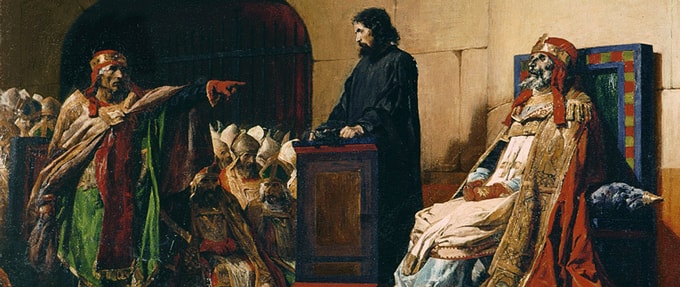

In January 897 CE, a dead pope was carried into the Basilica of St. John Lateran in Rome to face judgment. Pope Formosus had been in his grave for around nine months when his casket was opened and he was brought back into the world of the living. His remains were clothed in papal vestments and seated before the assembled bishops. Since the dead man could hardly answer the accusations himself, a deacon was reportedly chosen to speak for him.
Then, Stephen VI addressed the corpse of the man who had occupied the papal throne before him. There was never much doubt about the verdict: Formosus was declared guilty, his papacy was treated as unlawful, and the official acts carried out in his name were overturned. They took the vestments from his body, and the fingers associated with papal blessings were severed from his right hand. His remains would eventually be cast into the Tiber.
Even the medieval papacy produced few scenes quite like this one. When I first read about the Cadaver Synod, I assumed it could only have been the work of a vindictive or unbalanced pope. It seemed to belong among those stories used to demonstrate the supposed brutality and superstition of the Middle Ages. Once I began looking beyond the corpse in the courtroom, however, that simple explanation became much harder to accept.
Understanding the reasons behind it means entering a tangled world of popes, bishops, and rulers competing for influence in Italy. Their loyalties changed frequently, and several of the names are unfamiliar today. I will try to keep that background under control, because we only need enough of it to understand why Formosus remained a problem after his death. His decisions remained in force, the clergy he had ordained still held office, and rulers could continue to draw legitimacy from his actions.
Stephen was not simply putting a corpse on trial. He was attempting to place an entire papacy in the dock. Why did a dead pope still appear so dangerous?
A Pope With Powerful Enemies
Formosus had spent much of his career close to the political struggles surrounding the papacy. He became bishop of Porto, near Rome, in 864 and served as a papal representative on several important missions. His work in Bulgaria was so successful that the Bulgarian ruler Boris I reportedly wanted him as the country’s archbishop. The difficulty was that a bishop was expected to remain with the diocese already placed in his care. Moving from one episcopal seat to another was not simply a matter of accepting a better appointment.
His growing reputation did not protect him from enemies. During the pontificate of John VIII, Formosus was accused of abandoning Porto, conspiring against the pope, and seeking the papal throne for himself. He fled Rome and was excommunicated. According to one account, he later swore that he would remain a layman and never return to his former bishopric, although the circumstances of that promise remain uncertain.
The death of John VIII changed Formosus’s fortunes. He returned to his former position as bishop of Porto, and in 891 his career took a remarkable final turn. The man who had once been accused of plotting to seize the papacy was now chosen to occupy it. But the old accusations had not disappeared—they were waiting to be used again.
The Struggle for an Emperor
The pope did more than lead the Western Church. A papal coronation could strengthen a ruler’s claim to imperial power, which made control of Rome valuable to competing families. Formosus crowned Lambert of Spoleto as co-emperor, although their relationship did not remain secure. Another contender soon appeared. Arnulf of Carinthia crossed the Alps, entered Italy, and reached Rome in 896. Formosus crowned him emperor.
Arnulf’s success did not last. Illness forced him to withdraw, and Formosus died on April 4, 896. His immediate successor, Boniface VI, survived as pope for only about two weeks. Stephen VI then took the papal throne while the struggle over Rome continued.
For many years, the Cadaver Synod was explained as revenge by Lambert and his mother, Ageltrude, against the pope who had turned to Arnulf. That explanation is no longer as certain as it once appeared. Lambert later approved the council that overturned the Cadaver Synod, which would be a curious action if he had ordered it. Other Roman factions, including enemies Formosus had acquired long before Arnulf’s arrival, may have been more important.
The Corpse Takes the Stand
The Cadaver Synod’s records were later destroyed, so the familiar account has been reconstructed from sources written after the event. Even so, the central facts are difficult to dispute. They removed Formosus from his tomb and brought him before a church council at the Lateran. His corpse was dressed as pope and seated for the proceedings, with a deacon assigned the impossible task of answering for him.
The charges returned to the disputes of his earlier life. Formosus was accused of breaking an oath, exercising episcopal authority after being reduced to lay status, and unlawfully moving from the bishopric of Porto to become bishop of Rome. These may sound like technical matters beside the sight of a decomposing pope in court, but they had serious consequences.
If Formosus had never lawfully been pope, his papal acts could be treated as invalid. So could the ordinations he had performed. Stephen himself had been made bishop of Anagni by Formosus before becoming pope, leaving him with his own awkward move between bishoprics. Undoing Formosus’s authority may have offered a way to undo decisions that still bound the living.
The corpse was convicted, stripped of its vestments and dressed as a layman. Later accounts disagree over exactly how many fingers were removed from its right hand, but the mutilation carried an obvious message. These were the fingers with which Formosus had blessed the faithful and performed sacred ceremonies. Removing them turned the punishment into something more than an attack upon his body. His remains were buried, but even that did not end matters. They soon unearthed them again and threw them into the Tiber.
Why Attack the Dead?
Political hatred was clearly present, but revenge alone does not take us very far. A private reburial would have kept Formosus out of sight. Stephen instead chose a public judicial ritual. The dead pope had to be declared unlawful, humiliated, and separated from the sacred office he had held.
Historian William S. Monroe has suggested another possibility. Some people in Rome may have regarded Formosus as a holy man, perhaps even a martyr. If supporters were gathering around his tomb, his body was more than a reminder of a defeated rival. It could become a relic and a focus for opposition. The trial and disposal of the corpse may therefore have been intended to destroy not only Formosus’s legal authority, but also his sacred reputation.
The evidence does not allow us to identify one motive with certainty. That may be the most honest conclusion. Old ecclesiastical charges, Roman factional hatred, disputed ordinations, and fear of Formosus’s posthumous influence could all have led to the same courtroom.
A Verdict Reversed
Whatever Stephen hoped to achieve, the spectacle turned against him. Opposition grew in Rome, and he was removed from office, imprisoned, and strangled later in 897. Stories soon circulated that Formosus’s body had been recovered from the river and had performed miracles. The attempt to disgrace him may only have strengthened the belief that he had been wronged.
Theodore II, whose pontificate lasted only a few weeks, annulled the Cadaver Synod and ordered Formosus to be reburied with honor in St. Peter’s Basilica. John IX confirmed his rehabilitation at councils held in Rome and Ravenna in 898. Formosus’s ordinations were recognized, the records of the corpse trial were ordered destroyed, and future trials of dead people were prohibited.
The controversy did not disappear completely. Pope Sergius III, an opponent of Formosus, later supported the verdict against him. The argument over one dead pope continued through the reigns of the living.
The Dangerous Dead
It is tempting to finish the story by describing Stephen VI as insane. That provides an easy explanation for an event that appears to defy reason. But dismissing Stephen this way also lets us avoid the more interesting question: what did he believe this extraordinary trial would actually achieve?
However grotesque it appears to us, the Cadaver Synod was intended to do something. It challenged decisions that still affected clergy members, attacked the reputation of a political opponent, and tried to change how Formosus’s papacy would be remembered. It may also have been an attempt to prevent the dead pope from acquiring a reputation for holiness.
Formosus could no longer speak, govern, or defend himself. Yet the treatment of his body revealed that, in the Rome of 897, a dead pope could still be considered dangerously powerful.
Further Reading
The Trials of Pope Formosus by William S. Monroe
The Complete Works of Liudprand of Cremona by Liudprand and translated by Paolo Squartini
Gods and Symbols of Ancient Mexico and the Maya by Mary Miller and Karl Taube
“'A New Look at the Cadaver Synod,’ Proceedings of the XV International Congress of Medieval Canon Law” by William S. Monroe
“The Cadaver Synod: Putting a Dead Pope on Trial” by Amelia Soth


