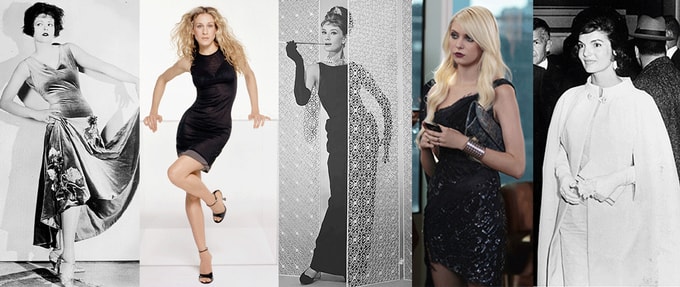
Fashion has never been just about the clothes themselves; in American history, it has served as a vital visual language for self-expression, progress, and social transition.
What we wear often acts as a mirror to the era's cultural anxieties and aspirations, shifting with the tides of war, economic upheaval, and social movements. From the restrictive steel hoops and corsets of the 1800s that physically confined the body to the nostalgic, eco-conscious thrifting of the 2020s, every silhouette tells a story of change.
By examining the evolution of the American wardrobe, we can see a clear timeline of how we have redefined our daily lives—revealing both the rigid norms we’ve outgrown and the identities we are still fighting to claim.
Fashion of the 1800s: Breaking the Cage
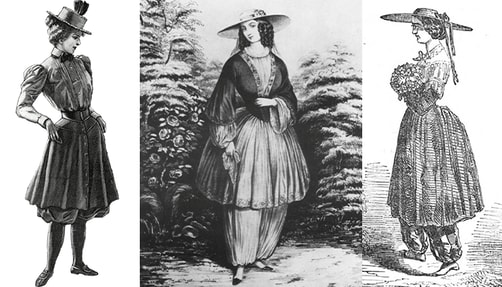
 Photo Credit: Wikimedia
In the mid-19th century, women’s fashion was a physical manifestation of their legal and social restrictions. Formal styles relied on tight corsets and "wide steel hoop cage crinolines" that weighed up to 15 pounds. This rigidity sparked the first major "reform dress" movement. Activists, frustrated by "tyrannical public opinion" and "domestic drudgery,” sought clothing that allowed for physical health and independence.
The "Bloomer" costume—a loose-fitting short dress over trousers—became a flashpoint for this struggle. As noted in The Lily (1851), Elizabeth Smith Miller was the first to adopt the style for "all times and places." However, the social significance of the garment was so disruptive that the popularity of the "reform dress" eventually died down after women were met with widespread public mockery.
Fashion of the 1910s–1920s: The Dawn of the Liberated Woman
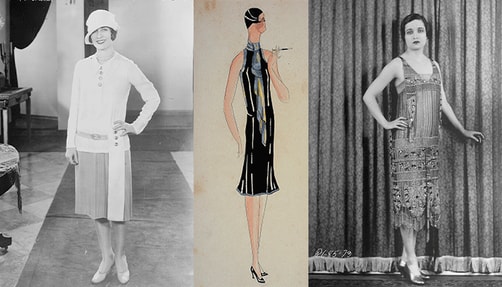
As the suffrage movement reached its peak, fashion became a strategic political tool. Suffragists adopted white clothing to represent "purity" and morality, intentionally refuting the negative image of activists as "masculine" or "sexually deviant." By the 1920s, the end of WWI and the rise of jazz culture saw the birth of the Flapper.
This era marked a definitive shift toward sexual freedom. The Victorian silhouette was replaced by a "straight and slim" profile, shorter hemlines, and the "Little Black Dress," popularized by Coco Chanel. As women entered the workforce and gained their own income, advertising executives like Helen Lansdowne Resor began using "sex appeal as a method of marketing to women," reflecting a new, independent consumer class.
Fashion of the 1940s–1960s: From Practicality to Personal Expression
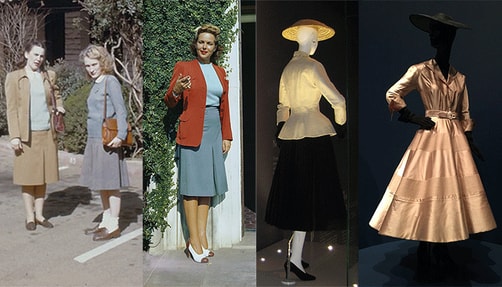
The early 1940s were defined by "utility dressing" due to wartime fabric scarcities. With resources diverted to the front lines, hats shrunk, shoes became sturdier, and menswear-inspired skirt suits became the functional norm as women stepped into vital industrial and service roles.
However, once the war ended, the fashion landscape shifted dramatically. In 1947, Christian Dior introduced the "New Look," a collection fashion historians describe as the "antithesis of what American and British designers championed during the war." This silhouette, with its cinched waists and voluminous skirts, signaled a return to hyper-femininity and a departure from wartime practicality.
By the 1960s, American fashion finally stepped out from under French dominance to find its own voice. As John and Jacqueline Kennedy brought an "aura of American youth" to the White House, the era’s clothing began to align with burgeoning social movements. Black models and "African-inflected clothing" reflected the pride of the Civil Rights movement, while the rise of the miniskirt challenged the rigid "model femininity" of the 1950s.
According to TIME, this shift in hemlines and silhouettes mirrored a larger cultural breaking point: women "threw off old norms about what was proper" in tandem with an American society that was actively "breaking loose from restrictions of the past."
Fashion of the 1970s–1990s: Power Suits and Grunge
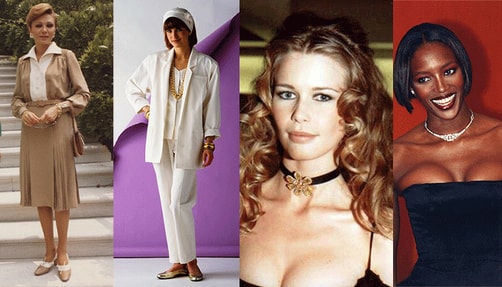 Photo Credit: Wikimedia Commons
The 1970s brought the "power suit" to the forefront of feminist fashion. Women often adopted masculine silhouettes—complete with vests and ties—to reject "chauvinistic fashion norms" that sought to diminish their professionalism in the workplace. By the end of the decade, this evolved into a period of "taking back" individuality, where women felt empowered to choose between a no-nonsense suit or a traditionally feminine dress based on their own preferences rather than societal pressure.
This focus on individuality continued to rise in the 1990s with the emergence of the Supermodel. Icons like Naomi Campbell and Cindy Crawford became household names, serving as fashion blueprints that brands clamored to work with. While supermodels dominated the glamorous side of the industry, the decade was defined by two opposing fashion trends: grunge and minimalism.
For the minimalists, fashion was prized in its "purest form," characterized by seamless slip dresses and a "virginal" lack of embellishment. This stood in stark contrast to the gritty vibe of grunge fashion.
Simultaneously, the decade saw the first playful influences of the digital age, with fiber technology advancing as designers began to experiment with the "concept of the World Wide Web."
Fashion of the 2000s–Present: Nostalgia and Political Statements
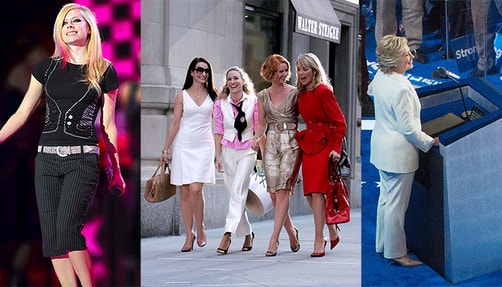 Photo Credit: Wikimedia
The early 2000s (Y2K) used fashion as a "distraction from the fears" of rising technology, emphasizing individual sex appeal through shows like Sex and the City. Interestingly, the "Suffragette white" of the early 1900s made a massive comeback in the 2016 election, with politicians using the color to connect "past struggles with current struggles."
Today, our fashion is increasingly driven by a "penchant for nostalgia." Amidst global conflict and climate crises, there is a surge in vintage styling and second-hand thrifting. In a world of uncertainty, Americans are looking backward to move forward, using fashion to reclaim a sense of personal identity in an ever-changing landscape.
Works Referenced:
- Dressing for the Movement. Wilton Historical Society.
- Decoding the Symbols of the Women’s Suffrage Movement. National Geographic.
- The Evolution of the Supermodel. Elle.
- Everything You Need to Know About Christian Dior’s New Look Silhouette. Vogue.
- Flappers. History.com.
- Harper’s New Monthly Magazine, 1851. Hathi Trust Digital Library.
- The History of the Power Suit for Women. JSTOR Daily.
- The Lily (August 1851 Edition). Internet Archive.
- Mod Fashion: How the 1960s Defined American Style. TIME.
- Suffragette White: The History Behind the Sartorial Statement. WWD.
- Vintage, Y2K, and the Penchant for Nostalgia. Vogue.
- Why Coco Chanel Created the Little Black Dress. Smithsonian Magazine.
- Working Women’s Wardrobe: How the 1970s Opened Feminist Fashion. PBS Independent Lens.
- 90s Fashion: A History Lesson. Vogue.
- 1940s Fashion: A History Lesson. Vogue.


