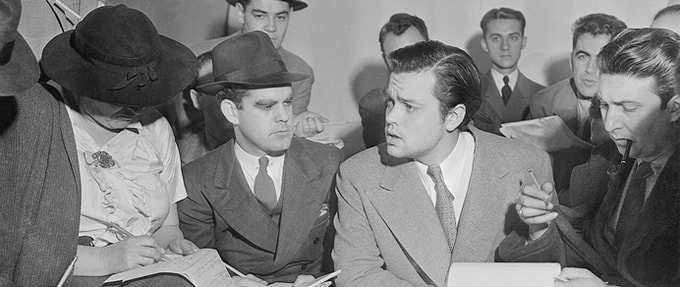
Something had landed in a field near Grovers Mill, New Jersey. It was Sunday evening, October 30, 1938, and radio listeners across America heard reports of a strange metallic cylinder that had apparently fallen from the sky.
A reporter described the crowd gathering around it. Police officers kept people back while scientists examined the object. Then the top began to unscrew. Moments later, the reporter was describing creatures emerging from the cylinder and a terrible heat ray sweeping across the field. The transmission broke off.
It sounded as though America was facing an invasion from another world. Of course, no Martians were in New Jersey that evening. What listeners had heard was Orson Welles’s radio adaptation of H. G. Wells’s The War of the Worlds, performed by the Mercury Theatre company on CBS.
Yet by the following morning, newspapers were reporting extraordinary scenes of frightened Americans fleeing their homes, calling the police and preparing for disaster. The story quickly became a broadcasting legend. But how much of the panic actually happened?
Bringing the Martians to America
H. G. Wells’ original novel appeared in 1898, with its Martian invaders descending upon southern England. 40 years later, Orson Welles and his colleagues moved the action across the Atlantic, setting it in the quiet community of Grovers Mill.
Howard Koch wrote the radio adaptation, but the production was far removed from a conventional play. Instead, the invasion unfolded through interrupted musical performances, urgent announcements, and reporters supposedly describing events as they happened.
American radio in the 1930s was a lively business. CBS and NBC fought for listeners, and the competition pushed broadcasters to experiment with comedy, music, news, and increasingly ambitious drama. Radio audiences knew the sound of a breaking story. A musical program might give way to an announcement, followed by a reporter speaking from the scene.
Welles and his company used that familiarity to their advantage. For much of the first half of the broadcast, the invasion was presented as something listeners were discovering alongside the reporters.
A Voice Borrowed from Disaster
Frank Readick’s performance as reporter Carl Phillips owed something to a tragedy that had taken place the previous year. In May 1937, the German airship Hindenburg caught fire while landing at Lakehurst, New Jersey. Herbert Morrison’s recorded commentary captured the terrible moment as flames consumed the airship.
Readick reportedly obtained a copy of Morrison’s recording and listened to it repeatedly. He was interested in how the reporter’s voice changed as the disaster unfolded, from professional observation to shock and disbelief.
When Carl Phillips witnessed the Martian cylinder opening, Readick drew upon that example. It was an unusual preparation for a science fiction drama: the Martians were imaginary, but the actor drew inspiration from a man who had witnessed a real catastrophe.
The Listeners Who Missed the Beginning
The Mercury Theatre broadcast opened with an announcement explaining that it was a dramatization of H. G. Wells’ novel. But another popular program aired that evening: NBC’s Chase and Sanborn Hour, featuring Edgar Bergen and Charlie McCarthy. Some listeners reportedly changed stations during a musical interlude and found themselves on CBS after the opening introduction.
They heard reports of explosions on Mars, followed by news of an object landing in New Jersey. To someone arriving midway through the program, it could have sounded like an emergency interrupting ordinary broadcasting. The international situation probably added to the unease.
Only weeks earlier, the Munich crisis had brought Europe close to war. Americans had followed the negotiations through newspapers and radio, hearing reports of military threats and hurried diplomatic efforts. Against that background, an announcer breaking into a program with disturbing news was hardly unfamiliar.
Whether every frightened listener had missed the introduction is impossible to establish. But the format certainly gave late arrivals an opportunity to misunderstand what they were hearing.
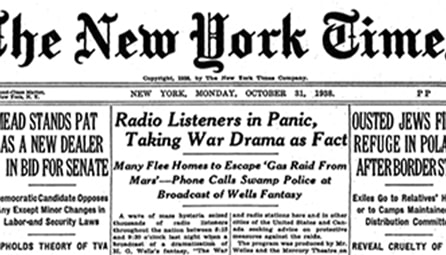

New York Times headline from October 31, 1938.
Photo Credit: Wikimedia CommonsDid America Really Panic?
The following day’s newspapers left little doubt about their interpretation. Reports described frightened families, calls to police stations, and listeners convinced that something terrible was happening. Some accounts suggested widespread hysteria. There were genuine incidents of confusion. People contacted authorities and newspapers seeking information, while CBS received complaints about the broadcast.
But the scale of the reaction has been questioned ever since. Audience surveys conducted at the time suggested that relatively few Americans had been listening to the Mercury Theatre production. Most had chosen other programs. In 1940, psychologist Hadley Cantril published The Invasion from Mars, an influential study of the broadcast and its psychological effects. His estimates helped establish the familiar picture of millions of listeners becoming frightened or confused.
Later researchers challenged aspects of his methodology and questioned whether the results justified such sweeping conclusions. The newspapers themselves played a role in the story. Radio had become a formidable competitor, especially when news broke. Newspapers could no longer assume they would be the first to tell Americans what had happened.
The Welles broadcast gave editors an opportunity to question radio’s influence and reliability. Some historians believe that competition encouraged exaggerated reporting of the supposed panic. It would be wrong to dismiss the frightened listeners. At the same time, the evidence does not support the familiar picture of an entire country losing its senses.
When Broadcasting Becomes Reality
People had tried disguising fiction as a news report before, including across the Atlantic. British broadcasting developed along different lines from America’s commercial networks. Under the BBC, programs generally followed a more formal public-service approach, although there was room for experimentation.
In January 1926, the BBC aired Broadcasting the Barricades, a satirical production written by Father Ronald Knox. It described an imaginary uprising in London through a series of news-style reports. Some listeners reportedly believed the disturbances were real. Much later, British television found itself at the center of another controversy.
On Halloween night in 1992, the BBC broadcast Ghostwatch, a fictional investigation of a haunted house. Its presenters included Michael Parkinson and Sarah Greene, familiar faces on British television. The program had been advertised as drama, but its presentation resembled live factual television. Viewers contacted the BBC in large numbers, and complaints continued after the broadcast.
There are clear similarities with the Welles production, despite the decades separating them. Both used recognizable broadcasting conventions to create a fictional emergency. The familiar voices of 1938 radio news had their counterpart in the trusted television personalities of 1992.
The Invasion That Never Ended
Orson Welles was only 23 when The War of the Worlds aired on CBS. Whatever the true extent of the panic, the publicity surrounding the broadcast helped make him a household name. The story continued to grow. Over the following decades, accounts of Americans fleeing their homes and preparing for a Martian invasion became part of the program’s history.
Today, listening to the surviving recording is a curious experience. The voices, musical passages, and dramatic performances belong unmistakably to another era. Knowing the outcome, it’s hard to imagine anyone taking the story seriously. But that is the difficulty with looking back. We already know it was fiction, and we have heard the stories about the supposed panic.
For listeners in 1938, the experience was different. Radio was a familiar source of news, international tensions were high, and some people encountered the program without hearing its introduction. Others understood perfectly well that it was a play. Many Americans never listened to it at all.
The Martians never reached Grover’s Mill. Yet the story of the night they supposedly frightened America has outlived the broadcast itself.
Further Reading
The War of the Worlds by H. G. Wells
The Invasion from Mars by Hadley Cantril
The Panic Broadcast by Howard Koch
Broadcast Hysteria by A. Brad Schwartz
“The Myth of the War of the Worlds Panic” by Jefferson Pooley and Michael J. Socolow


