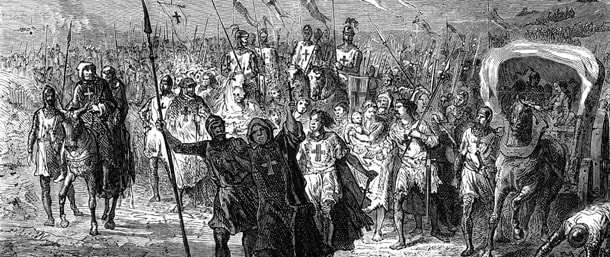
He left with the expectation of a return—that much can be assumed. A knight leaving England in the Middle Ages usually left matters unfinished, land still needed oversight, obligations remained in place, and someone at home expected him to return. He might be heading for war, service, or pilgrimage, but whatever the purpose, there was no guarantee of an ending that anyone could confirm.
For some, there was no ending at all. No grave. No message. No witness who could say, with confidence, what had happened. Weeks turned into months. Months stretched into years. The silence itself became the problem.
Going Abroad and Falling Out of Record
Travel beyond England was common enough to be unremarkable. Knights left England for many reasons. Some followed armies overseas, others entered foreign households, and many traveled as pilgrims to Rome, Santiago, or Jerusalem. Once they crossed the Channel, English record-keeping rarely followed. Letters failed to arrive. Messages changed hands and changed shape. What returned home was often incomplete, if it returned at all.
A man might leave with witnesses to his departure, but none to his end. If he died quietly of illness, was captured, or drifted into debt or service elsewhere, England might never hear of it. What survives instead is the moment when his name stops appearing. A charter is no longer renewed. A tax entry is left blank. A legal obligation goes unanswered.
In the mid-thirteenth century, records relating to English participation in the Seventh Crusade show several such disappearances. Knights appear in royal service lists before 1248, then vanish from domestic records entirely. Some may have died overseas. Others may have survived in captivity or service abroad. What matters is that their absence was never formally resolved at home. Families waited without confirmation, and the record simply moved on around them.
That silence is where many stories begin.
The Legal Problem of Not Knowing
For medieval society, uncertainty was not merely emotional. It was legal. English landholding relied on clarity. Feudal obligations, inheritance rights, marriage contracts, and debts all assumed that people were either alive or dead. A man who vanished did not fit either category.
Widows were left in limbo. Without proof of death, remarriage was difficult or impossible. Heirs could not inherit land that was technically still held by a living man. Creditors had no clear target. Lords could not be certain whether service was being withheld or simply delayed.
One early 13th-century case illustrates this tension. Sir William of Goldington disappeared after leaving England on campaign in France. There was no confirmation of death, only a prolonged absence. His wife eventually petitioned the crown, avoiding any request for a declaration of death. The wording is cautious throughout, focused on temporary measures rather than final judgment.
Years passed before the estate was administered, and when it was finally settled, the decision rested on the passage of time rather than certainty. The law responded cautiously in such cases. Inquests might be ordered. Witnesses questioned. Rumors weighed. But absence alone was rarely enough to justify decisive action.
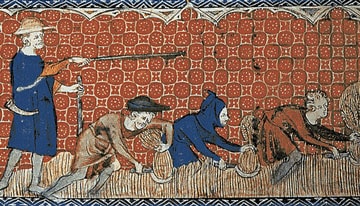

Medieval illustration of men harvesting wheat with reaping-hooks (1310).
Photo Credit: Wikimedia CommonsVanishing from the Page
Many cases survive only indirectly. A knight appears in royal service records, then disappears. A landholder is mentioned repeatedly in local charters, then stops signing altogether. There is no note of death, no succession recorded, just a gap.
Legal petitions sometimes reveal how long families waited before seeking a resolution. Years could pass before a wife or son dared to ask the court to intervene. Even then, the wording remains tentative. The missing man is described as absent beyond the realm, not dead. The implication is always provisional.
What matters is not that these men disappeared, but how often this pattern occurs. It suggests not an isolated tragedy, but a recurring feature of medieval life.
Still, those who disappeared were not always prominent figures. Many were minor landholders or retainers whose names rarely appear beyond local records. Their absence still carried weight at home. Most of these cases fade rather than conclude. Once legal matters were settled, the personal story usually vanished from view.
Rumor, Sightings, and False Hope
With absence came a space created for rumor. Reports circulated of men seen alive in foreign ports or serving under other banners. Captivity was a frequent explanation, particularly during periods of prolonged warfare. So was enforced service, where men were said to have entered the household of a foreign lord and never returned.
Such claims could delay legal decisions for years. Courts were reluctant to act if there was even a suggestion that a man might still be alive. A single witness asserting that someone had been seen abroad could indefinitely halt inheritance proceedings.
There were also cases of mistaken identity. Men returning after long service were confused with those long thought dead. In rare instances, impostors appeared, claiming the identity of the missing in order to reclaim land or status. These episodes, though uncommon, made courts even more cautious. Certainty, once lost, was difficult to recover.
Crusade, Pilgrimage, and Quiet Ends
Crusades loom large in popular memory, but many disappearances were not dramatic. Men died of disease rather than battle. Others succumbed to injuries far from home. Some never returned because they could not afford to.
That being said, pilgrimage brought its own hazards. Travelers fell ill, were robbed, or simply failed to complete the journey. Many died without a record, were buried locally, or were left unmarked. Their families in England waited for news that never came.
The absence of documentation does not mean these men were forgotten. It means their endings were not witnessed by anyone with the reason or ability to record them.
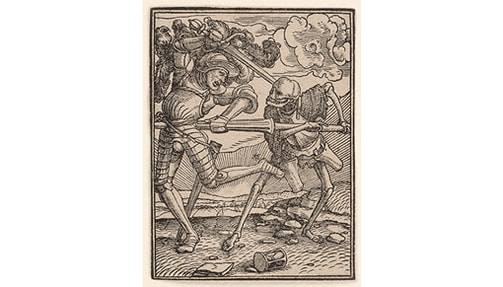
The Knight, from The Dance of Death (1526).
Photo Credit: Hans Holbein the Younger / Wikimedia CommonsA World Without Closure
Eventually, the law was forced to act. After long periods of absence, courts permitted estates to pass. The language used in these decisions is revealing. Men were not declared dead so much as presumed gone beyond a reasonable expectation of return.
A 14th-century case involving Sir John Engayne clearly demonstrates this reluctance. Engayne disappeared while abroad, and for years his status remained unresolved. When the court finally permitted the transfer of his lands, it did so without certainty, relying instead on the passage of time and the absence of credible sightings. The decision closed the legal matter without answering the human one.
There was no fixed timeline for such judgments. Each case was weighed individually, balancing rumor, time, and necessity. The process was cautious, sometimes painfully slow.
Medieval England lived with uncertainty as a condition of life. Travel, war, and disease made disappearance familiar enough that systems developed to cope with it, even when resolution proved impossible.
The men who never returned sit awkwardly in the historical record. They appear briefly, vanish, and are later accounted for only through assumption. Identity depended less on proof than on time.
There is no final clarification waiting in these records. No single explanation that settles every case. In a world without reliable communication, disappearance was not an anomaly.
It was a risk that required no explanation.
Featured image: Vintage Illustrations / Canva


