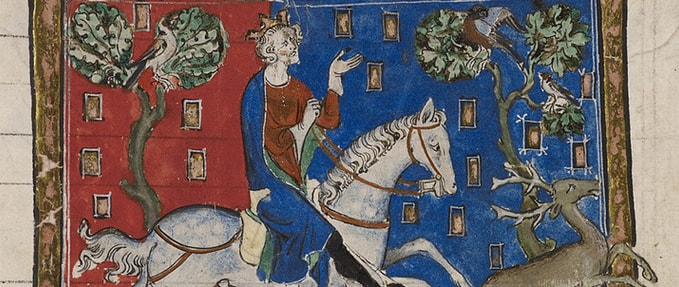
In October 1216, King John was moving through eastern England under pressure. Civil war had fractured his kingdom, Magna Carta had failed to secure stability, and rival forces were advancing across territory that could no longer be assumed loyal. Movement was constant. The royal household traveled with carts, animals, servants, documents, coins, and the material infrastructure of government.
During this retreat, part of that moving court vanished.
Somewhere in the tidal landscape of the Wash, the broad estuary on England’s eastern coast where Lincolnshire meets Norfolk, a baggage train carrying royal possessions was lost. Contemporary accounts describe carts swallowed by mud, animals struggling, and goods disappearing into water and sand that shifted faster than those crossing it could react. The king survived. The baggage did not.
The episode was recorded as a misfortune. Over time, it became something else.
A King in Retreat
By the autumn of 1216, John’s authority was unstable. The First Barons’ War had drawn foreign intervention, strained royal resources, and forced rapid movement between strongholds. The royal government in this period was not fixed to a capital. It traveled. Administrative records, treasury resources, and ceremonial objects moved with the king.
Loss, therefore, meant disruption beyond material value. The disappearance of carts could mean the loss of documents, seals, correspondence, and financial reserves. What later generations would describe as treasure may have included the working machinery of rule.
The crossing of the Wash occurred in this atmosphere of urgency rather than spectacle.
The Wash was not a single navigable surface but a complex estuary of channels, mudflats, and temporary causeways. Safe passage depended on local knowledge and careful timing. Even then, routes could change.
Sources indicate that John himself took an inland path while the baggage train attempted the more direct crossing. The decision may have been practical rather than reckless. Such routes were used when conditions allowed.
Something went wrong.
Accounts suggest that rising water and unstable ground caused carts and pack animals to sink. Recovery in a tidal environment would have been extremely difficult, particularly if the loss occurred over distance rather than at a single point. Goods dispersed quickly. Movement of sediment began immediately.
The event was sudden, practical, and largely irreversible.
What Was Actually Lost
Later retellings often describe royal regalia disappearing beneath the sands, although medieval evidence is less specific. The baggage train likely carried coins, household plates, administrative material, and equipment associated with royal travel. Some items would have held symbolic importance. Others were simply necessary for governance.
The idea of a single concentrated hoard is a later simplification.
Royal administration depended on portable resources. Losing them mattered politically, even if their monetary value could not be precisely reconstructed. The distinction between treasure and infrastructure blurred in a mobile government.
Uncertainty about the contents lost contributed to the story’s later flexibility.
Knowledge of the event relies on chroniclers writing after the crossing, including traditions associated with chroniclers such as Roger of Wendover and, later, Matthew Paris. Their accounts preserve the loss but provide limited logistical detail. Location is vague. Scale is implied rather than measured.
Medieval narrative priorities shaped the record. The loss could be interpreted as misfortune, poor judgment, or symbolic decline at the end of a troubled reign. John died only days later, which reinforced the episode’s narrative weight.
Environmental instability compounded the problem. Channels shifted even within a single generation. A route remembered by one traveler might be unrecognizable to another.
The absence of precision allowed the story to evolve.
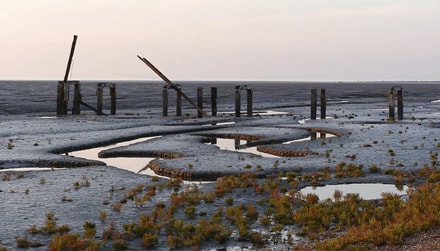

The Wash in East Anglia.
Photo Credit: Wikimedia CommonsWhen Disaster Became Treasure
By the 19th century, antiquarian interest reframed the episode. Victorian writers were drawn to moments where history intersected with landscape. As such, the Wash, visually expansive and difficult to interpret, invited speculation.
Descriptions of lost material became more detailed without corresponding new evidence, while the language of treasure replaced that of logistical loss. The possibility of recovery became central to retellings.
This shift reflected broader cultural interest in discovery and material history. It also reflected confidence in mapping and engineering, suggesting that landscapes could be understood, measured, and revisited.
However, the Wash proved resistant to that confidence.
The terrain crossed in 1216 does not exist in the same form today. Over centuries, the Wash has been shaped by natural sediment movement, coastal change, and extensive human intervention. Drainage schemes, embankments, and land reclamation altered shorelines and redirected channels.
Areas that were once tidal became agricultural land. Former routes disappeared beneath new surfaces. River courses shifted. Engineering projects in the early modern and later periods accelerated transformation.
This long history of drainage and reclamation complicates attempts to identify the original crossing. Even if a general corridor can be proposed, the precise conditions of 1216 cannot be reconstructed with certainty. Material lost in an estuary is subject to dispersal, burial, corrosion, and movement across layers of sediment.
The changing landscape is not a background detail. It is the central obstacle.
Why the Story Persists
Interest in locating the lost baggage train has appeared repeatedly. Antiquarians proposed routes based on historical geography. Later researchers compared maps, tidal behavior, and environmental change. The problem has remained consistent: The landscape moved faster than the evidence accumulated.
Modern interest surfaces periodically. Detectorists, local historians, and survey projects have explored areas believed to align with possible crossings. Some ventures have been organized commercially, reflecting the enduring appeal of a recoverable royal loss.
Alongside formal investigation, more speculative approaches have appeared. Media reports occasionally describe individuals employing unconventional methods, including dowsing, to suggest potential locations. Such claims are rarely supported by verifiable evidence, yet they illustrate the story’s persistent imaginative pull.
The search continues not because discovery is likely, but because uncertainty remains.
King John’s lost baggage train sits at the intersection of documented history and unresolved geography. Something was lost. The scale is debated. The location is uncertain. The landscape changed. That combination sustains interest.
Unlike purely legendary treasure stories, this episode begins with a recorded event during a moment of political crisis. The mystery arises from environmental instability rather than the absence of evidence. Each generation revisits the question using the tools and assumptions available to it.
The Wash continues to shift. Agricultural land overlays former tidal space. Mapping improves, but reconstruction remains interpretive. The possibility of discovery cannot be entirely dismissed, yet certainty grows more distant with time.
The story endures because it reflects a broader historical reality. Governments moved. Landscapes changed. Losses occurred in ways that cannot always be reversed.
What vanished in October 1216 may never be recovered. The episode remains compelling not simply because of what might lie buried, but because it captures a moment when political upheaval and environmental instability collided, leaving a question that history cannot fully resolve.
Further Reading
King John by Ralph V Turner
King John by Stephen Church
The Flowers of History by Matthew Paris, Roger of Wendover
Featured image: Wikimedia Commons


