A few months ago, while researching another project on St. Helena, I noticed something that had never really crossed my mind before.
Every book, newspaper report, and official document seemed to revolve around Napoleon. That was hardly surprising. His exile has dominated the island’s history ever since 1815. Yet as I worked through more contemporary accounts, another question kept coming back to me. Historians have written endlessly about what St. Helena meant for Napoleon, but far less has been written about what Napoleon meant for St. Helena.
The more I read, the more I realized they were two very different stories.
Before Napoleon arrived, St. Helena was already an established community with a history stretching back more than two centuries. Controlled by the East India Company, it occupied a strategic position on the sea route between Europe and Asia. East Indiamen called regularly for fresh water, livestock, fruit, vegetables, and repairs before continuing around the Cape of Good Hope. For ships making journeys that could last many months, the island was less a destination than a welcome pause in an otherwise exhausting voyage.
Life ashore was steady rather than dramatic. Ships came and went, livestock grazed the hillsides, and the island carried on much as it always had. There was little reason to think that anyone beyond sailors, merchants, and Company officials paid it much attention.
That changed because of one decision taken thousands of miles away.
A Problem Britain Could Not Ignore
Waterloo ended Napoleon’s ambitions of returning to power, but it left Britain with an awkward problem. Elba had already shown what could happen if he was given too much freedom. He had escaped, returned to France, rebuilt an army, and plunged Europe back into war. No government wanted to risk seeing history repeat itself.
Britain needed somewhere from which escape was all but impossible. On paper, St. Helena seemed almost purpose-built for the task. It lay alone in the South Atlantic, well over a thousand miles from the nearest mainland. Any rescue ship would have to cross an immense stretch of open ocean before even reaching the island, and, once there, it would still have to evade the Royal Navy.
Distance became the island’s greatest defense. The government nevertheless refused to rely on geography alone. Ministers assumed that Napoleon still commanded fierce loyalty and that an escape attempt, however unlikely, could not be dismissed. Orders were issued, reinforcements assembled, and preparations began long before his ship appeared on the horizon.
For St. Helena, it marked the beginning of an extraordinary period.
Preparing for One Prisoner
Napoleon reached St. Helena aboard HMS Northumberland in October 1815. His arrival did not simply bring one former emperor to the island. It brought soldiers, engineers, officials, naval personnel, and an entirely new set of responsibilities.
The existing garrison expanded rapidly. Coastal batteries were strengthened. Signal posts appeared on prominent ridges where they could relay warnings across the island. Roads received attention because troops and supplies had to move quickly between military positions. The landscape itself began to change as Britain turned one of its smallest possessions into the most secure prison in the empire.
Reading contemporary reports, what struck me was not the fear of invasion, but the determination to leave nothing to chance. British officials behaved as though another escape was always possible, even on an island surrounded by thousands of miles of ocean. For local people, those decisions quickly became part of everyday life.
More mouths needed feeding. More accommodation was required. Farmers found ready buyers for livestock and produce, while craftsmen and laborers discovered there was no shortage of work. At the same time, the sudden increase in population pushed prices higher and placed additional pressure on the island’s limited resources. Like so many periods of rapid change, there were winners and losers.
The Island Makes the News
One of the more unexpected discoveries during my research was just how often St. Helena appeared in British newspapers after Napoleon’s arrival.
Reports from Longwood were printed with surprising regularity. Readers followed Napoleon’s health, his arguments with Sir Hudson Lowe, visitors received at Longwood, and even seemingly ordinary details of his daily routine. Maps of the island appeared in print, engravings found their way into books, and readers who had probably never heard of St. Helena suddenly knew where it was.
Most of that interest centered on one man. Even so, something else had happened almost by accident.
Every newspaper report that mentioned Napoleon also introduced readers to the island itself. Its steep valleys, isolated position, and unfamiliar place names slowly became part of the public imagination. St. Helena had not set out to become famous, but fame had arrived anyway.
By the early 1820s, it was no longer simply an East India Company possession in the South Atlantic. Whether the island welcomed the attention or not, it had become inseparable from one of the best-known stories of the 19th century.
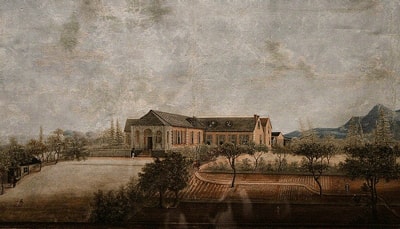

Longwood House, the final residence of Napoleon Bonaparte on St. Helena.
Photo Credit: Wikimedia CommonsAfter Napoleon
Napoleon died at Longwood House on May 5, 1821. The reason for maintaining such an extensive military presence disappeared almost overnight. Troops gradually left the island, naval patrols were reduced, and life began to settle into a more familiar pattern. Yet St. Helena was no longer quite the same place it had been six years earlier.
One of the first things I noticed while looking through accounts written after Napoleon’s death was that visitors still arrived asking the same questions: where had he lived and where had he been buried? Curiosity about the emperor did not end in 1821. If anything, it grew.
His grave, set in a quiet valley a short distance from Longwood, became a destination in its own right. When France secured permission to return his remains in 1840, newspapers once again turned their attention to St. Helena. The emperor left the island for the second and final time, but the connection between the two had become permanent.
The empty tomb remained. So did Longwood House. Neither was simply preserved because Napoleon had lived there. They survived because people continued to make the journey to see them for themselves.
A Legacy That Could Not Be Undone
There is an irony running through the whole story. Britain chose St. Helena because it wanted Napoleon to disappear from European affairs. Instead, his exile made the island better known than it had ever been before.
Longwood House, the Briars Pavilion, and the Valley of the Tomb are now among St. Helena’s best-known historic sites. Since 1858 they have been under French administration, an unusual arrangement that reflects the unique circumstances surrounding Napoleon’s final years. Few places in the British Overseas Territories contain land administered by another nation, yet St. Helena quietly does.
That, however, is only part of the island’s story.
Anyone who spends time reading beyond Napoleon soon discovers there is much more to St. Helena than six years of exile. The East India Company shaped its early development. Ships from around the world relied on it during the age of sail. Later came the Boer prisoners during the South African War, another chapter that left its mark on the landscape and the people who lived there.
Looking at the island as a whole, Napoleon becomes one episode in a much longer history. An important episode, certainly, but not the only one.
Looking Beyond the Familiar Story
Research often takes you somewhere you were not expecting to go.
My original interest in St. Helena centered on the Boer prisoner camps established there at the turn of the 20th century. Following those sources inevitably led back to Napoleon. The same roads appeared, the same locations, the same names. Gradually, it became obvious that his years on the island had shaped much of what came afterward.
That was the real surprise. The changes introduced between 1815 and 1821 did not vanish with the soldiers. Roads continued to be used. Buildings found new purposes. The attention focused on the island encouraged later generations to preserve places that might otherwise have disappeared or been altered beyond recognition.
Even now, many people first encounter St. Helena because of Napoleon. Some leave having discovered an island with a history stretching far beyond his exile. I suspect that is one reason the story continues to fascinate. It begins with a defeated emperor, but it ends somewhere quite different. History often fixes its attention on famous people. Places can become little more than the backdrop against which events unfold.
St. Helena deserves better than that. Long before Napoleon arrived, it was already an important link in Britain’s global trading network. Long after he died, it continued to develop, adapting to changing times while carrying the legacy of one extraordinary chapter in its past. Napoleon undoubtedly changed St. Helena. He brought soldiers, investment, international attention, and a place in history that no one on the island could have imagined a few years earlier.
Yet perhaps the greatest change was a quieter one. Because of Napoleon, generations of people have come looking for a famous emperor. In doing so, they have discovered an island with a remarkable story of its own.
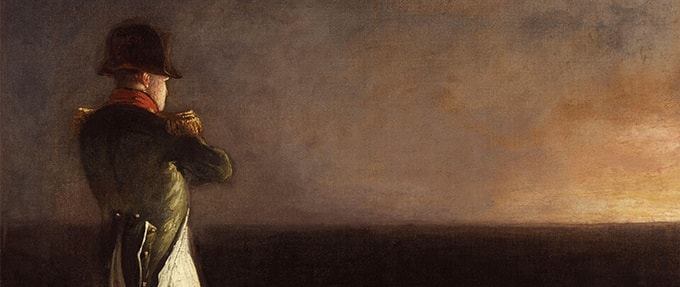
Featured image: Benjamin Haydon/Wikimedia Commons


